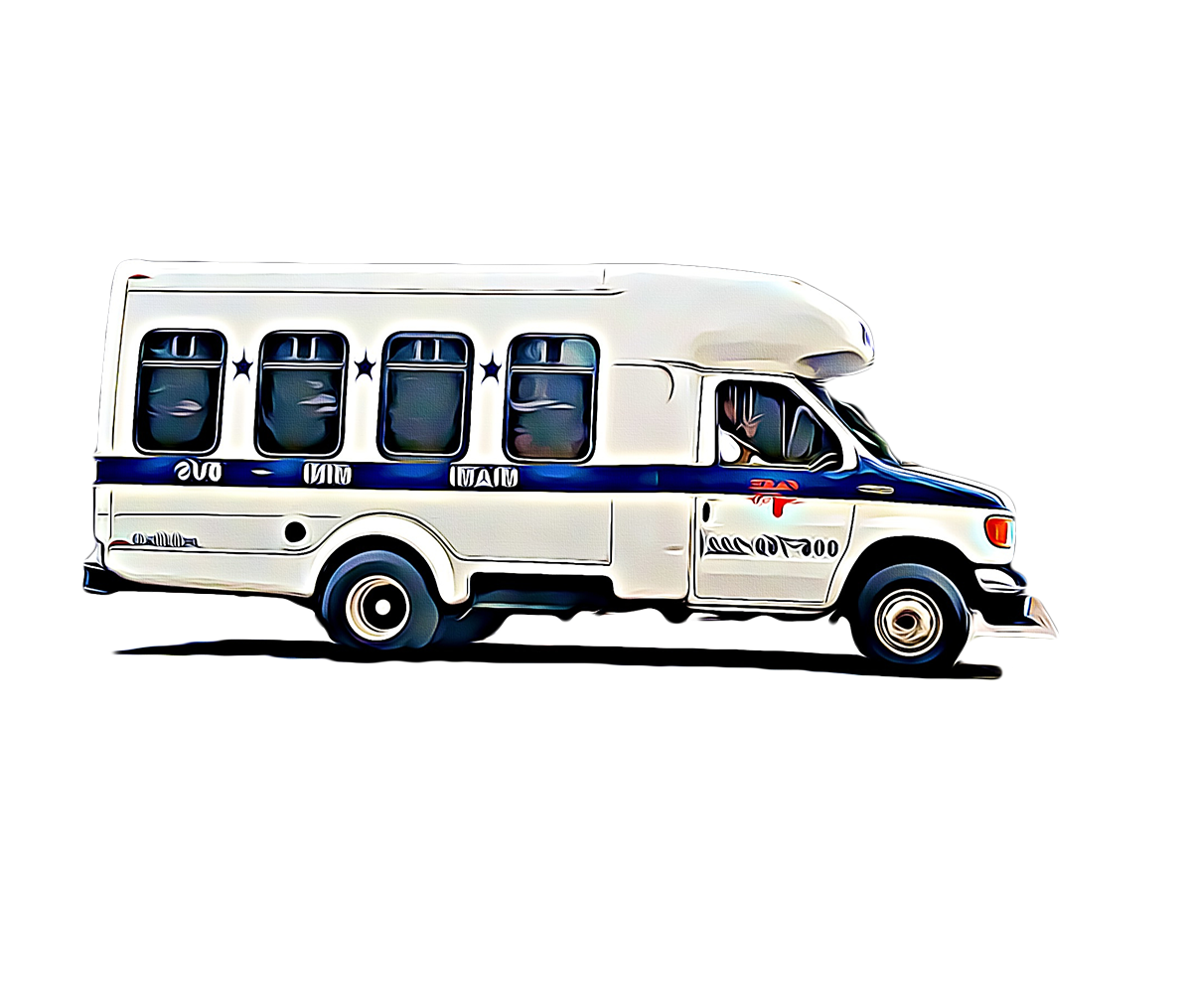

Oscar Senior took a ride on his bike. Gloria had decided to take the bus because she felt too old to ride on the bike with Oscar.
The humble light-blue house of Josefina, Gloria’s mother, was six miles away from their home. They both had gone to visit the old folks—it had been a while since they last saw each other. Actually, Josefina had been sick for quite a long while. She had gotten the flu really bad, her knees had gone weak, and the veins on her legs had thickened—blue, sometimes purple—but her daughter had come over with Oscar, and she was going to be okay.
Gloria had gone to nursing school, and she really knew how to handle the injection needle. Who knows exactly how many injections she had given to people; everyone in their neighborhood knew she was a certified nurse, and most of them had gone to her house once or twice for an injection or two.
Now Gloria found herself inside her mother’s house, the same exact house she had lived in ever since she was a little girl. After fifty-some years, she was back in the old house, and as she injected the antibiotic into her mother’s left arm, Gloria thought about her childhood. She thought about the many little details engraved in her memory—the walls of her mother’s house, the old tile floor, the high ceilings, her long-lost friends, her five sisters, and her two brothers. She thought about them as little girls and boys, and she thought about time—how it had gone by so fast. Gloria thought about her three kids, and how each of them had started their own family life. She thought about Oscar Junior and his pregnant girlfriend, and the baby boy inside her belly.
“What are you thinking about, mama?” Josefina asked.
“My son. I’m thinking about my son.”
“Which one, Carlos?”
“No. Oscar. Wow, I can’t believe he’s having a baby boy.”
“Yeah, me neither.”
Gloria had already injected the antibiotic into her mother’s arm, and an hour had just passed since she’d arrived at the old house.
“Look, there comes your husband.”
“Where?”
“There.” Josefina pointed with her right arm toward the outside. Her left arm felt numb, with a constant electric shock of pain.
Gloria looked through the windows and kept her eyes on Oscar.
Oscar rode his bike down a little hill where the main street pavement had been laid, about fifty feet in front of Josefina’s old house.
He maneuvered his bicycle and stopped it right at the front gate. Got off. Parked it under the tropical shade of an almond tree. Opened the front gate slowly and walked in under the tin roof of the front porch.
Oscar walked into the house through the front door, feeling out of breath. His legs felt weak, and sweat slowly ran down both sides of his forehead.
“You had me worried there for a moment, my love,” Gloria said to him.
“Oh, I’m okay, my princess. It had been a while since I last rode that bicycle.”
“I know,” Gloria replied.
“Why don’t you sit down and rest? I’ll make you some good coffee,” said Josefina.
“Thank you,” Oscar replied.
He sat down on Josefina’s old, comfortable couch and took a deep breath. Then he sighed.
Josefina, with caution, stepped down into the kitchen, which was at a lower level than the living room, and started heating the water for coffee. Gloria and Oscar sat by themselves under the living room ceiling and looked at each other. Gloria smiled at him. He smiled at her. They both had puppy eyes, and it was obvious that love was now stronger than ever.
After a while, Josefina walked back into the living room and handed Oscar a warm cup of good Honduran coffee. She sat next to him on the couch. Gloria sat at one of the chairs at the dining table. The three of them talked and laughed for a good while. And after five whole hours, they all felt tired. Oscar and Gloria decided it was time to head back to their small house.
They both kissed and hugged Josefina. Gloria gave her an extra hug, and they embraced tightly for a moment.
Meanwhile, Oscar stood outside the house, under the cool tropical shade of Josefina’s almond tree, and thought about his cockfighting chickens. He thought about training them some more. Thought about taking them to competition. All his life, Oscar had been a fanatic of the cockfight. He owned seventy-two fighting roosters and sixty-three fighting hens.
Finally, Gloria came out of her mother’s house and closed the front gate behind her.
“Are you taking the bus again?” Oscar asked.
“Do you want me to go with you?” she asked.
“Only if you want, but it’s a long ride. Maybe you should take the bus.”
“Okay, I’ll take the bus.”
“I’ll walk you to the bus stop.”
They started walking toward the main street hill, and halfway there they both turned around and looked at the house, as if looking for Josefina. And she was there—standing behind the front gate of her house and under the tin roof of her porch. Gloria and Oscar waved. Josefina waved back. They kept on walking and started climbing the hill. Reached the main street. Crossed it, making sure there were no cars coming either way. They got to the bus stop. Oscar parked the bicycle off to the side. He held Gloria’s hand. Gloria held his. They kissed. Smiled. And waited for the bus to come.
After a moment, the bus finally arrived. Gloria got in, paid her fare. The bus started moving. She looked out through the window, searching for her husband. He was still there. Standing. Waiting for her to look. He knew she would. And she had. They stared at each other and smiled. Oscar waved. Gloria didn’t. And her bus was now very far away, heading toward their neighborhood.
Oscar unlocked the parking pedal of the bicycle. Walked it a bit. Then hopped on. Started pedaling. He was in motion. Slowly gaining speed. Now going fast—fast enough to feel and hear the wind in his ears.
Between Josefina’s house and the house Gloria and Oscar owned, there were six miles of sugarcane plantation. While riding, Oscar settled into a comfortable pedaling rhythm without even noticing. There was a nice fresh afternoon feel to the air, and Oscar had not started to sweat. He had rested his knees for five hours, and they didn’t feel weak—they felt strong. His knees felt young and light.
He rode on the narrow side of the main street that was dusty and kept the road to himself there, careful not to ride in the center lane—this part of town had a reputation for bad drivers. Oscar Senior had always preferred his horse ride over the bus ride because he knew too many people—or should I say, too many people knew him—and to avoid the small talk, he’d take the long way, because the long way was lonely and quiet and peaceful.
Halfway home, in the middle of all that sugarcane, Oscar stopped pedaling. Slowly, his bicycle coasted to a stop. It had been a long day and full of nothing. No action. The sun looked good—giant and orange. He felt a little out of breath, but that was okay.
Right where Oscar stopped, there in the middle of the road and the sugarcane, he gave a deep sigh and thought about his kids. Gloria’s kids were the same kids Oscar thought of whenever he thought of his kids. Now he thought of the youngest—Carlos Antonio Fuentes—who had recently moved out and into a small, simple place he and his girlfriend had found on the skirt of Merendon Mountain.
“Goddamn it, Oscar, you did it,” he said to himself.
The orange Central American sun was going down slow and majestic, and Oscar loved to catch the sun on its way down. Every day around this time, he made sure to be out in the open, looking toward it. But he would never look straight at the sun. Instead, he liked to contemplate the mix of colors in the Central American sky.
Today the sky looks nicer than yesterday, Oscar thought.
And while thinking that, he noticed how it was getting dark and late. So he pushed his bicycle forward, hopped on, and kept heading toward his house. The colors in the sky were fading. The sky was now not so pretty. And Oscar knew this, but still, he kept looking up while riding the old horse.
Then he heard a voice. The voice came from behind.
Oscar turned his head and looked back.
Someone was riding a bicycle toward him—but they were too far away to make out.
“Oscar!” the voice called again.
Oscar stopped completely. Turned. Waited.
The man got closer.
He looked familiar.
Oscar squinted, trying to recognize him.
Then the man spoke again—
Oscar turned. The sun hit his eyes.
He squinted. The man on the bike called his name again.
“Oscar!”
Oscar couldn’t see his face. The light was too strong.
The man got closer.
It was Bonerges.
His childhood friend.
Oscar hadn’t seen him in years.
They once rode a small boat together to the center of Ticamaya Lagoon. They scattered Bonerges’ father’s ashes that day. It was his father’s birthday. A lightning storm broke open the sky. They never forgot it.
That same lagoon had almost drowned them once.
They were teenagers then. They had skipped school. The day was too beautiful to stay inside. A group of girls was going to the lagoon. They followed. Showed off. Ran into the water laughing, chasing each other.
They wore jeans.
Bad idea.
The jeans pulled them down fast. Like stones. They couldn’t swim right. They panicked. Yelled. Water in their mouths.
One of the girls jumped in.
Lorena Duranza.
She swam hard and fast. She went under. Came up. Shouted:
“Take off your pants! You’re sinking!”
They did. Handed them to her.
She held their jeans in one hand and told them to swim.
They swam.
The other girls waited on the shore. Laughing. Nervous. Clapping for Lorena.
Two skinny boys. Cold. Ashamed. Chicken skin on their arms. Hands covering themselves. Laughing. Embarrassed.
Now they walked together again. Pushing their bikes. Quiet. Remembering.
Oscar thought about Lorena.
He didn’t say it out loud.
He just walked.
Support independent Miami stories.
Help keep The Jitney running. It only takes a minute. $5, $10, $25, $100, $500, Bitcoin, SpaceX stock, a suitcase full of unmarked bills. Whatever. The Jitney needs gas, and every donation helps keep independent fiction, arts coverage, and Miami culture alive.
DONATE