Category: Movies & TV & Theater

Movies & TV & Theater on The Jitney is Miami’s cultural corner booth, the one where the cortadito hits hard and the takes hit harder. This page is for people who live their lives between art openings, Heat games, and late-night arguments about whether the new A24 movie was genius or basura. Everything here moves with Miami speed. Reviews are not academic snoozers. They’re fast, emotional, sunburned dispatches from someone who has seen too much, feels too much, and still shows up for another round.

Miami movies and theater.

Film coverage jumps from Wynwood-indie-weirdo vibes to blockbuster spectacle at Dolphin Mall. TV gets the same locally-sourced treatment. Prestige dramas, trash TV, guilty pleasures you’d never admit at Panther Coffee but binge anyway at 2 a.m.

Miami movies and theater.

Theater, though — that’s where the page breathes. Broadway, Off-Broadway, tiny Miami rooms where the AC barely works. If a show risks something, if it tries, if it even thinks about having corazón, it finds a home here.

This isn’t some neutral critic voice. It’s Miami talking. Sweaty, loud, honest, a little chaotic, and deeply in love with storytelling — the kind that rearranges your soul, at least for the night.

  • English Only Is an Entertaining Reckoning With Language and Belonging

    English Only Is an Entertaining Reckoning With Language and Belonging

    Miami New Drama’s latest world premiere play English Only is remarkable from the first line of dialogue until the final moment. The one-act play chronicles a pivotal piece of Miami history from 1980 that is very relevant today. Only this week it was announced that Florida will be conducting its driving exams “exclusively” in English.

    Back in 1980, in the wake of the Mariel Boatlift, a movement emerged in Miami-Dade County to make English the official language on all county documents, signage, and public communications. This play brings that initiative vividly to life, examining the cultural, political, and emotional fault lines it created. And oh, boy, does this play erupt!

    English Only dramatizes very important questions. Who gets to define American? What’s more important? Nationalism or humanity? Its themes of cultural fear, immigration and belonging, media influence and misinformation, are so important today.

    English Only takes its themes and knocks them out of the park. It’s a grand slam of cultural storytelling, superb acting and timely relevance. The play is highly entertaining!

    English Only Review   

    The first six months of 1980 in Miami are among the most significant periods in American history. Need proof? Read Nicholas Griffin’s nonfiction book The Year of Dangerous Days, arguably the best book ever written about Miami. Griffin, previously adapted a slice of this material for the MND stage, in 2024’s Dangerous Days.

    With English Only, he wisely narrows his focus to a single moment and expands it into a fully realized, compelling drama, yet the rest of the year is not lost, its context is very much there.

    Under the direction of Margot Bordelon, the staging works beautifully.

    On one side of the stage, Manny Diaz and his assistant Lucy Alvarez fight for Cuban refugees at the offices of the civil rights organization SALAD. On the other, Emmy Shafer and Barbara Simmons, in Shafer’s living room, lead the English-only initiative that places the issue on the ballot and passes it, making English the official language of Miami-Dade County for 13 years.

    At the center of the stage is shock-jock radio host Stan Rogers, whose blaring, fear-driven broadcasts frame the debate and give voice to both sides of the argument. The result is a production that feels balanced, thoughtful, and alive.

    English Only Performances

    The performances are exceptional. Laura Faye Smith brings a steady, sharp intensity to Emmy Shafer. Andy Mendez is impassioned and versatile as Manny Diaz. Linda Mugleston delivers a compelling antagonist in Barbara Simmons, adding eccentric charm to the role. Carmen Peláez provides grounding warmth and sincerity as Lucy Alvarez.

    This was one of the best assembled casts in recent regional memory.

    And the standout among standouts is René Granado. He commands the stage as shock jock Stan Rogers and also plays five additional characters. His vocal power, presence, and range elevate the entire production. What a talent! We spoke to Granado who admitted that he had quit acting for about a year, taking on a sales job in pest extermination. Thank goodness MND called and brought him back to the arts. We are all better for it.

    Final Thoughts

    Political debates around language, identity, and immigration continue today. This play enters the conversation with intelligence rather than spectacle and presents both sides with fairness and invites genuine reflection instead of easy judgment.

    English Only is entertaining, provocative, and meaningful. It is exactly what a world premiere should be, a piece of theatre that speaks to its city and the moment.

    For more info and tickets click here.
     

    By Morgan Sophia Photography
    Laura Faye Smith, Linda Mugleston and Andhy Mendez – By Morgan Sophia Photography
    Laura Faye Smith, Linda Mugleston and Andhy Mendez By Morgan Sophia Photography
  • FGO’s Die Fledermaus Peak Storytelling and Entertainment

    FGO’s Die Fledermaus Peak Storytelling and Entertainment

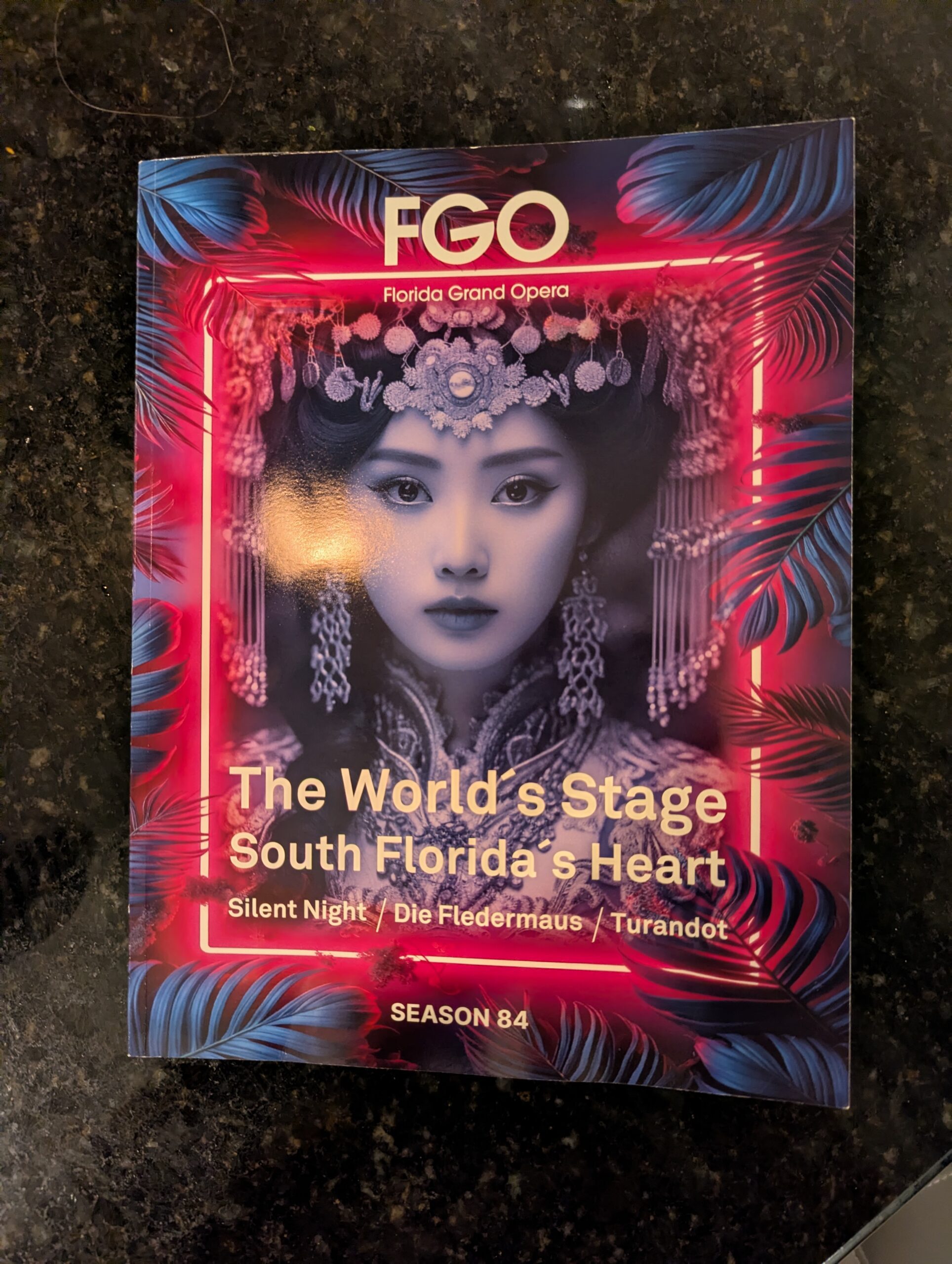
    The Florida Grand Opera delivered a production of Die Fledermaus with a level of polish and class that would hold its own in any major city on the planet. Every part of the company works in harmony, from the performers to the design team, creating a seamless and confident theatrical experience.

    Die Fledermaus was one of the most entertaining operas in recent memory.

    It was captivating, epic, and genuinely funny.

    It ran the full range of storytelling.

    It’s an opera, yes, but one with an unusual amount of play woven between the music. The dialogue across three acts grounds the audience in character and mischief before the production lifts into full operatic flight, dropping viewers into sweeping moods that feel almost cinematic. Then it returns, once again, to story. The result is something silly, clever, and deeply joyful. There’s plot, betrayal, and lies, but all in the name of fun.

    It’s easy to see why this opera has become a New Year’s Eve tradition in Vienna.

    Meanwhile, back at home, one of South Florida’s best-kept cultural secrets is catching an opera at the Florida Grand Opera on a Tuesday night. The company’s schedule is delightfully unconventional. They open on Saturday, a Sunday matinee, dark on Monday, and close on Tuesday. There’s something quietly magical about sitting in a grand hall at 8 p.m. in peak season, when the rest of the country is frozen and Miami is alive with visitors and possibility. It’s hard to imagine a better way to spend a Tuesday evening.

    This was culture at full volume. Dance, song, theater, costume, lighting, comedy, romance, and a full orchestra breathing life into the room.

    Die Fledermaus

    At the heart of the story is Dr. Falke’s elaborate revenge on his friend Eisenstein. Years earlier, Eisenstein humiliated Falke by abandoning him drunk in a public park while dressed in a bat costume, earning him the nickname “Dr. Bat” and making him the laughingstock of Vienna. That old prank becomes the fuel for an entire night of elegant chaos at Prince Orlovsky’s ball.

    And what a ball it was.

    The Florida Grand Opera stages it in a grand, Art Deco, 1920s, Great Gatsby–style world that feels decadent, glamorous, and joyfully over the top.

    The cast is stellar. Ginger Costa-Jackson’s Prince Orlovsky stands out as bold, gender-bending, and extravagantly playful, grounding the production in decadence and humor. Jesus Garcia shines as Alfred, the mischievous trickster and hidden lover, while soprano Rebecca Nelson commands the stage as Adele, her voice ringing out with confidence and charm.

    This is the kind of storytelling that deserves to be celebrated loudly, especially for new audiences discovering how thrilling opera can be.

    Prince Orlovsky’s ball becomes a spectacle, a party, and a celebration of art, excess, and theatrical joy.

    In its 84th year, the Florida Grand Opera proves once again that excellence is not an accident.

    Bravo.

  • Cosford Cinema Is a Treasure for Miami Film Fans

    Cosford Cinema Is a Treasure for Miami Film Fans

    Damien Chazelle’s 2022 film Babylon  unfurled some months ago at the Bill Cosford Cinema on University of Miami’s campus in Coral Gables for an audience of myself and the venue’s manager Rene Rodriguez. After the screening, Rene, who’d been interested in revisiting the film since his initial viewing upon release, and I ambled toward the back of the auditorium awash with glee and convened just outside the theater to share an equal measure of ecstatic commentary over Chazelle’s boldly audacious love letter to the ineffable divinity of cinema. So, there we were; two film lovers still in the throes of a youthful obsession that never receded and likely never will.

    While I certainly found Chazelle’s film a remarkable accomplishment, the afternoon became an indelible memory for me for another reason. Since 2022, Cosford Cinema has served as the exhibition launch pad for all but one of my feature films. In this most spacious A/V sanctum, I screened them for the first time before a gallery of family, friends, collaborators and their guests. And upon the first of these gracious accommodations made possible by Rene, I pledged my most loyal patronage from then on and, since my gesture, I think I’ve proved its earnestness by having attended 60+ screenings at Cosford. However, I never anticipated how deep and abiding my appreciation of cultural stewardship and those who take up its cause could become.

    But what’s the point of going to the movies? Why should we tolerate exorbitant ticket and concession prices, the lack of etiquette among fellow moviegoers who always believe their indiscretions are exceptional and the possibility that our movie selection may not satisfy our aesthetic or emotional yearnings or those of whom we wish to treat? All for a momentary stay of all the pressures, troubles and urgencies of life beyond the darkened theater?

    Because it is a battle and it always has been. A battle to care for something one or more human beings have crafted in order to squeeze a sliver of truth, beauty and/or moral refinement out of our sordid and fundamentally mysterious existences. That’s why we put up with it. That’s why we tolerate the soreness of our legs, the strain on our bladders and the often questionable skill of the filmmakers who’ve offered up their work to our highly discerning taste. Many of us persist in these auditoriums out of sacrificial duty to a cause greater than our immediate flesh and nerve. It is never easy to focus for hours at a time on a narrative thread or other offered extremity of mimetic construction but it’s what holds together the very foundation of culture and civilization. Patience, restraint and a touch of stoic character. It’s all that holds our puny social order together. Without this discipline and durability, we are vulnerable and compromised.

    Cosford Cinema

    So, Cosford Cinema is where I’ve chosen to regularly practice this form of viewerly asceticism. And the rewards have been rich and varied. From a vast showcase of UM’s own student films to retrospectives of mainstream directors’ catalogs to a thorough roll call of the global critical community’s top favorites to new 4K masters of modern classics to selects from luminaries of the local community (where I met Mayor Daniella Levine Cava and gifted her a copy of my book) to advance screenings of hotly anticipated titles to simply works selected on account of seasonal appeal or the theater manager’s plain and simple preference, Cosford has offered an embarrassment of riches to those who’ve taken up the aforesaid challenge to engage with one of the most ennobling pursuits of our often clumsy, wayward species. And a fair amount of the time, the screenings offer opportunities to hear directly from the filmmakers involved or their loved ones, as in the case of a past Q&A with local documentarian Billy Corben following a screening of one of his latest films or a live, in-theater Zoom call with the wife of Gene Kelly after a presentation of the 1952 musical Singing in the Rain.

    Moreover, Rene furnishes all of his revivalist weekend screenings with the finest, most informed curation you’re likely to find in all of South Florida. Throwing his weight into the job as a seasoned film critic who’s shared ample time, space and words with some of the most legendary filmmakers in the North American film industry, Rene lends a wealth of insider insight and perspective into his introductory remarks, complete with a comprehensive slide presentation. And following screenings, Rene is routinely on-hand to kick-off and guide a discussion with attendees about the merits and context of a given classic film or more contemporary offering. But there’s no limit to the range of discussion and everyone is always encouraged to participate, making it a refreshingly civic and democratic event.

    Nearly two decades before Rene’s management of the theater, there had existed an air of intelligent, counter-cultural programming at Cosford that appealed to many discerning locals in an environment of increasing media company consolidation, including a dear high school classmate of mine who often encouraged my attendance at the theater. However, my history with the venue as a patron commenced some time after my friend’s imploring, when my parents, who raised my siblings and me in a household where trips to the local cineplex were extremely rare yet highly desired, assented to my burgeoning and rapacious adolescent interest in filmmaking by encouraging me to attend an exhibit of short films from UM’s graduating film students. I remember sitting in the rearmost row with my parents and later feeling more than cocky in asserting my thoughts about the perceived strengths and weaknesses (mostly weaknesses) of the work on the car ride back from the event.

    After a traumatic mental health-related experience as a film student at University of Central Florida, I returned to Miami in the late 2000s and reconstituted myself with the help of association and involvement with a community of film students at UM. Consequently, I would attend their film program’s exclusive Canes Film Festival at Cosford to see the results of the hard work applied throughout their semesters, some of which I had a hand in. It was here that a familiar impulse to put my patience and focus to the test by watching hours’ worth of student work from these fellow aspiring filmmakers. I attended several editions of the film festival before the demands of my own personal filmmaking picked up again along with the responsibilities of my return to the university setting at Florida International University as a Communication Arts major. Experiencing a personal renaissance in the mid-to-late 2010s, my development as a filmmaker – and one beginning to produce his own feature films – would soon land me in the good graces of a veteran film critic with a fairly new gig in town.

    Cosford Cinema is like Home

    I don’t recall under what circumstances we became Facebook friends but it’s not uncommon to send/receive friend requests to/from those within the local film community, who share many mutual contacts and are rather extroverted online about a common affinity. Either way, I came to know that Rene Rodriguez was a well-regarded film critic who’d recently been hired as theater manager at Cosford in the early 2020s. This information became of particular interest when I was in search of a theater venue to host the first public screening of my 2nd feature film State v. Unknown which I had produced throughout the dénouement of the global COVID-19 pandemic and completed in the spring of 2022. So, I reached out. Thankfully, Rene responded with a welcome promptness, open-armed about the prospect of screening my film at Cosford and we set to meet some time later at the theater to ingest my film into the theater’s DCP projection system.

    When I arrived on the patio just outside of the auditorium, I believe my characteristic earliness caught Rene off-guard. He was shirtless, perspiring and preoccupied with moving some outside furniture into place. And so, my first impression of Rene was a man who put his body and sweat into the job – quite literally. Our ensuing interactions were the most cordial and amiable. Whether he mentioned the length of his film critic tenure at Miami Herald (33 years!) made no difference to me. Rene was, at once, a prepared, thorough, sincere, caring and extremely intelligent man to whom I would always listen first and let guide the direction of every interaction from then on. We became fairly fast friends that day and my fondness for Rene as a writer, cinephile and mentor has only accumulated since the start of my association with him. To say the least, our coordination and execution of my 2nd feature’s screening went off without a hitch and we remained in regular contact as I made good on my promised patronage at Cosford. When Rene would playfully deride my peculiar vow, I would respond that I possessed “few loyalties.” Rene and Cosford among them.

    4K digital projection., 7.1 Dolby Digital sound, 70-square-foot screen, and 240-seat auditorium. The Bill Cosford Cinema is the largest, single-screen theatrical venue in all of Miami. You can find its schedule of programming at cosfordcinema.com. Come on down sometime!

  • GableStage’s Sotto Voce Whispers Its Way Through History and Love

    GableStage’s Sotto Voce Whispers Its Way Through History and Love

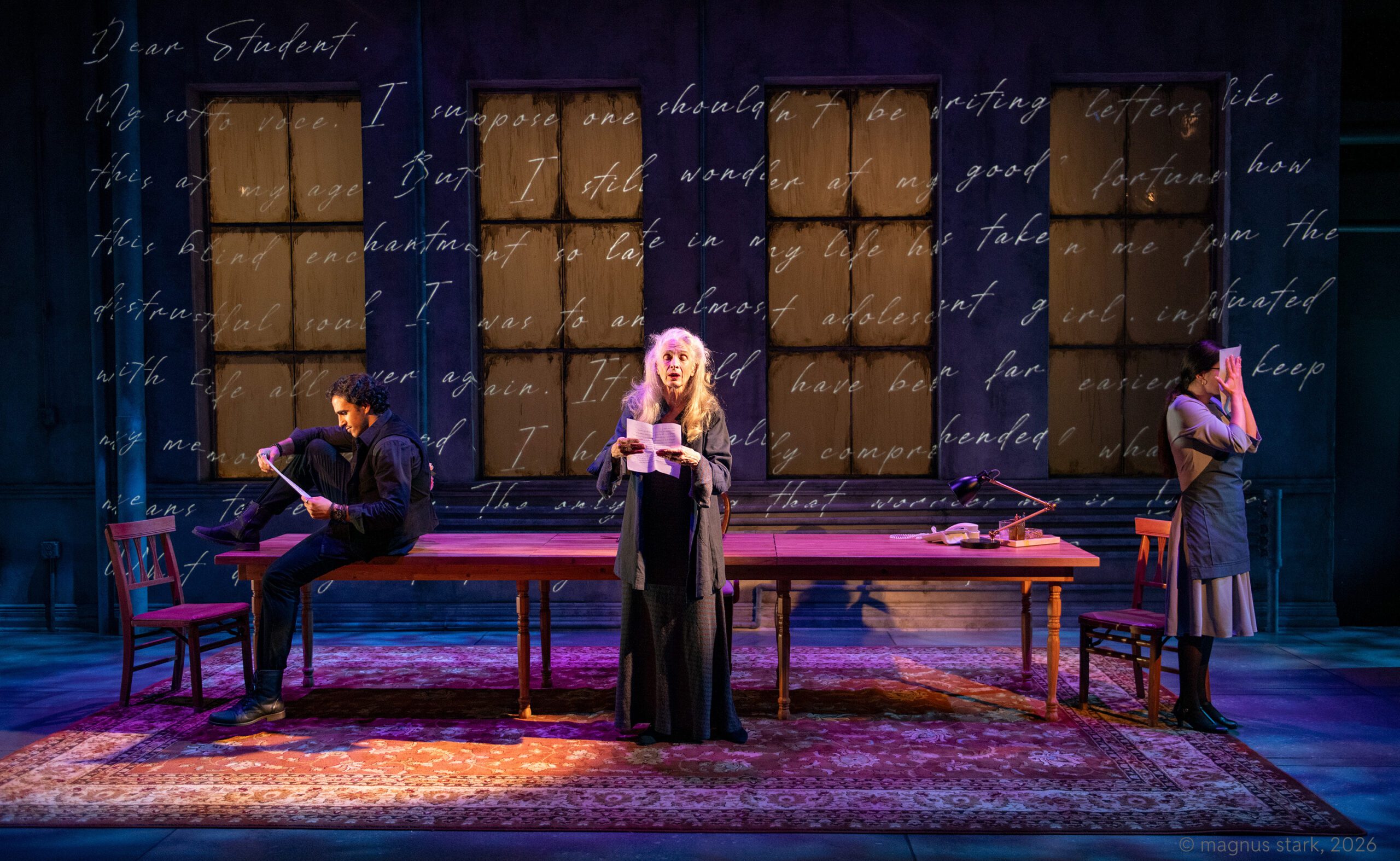
    The sound of the ocean. A wisp of seafoam frozen in the air. Tides tango, a soft kiss from a wistful breeze — the poetry of memory — a vacillation in time, love and loss, a soft whisper, a low voice — this is Nilo Cruz’s Sotto Voce now playing at GableStage.

    The play is wrapped around the story of the MS St. Louis, a ship filled with Jewish refugees who fled Europe in 1939. They were denied entry into Cuba, the U.S., and Canada, and sailed back to Europe. Many assimilated into different countries, but about 300 ultimately wound up killed in concentration camps. It is a story that carries shame.

    The story of the St. Louis is a cautionary tale about our responsibility to neighbors in need, and about acceptance in the face of nationalism. It’s relevant today.

    The frame of Sotto Voce is as follows.

    Bemadette Kahn (Sara Morsey) is an 80-year-old German author living in Manhattan. Saquiel (Gabriell Salgado) is a young researcher from Cuba who is obsessed with the story of the St. Louis. He interviews Bemadette after finding letters, private correspondences between Bemadette and her old lover, Ariel, who ultimately perished.

    Like Titanic, the story unfolds through an older narrator traveling back in time, revisiting her relationship with Ariel before the voyage.

    The play is a subtle lullaby of memory and loss.

    It is a poetic meditation on love, belonging, and the weight of history.

    Yet the play is also more disguised as a historical drama.

    Sotto Voce Review

    Scenes at times shift between the present and past, but this two-act, 120-minute play, with a 15-minute intermission, is not grounded in action or traditional historical drama. Much of the play consists of characters talking to one another, in the present, trying to connect. The researcher struggles to reach the reluctant author, while a third character, Lucila (Claudia Tomás) the author’s assistant, a young Colombian woman, triangulates the drama, offering comic relief, sparking moments of chemistry and desire for life.

    The acting is steady. Sara Morsey delivers a deep impassioned performance. Claudia Tomás is a delight, bringing whimsy and real chemistry. And Gabriell Salgado is a stud, in range and presence. Salgado is one of South Florida’s most prolific actors, appearing in productions it seems like everywhere. We last loved him in Lincoln Road Hustle. His career appears destined for bigger things, in television, perhaps film.

    The play itself is literary in its ambition but unusual in its use of point of view. It bounces between emails, phone calls, letters, diary-like passages from Bemadette’s book, and third-person scenes that occasionally slip into flashbacks. The point of view shifts a lot for a play.

    The challenge is that this constant shifting doesn’t leave enough space to ground emotional depth or raise the dramatic stakes.

    The story moves like the ocean, back and forth, breaking and receding, perhaps intentionally, perhaps like memory.

    Memory, as years pass, becomes quiet, subtle, lingering in the psyche.

    But we don’t forget.

    Therefore, it is fitting this drama unfolds in a subtle manner, like a whisper or a soft voice (sotto voce translates to soft voice). There are no loud bangs. There is no traumatic, confrontational use of suspense, conflict, or resolution with dramatic stakes. The story, like the sea, like memory, vacillates. In its subtle vacillation lies its value and entertainment.

    Sotto Voce

    world premiered Off-Broadway in 2014, written and directed by Nilo Cruz. It was later performed in Atlanta, Washington, D.C., and Portland, Oregon, and now arrives in Miami, once again under Cruz’s direction. It is playing at GableStage until Feb 15th.

    For more info and tickets, click here.


    photo by Magnus Stark
    photo by Magnus Stark
  • Bug Broadway Review: This Play Crawls Under Your Skin

    Bug Broadway Review: This Play Crawls Under Your Skin

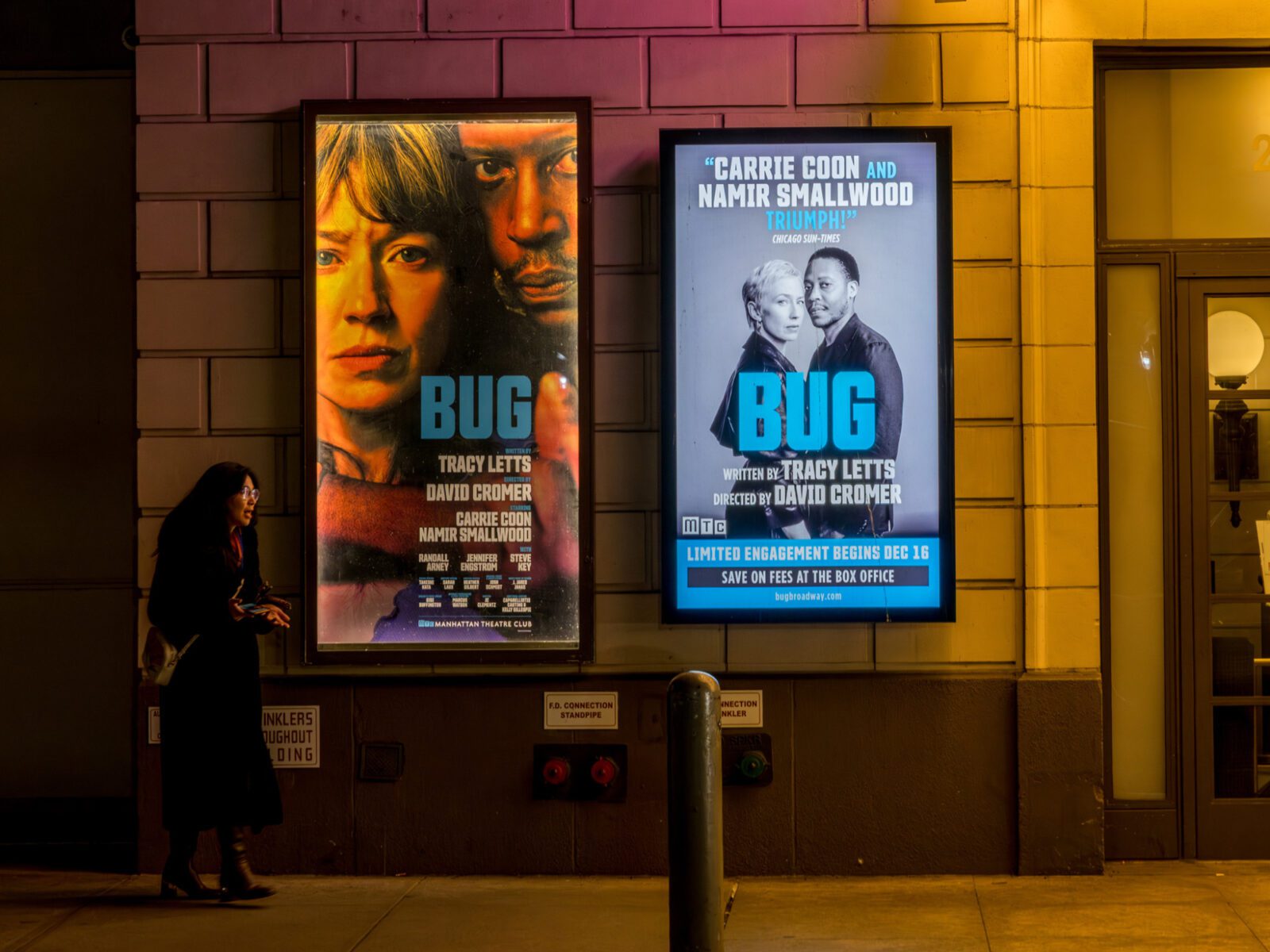
    Bug is a play by American playwright Tracy Letts, starring Carrie Coon and Namir Smallwood.

    It first premiered in London in 1996 and is currently making its Broadway debut at the Manhattan Theatre Club, at the Samuel J. Friedman Theatre.

    Most of the play takes place in a seedy motel room. A lonely cocktail waitress, Agnes, is living there, on the lam from her violent ex-husband, Jerry, who has recently been released from jail. One night, Agnes’s lesbian biker friend introduces her to Peter, a Gulf War veteran and drifter.

    Agnes gets involved with Peter, who grows increasingly paranoid about a bug infestation in the hotel room. This soon connects to a web of conspiracy theories involving the government. The play explores love, paranoia, addiction, conspiracy, and Agnes’s slow descent into insanity under Peter’s influence.

    This psychological thriller is gut-wrenching and tense. It will make you uncomfortable in the best way. You will cover your eyes during certain scenes. The performances are courageous, compelling, and traumatic. The chemistry and nuance between the actors are extraordinary. Both actors will almost certainly be nominated for Tony Awards under Best Revival of a Play.

    Bug Broadway Review

    On a deeper level, this play is more relevant in 2026 than ever.

    We give it five stars, a 96 out of 100.

    That said, this dark, twisted psychological thriller is not for everyone.

    And yes, we hate to get all freshman composition on you, but this play demands to be viewed through Ernest Hemingway’s Iceberg Theory, you know, the idea that only 20 percent of a story is visible on the surface, while 80 percent lives underneath in context and subtext. If you understand the cultural language and history beneath Bug, you will get far more out of it.

    If you don’t, you may only see a redneck woman and an African-American veteran holed up in a motel, smoking crack, having sex, getting paranoid, violent, and descending into addiction and madness. You might cringe at the self-harm and brutality and leave wondering what the hell you just watched, especially if you came for Carrie Coon fresh off The White Lotus and The Gilded Age.

    But if you go deeper, you’ll recognize how profoundly American these themes are: addiction, misinformation, domestic violence, paranoia, delusion, mental health decline.

    When the play was written in the mid-1990s, the internet was just being born. Misinformation was only a seedling. In 1996, Bug was a warning. In 2026, it’s a mirror.

    Even the word “bug” matters. In ’90s slang, to bug out meant going crazy. You buggin, meant, hey, you’re losing your grip. Language matters.

    In law enforcement, a bug is a listening device. Without cultural context, those meanings disappear, and so does the play’s power.

    There’s a moment in the Apple TV+ series Pluribus where a character (Carol) doubts her apartment has been bugged, and another character (Manousos) new to American culture, takes the word literally, picturing an insect. Again, language matters.

    This is not a feel-good night at the theater. It’s raw, violent, sexy, and deeply American. It asks uncomfortable questions about trust, trauma, and the stories we choose to believe when reality starts to fracture.

    Bug is tense, moody, dark, sexy, strange, riveting, and deeply unsettling.

    It’s not fun but it’s necessary.

    You will leave shaken and in that discomfort, you’ll know you felt something. That is all great drama ever promises.

    Bug opens January 8 and runs for a limited engagement.

    For more info and tickets click here.

    Sidenotes and ramblings

    The last two plays we’ve seen featuring strong, young African American men—Purpose and now Bug—present their male leads as essentially asexual despite the presence of sex, raising the question of coincidence or something more deliberate at work.

  • Miami Jewish Film Festival Returns

    Miami Jewish Film Festival Returns

    The Miami Jewish Film Festival (MJFF), the world’s largest Jewish film festival, proudly announces the full program for its 29th edition, returning January 14-29, 2026, with its most expansive lineup to date. This year’s Festival will present 139 films from 20 countries, including 105 features and 34 shorts, featuring 15 world premieres, 19 international premieres, 13 North American premieres, and 3 U.S. premieres. The hybrid festival will offer more than 90 live screenings across eight venues throughout Greater Miami, expected to welcome over 50,000 attendees, alongside an online program showcasing more than 80 films available to audiences across Florida and the United States.

    Opening the Festival is Once Upon My Mother, a triumphant and big-hearted French box-office hit that celebrates the transformative power of maternal love. The premiere will take place at the historic Miami Beach Bandshell amphitheater, where more than 800 guests will join acclaimed director Ken Scott for an unforgettable evening under the stars. Closing the 29th edition is the International Emmy Award–winning Israeli drama The Ring, a powerful and deeply emotional odyssey following a father and daughter’s journey from Tel Aviv to Budapest as they search for a gold ring that once saved their family during the Holocaust. Headlining this year’s slate is the world premiere of From Cuba to America, a made-in-Miami portrait of beloved community icon George Feldenkreis and his extraordinary journey from Havana to building the Perry Ellis fashion empire. Featuring original music by Grammy-winning legend Emilio Estefan, the film reflects Miami’s creative spirit and the Festival’s commitment to celebrating local storytelling.

    Also debuting as a headline premiere is Influenced, a laugh-out-loud, big-hearted comedy starring Jill Kargman, Gwyneth Paltrow, Drew Barrymore, Matt Damon, and David Krumholtz. Director Rachel Israel and Jill Kargman will attend the highly anticipated world premiere event. The Festival will welcome more than 75 filmmakers and distinguished guests from around the world. Among this year’s international guests are Amanda Peet and director Matthew Shear, who will present the charming romantic comedy Fantasy Life, also featuring two-time Oscar nominee Judd Hirsch, Alessandro Nivola, and Jessica Harper. Peet will also introduce a special nostalgic screening of the modern classic Igby GoesDown. Acclaimed producer Nancy Spielberg and award-winning Israeli filmmaker Tom Shoval will be inattendance for the premiere of their timely new documentary A Letter to David, following David Cunio, abducted from an Israeli kibbutz on October 7. Additional guests include trailblazing singer, songwriter, and pop-culture icon Carol Connors for the documentary Elvis, Rocky, and Me; Israeli comedic duo Guy Amir and Hanan Savyon for the premiere of Pure Luck; legendary documentarian Alan Berliner presenting Benita; and filmmaker Paula Eiselt premiering her joyfully nostalgic documentary We Met at Grossinger’s.

    By the numbers, the 2026 Miami Jewish Film Festival will showcase 139 films, including 15 world premieres, 19 international premieres, 13 North American premieres, 3 U.S. premieres, 8 East Coast premieres, 48 Southeast U.S. premieres, and 20 Florida premieres, along with more than 50 conversations with filmmakers, artists, and scholars from across the globe. Full program details and tickets are available at miamijewishfilmfestival.org.

  • Zoetic Stage’s The Inheritance, Part One is a big ask that is boldly answered

    Zoetic Stage’s The Inheritance, Part One is a big ask that is boldly answered

    Kudos to Zoetic Theater’s audacity to take on The Inheritance, Part One, a work of great scale and density. A three-and-a-half-hour drama about being gay in Manhattan is not an easy sell. But it’s precisely that ambition that makes this production of The Inheritance, Part One feel exciting and necessary, even when it isn’t always fresh.

    The idea of committing to a three-and-a-half-hour play about multiple generations of gay men living in Manhattan, staged at a regional theater, felt like a big ask. Three acts. Two ten-minute intermissions. This is four hours of your life. Yet what unfolds is bold, ambitious, grounded, occasionally transcendental, and often simply wonderful storytelling.

    The play weaves together crisscrossing generations, parallel narratives, and overlapping lives in a way that feels intimate, personal, and deeply engaging. When it works, and it often does, it feels timeless, emotionally rigorous, and genuinely compelling.

    Among the highlights of Part One is Anthony Michael Martinez’s portrayal of Toby Darling, a thirty-something writer who describes himself as a kind of gay J.D. Salinger, complete with a self-aware, gay Holden Caulfield stand-in. Martinez commands the room with a nuance that is both cocky and vulnerable, giving Toby a depth that slowly reveals itself. It’s a performance that anchors the play.

    Another standout is Alex Weisman as Eric Glass. On the surface, Eric appears fragile, almost transparent — as his name suggests — but he’s anything but shallow. Weisman plays him with warmth, vulnerability, and surprising confidence. His timing is excellent, and his character becomes even more essential as the play progresses.

    At its core, The Inheritance asks two major questions. What does it mean to be a gay man in America? And what does it mean to be human?

    When the play leans into the second question it explores love, loss, loneliness, and connection. And the play feels alive, original, and emotionally resonant. When it leans too hard into the first question, it feels slightly dated in 2026, weighed down by familiar tropes and ideas that no longer feel urgent in the same way.

    The Inheritance Part One Review

    The title itself points to the play’s central metaphor, inheritance. What do we receive from those who came before us? Property. Money. Influence. Trauma. Political struggle. The fight for rights. This idea blankets the play, sometimes elegantly, sometimes heavily.

    Directed with clarity and confidence by Stuart Meltzer, this production showcases the strength of the Zoetic Stage ensemble. With twelve male actors bouncing off each other like pinballs, the staging is dynamic and alive. Meltzer and his real-life partner, playwright and actor Michael McKeever, continue to prove why Zoetic remains one of the most vital companies in the region.

    There is a lot to track. It’s epic. Be on the lookout for emotional triangles, offstage histories, layered storytelling. If you lose focus, the final act can feel confusing and exhausting. But if you stay with it, the writing is strong enough to reward your attention.

    The Inheritance, Part One originally premiered in London in 2018, went on to Broadway, and won major awards, including the Tony for Best Play. Now, seeing it staged locally at this scale is both impressive and encouraging. It’s not perfect. It’s long and demanding. At times, it feels overstuffed.

    But it’s also brave, thoughtful, and deeply human.

    For a regional theater to kick off the year with something this ambitious says a lot. And most of it says the right things.

    For more info and tickets click here.

    The Inheritance, Part One is playing at the Arsht Center until Jan 25.

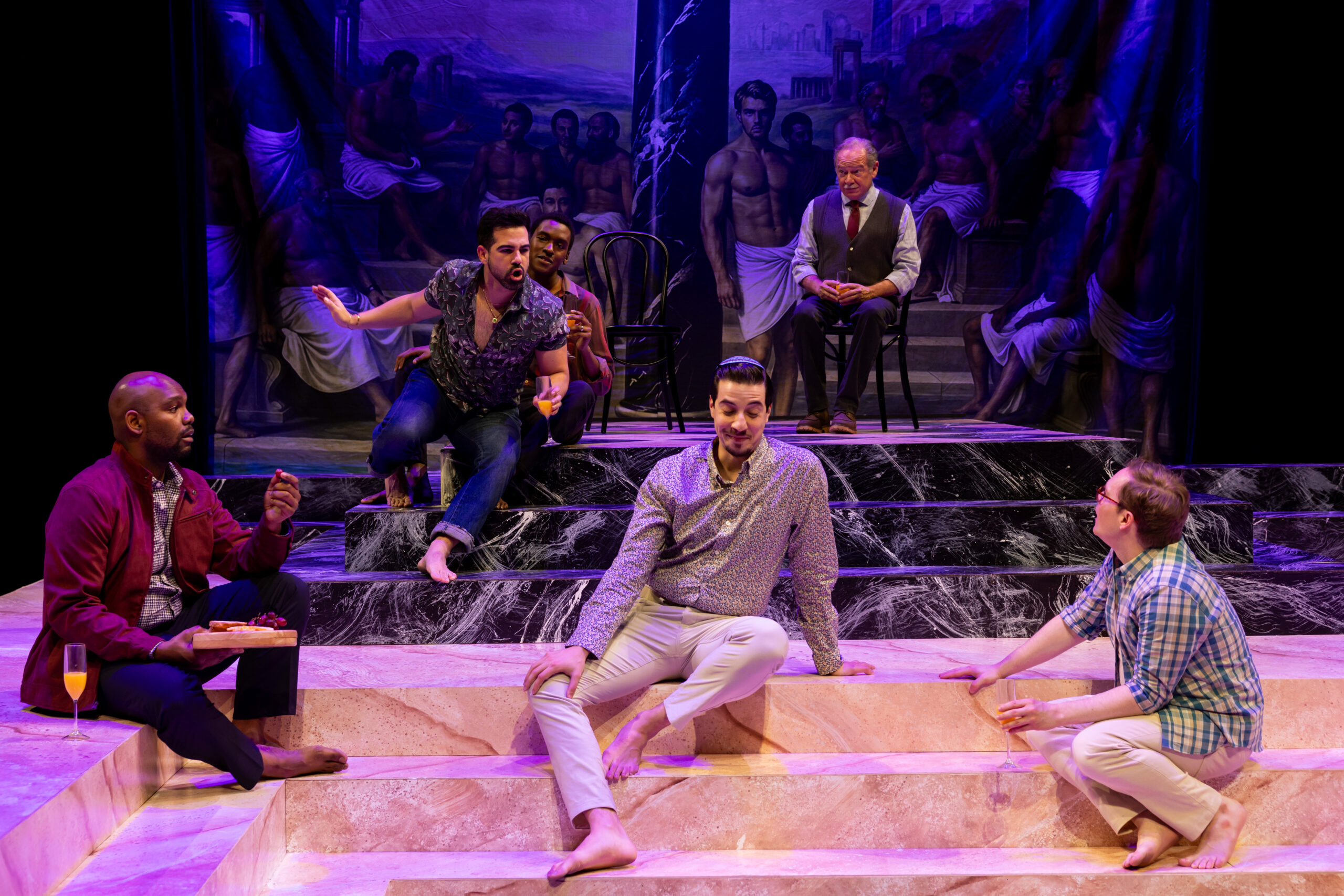
    Pictured-–-Randall-Swinton-Alex-Weisman-Angel-Dominguez-Imran-Hylton-Larry-Toyter.-Photo-by-Morgan-Sophia-Photography
  • Marjorie Prime Broadway Review

    Marjorie Prime Broadway Review

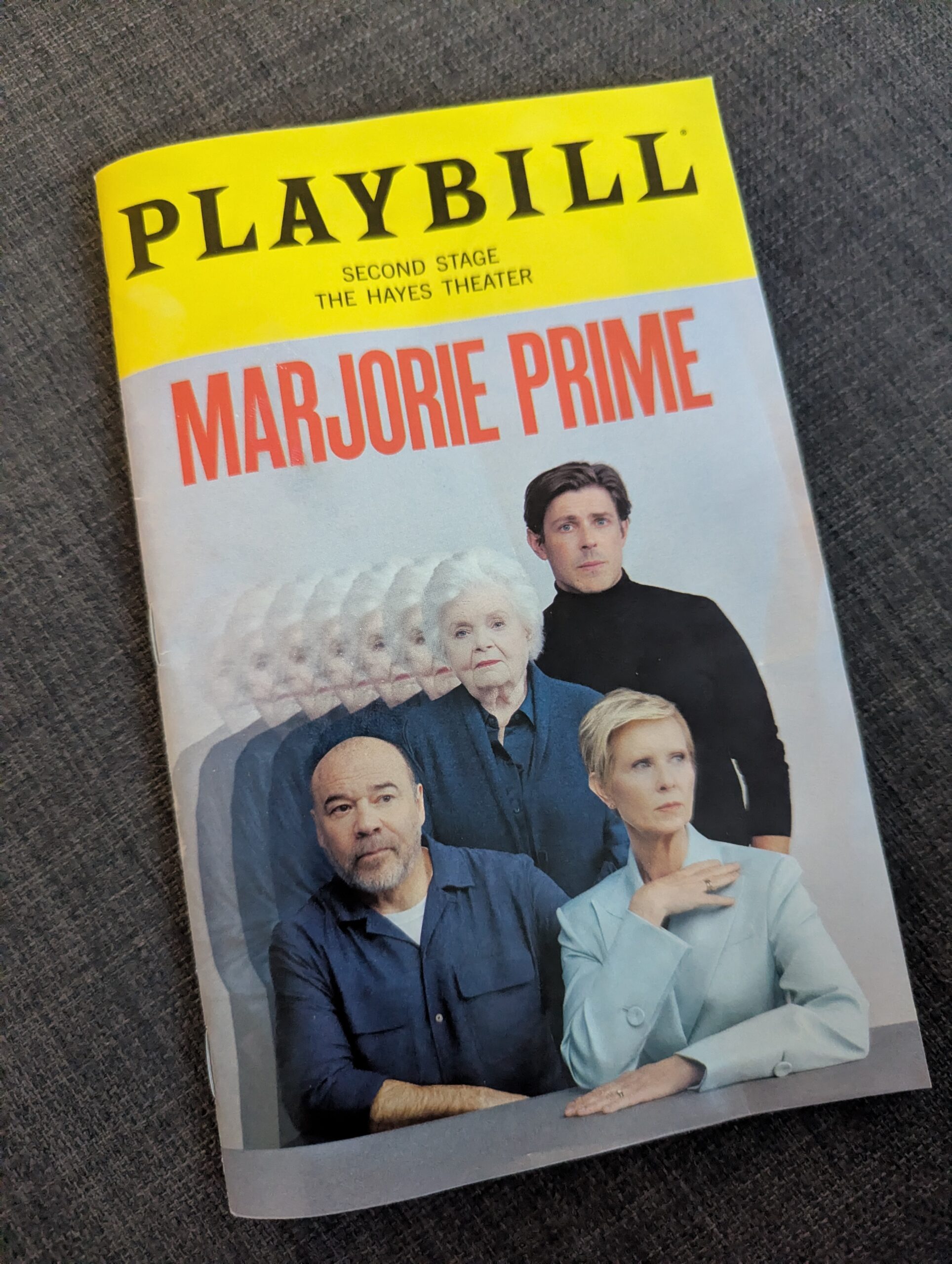
    Marjorie Prime is currently on Broadway. It is a sci-fi drama with a dark undertone, examining aging, grief, family dynamics, and memory.

    The play first premiered Off-Broadway in 2015, where it was a Pulitzer Prize finalist. A decade later, Jordan Harrison’s work makes its Broadway debut with a strong cast, including Cynthia Nixon, Danny Burstein, and a remarkable performance from 96-year-old June Squibb.

    The premise is deceptively simple. Marjorie is an 85-year-old woman living with dementia and fully aware of her decline. She’s cared for by her daughter Tess, played with controlled precision by Nixon, and by her husband John. The play is set slightly in the future, where AI holograms called “Primes” are created from deceased loved ones to provide companionship.

    Marjorie’s Prime is Walter, her late husband, recreated as a younger man in his thirties, from a time before Tess was even born. (Hard not to compare Walter to Darren Crisss’s helper bot in Maybe Happy Ending, they look a-like, chiseled chin and all). Walter’s role is to keep Marjorie company, assist with memory, and perhaps resolve unfinished emotional business before death arrives.

    This idea isn’t new. The resurrection of the dead through technology, or the use of technology to eliminate lonliness, has been explored repeatedly over the past decade, from Black Mirror’s “Be Right Back” and “San Junipero” to Spike Jonze’s Her. These stories function as cautionary tales and they rarely end well. Some conversations, it turns out, may be better left un-reopened.

    Marjorie Prime Broadway Review

    Marjorie Prime runs a tight 90 minutes with no intermission. It is not a feel-good experience. Portions of the play can be deeply triggering, especially for anyone who has been a caregiver or carries unresolved grief. The emotional terrain is heavy and familiar.

    As the play unfolds, without spoilers, the central dramatic question begins to wobble. Is the Prime truly necessary? Does this character require it, or does the device exist primarily to serve the premise? At a certain point, the Prime and/or Primes stop functioning as a dramatic engine and start feeling like a concept the play no longer knows how to interrogate. Like, are we to believe these characters needs these Primes.

    That said, the performances are undeniably strong. June Squibb plays Marjorie with surprising lightness and self-awareness, handling an extraordinarily difficult role with grace and control. Nixon is equally compelling as Tess, and both performances would be worthy of Tony nominations, even if wins feel unlikely.

    Still, this is not a holiday play, and it doesn’t feel fresh. Despite how close we are to this technology becoming real, the ideas feel well-traveled. You leave the theater more subdued than moved.

    This is a solidly acted revival of a familiar cautionary tale. And because we’ve already lived with these questions for years, Marjorie Prime ultimately feels skippable.

    For more info and tickets click here.
  • Haitian Men in Brother, I’m Dying and Mountains

    Haitian Men in Brother, I’m Dying and Mountains

    A few weeks ago I was driving when the light on my dashboard came on warning of low air in my back tire. I stopped at the gas station on Biscayne and found the air machine. As I inserted quarters into it, a beater of a pick-up truck pulled up next to me. “You using the air?” a middle-aged man asked in a Haitian accent.

    I explained how my tire keeps deflating every couple weeks and I need to get a new one. After my tire filled up, the machine was still spewing out air, so I handed the hose to the gentleman as he and his younger companion used it to fill up a bicycle tire. When I got into my car the older Haitian man said to me, “Remember to fix what is broken.”

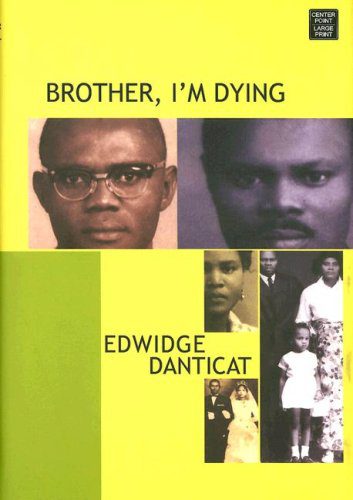
    That five minute interaction kept coming to mind as I read Edwidge Danticat’s beautiful memoir, Brother, I’m Dying. In this book which recounts her life as a child in Haiti and her adulthood in the United States, one man steals the show for me. Her Uncle Joseph is a very unique figure in modern storytelling. Usually, characters whether real or imagined are portrayed as flawed. Writers tend to think there is more interest in imperfection. Uncle Joseph contradicts this assumption. He is fascinating because he is so rare in fiction or non-fiction in that he is a true paragon of virtue. Life has struck this man many blows.  He loses his voice due to an illness and is forced to use a modulator to communicate. His wife dies. His church is destroyed. He spends his last days imprisoned while in exile, unwelcome in the United States. Still there is never the slightest iota of bitterness. All he does is give back, whether in helping to raise children that are not his own or when trying to uplift his impoverished community.

    Anyone who has dealt with any member of the human race, must wonder whether Danticat is painting her uncle with a thick paint of nostalgia. Surely a man who cared for her when she was young and her parents were unable to deserves such a glowing tribute. But one would think there would be one moment where he loses his temper or acts in a selfish manner. Every American I met finds something to complain about even when living under much more luxurious circumstances, but Uncle Joseph glides through this book with a metaphorical halo over his head.

    This quality makes it all the more heartbreaking when you read how he spent his final days. I would not wish his fate on any person. To first have the church he spent his whole life building to be destroyed by angry gang members who thought he betrayed them. Then once he escapes and finds his way to the United States to be taken to Krome Service Processing Center where he is imprisoned and not given proper medical care is torturous to read. A man like this deserves to be embraced by the world with open arms. Any country would be lucky to have such a man walk among them, but ours didn’t look at him for who he was, but only by where he came from. He then suffered the most tragic of demises.

    Throughout the book readers learn quite a bit about the Caribbean country’s harsh recent history. President Woodrow Wilson ordered the U.S. Marines to invade Haiti in 1915 which resulted in a fifteen year occupation which Haitians fought against guerilla style unsuccessfully. Through the twentieth century there were plenty of regime changes, apparently none more tumultuous than that involving Jean-Bertrand Arstide. In 1991 Arstide was ousted by military coup. According to Danticat, “residents remained steadfast in calling for his return through protests and demonstrations. In retaliation the army raided and torched houses and killed hundreds” (139). To survive such instability and poverty over decades perhaps makes for a man of patience and perspective such as Uncle Joseph or the gentleman I encountered at the gas station.

    Xavier, the Haitian- American male protagonist of the 2023 movie Mountains, is cut from a slightly different cloth. When we are first introduced to Xavier working as a construction worker striving to purchase a bigger home to share with his wife in Miami’s Little Haiti neighborhood, he too seems patient. As the film progresses we can observe a rage simmering underneath his stoic exterior. He is angry that his adult son still lives at home and doesn’t seem to aspire to do more than work as a valet and tell jokes at open mic comedy nights. Xavier is also frustrated that his neighborhood is gentrifying, pricing out his fellow Haitian exiles in exchange for yuppies of a lighter complexion. Finally, he goes from trying to play peacemaker for the racial tension between the Black and Hispanic workers, to confronting his foreman for making a racist comment.

    Xavier fell for the mythology of the American dream. He thought once he made it to the U.S his future would be golden. In the climactic scene where he tries to make peace with his son, Xavier bears his heart and regret. He spent all these decades working his behind off and feels like he’s gotten nowhere. Xavier reminisces about the more relaxed life in his native land where he spent entire days at the beach. And in the line of dialogue from which the movie gains its title, he rues how in Haiti you could see mountains, but in the United States all you see are buildings.

    It is a much more cynical perspective than that what we get in the entire book of Brother, I’m Dying from Uncle Joseph or the moment where I interacted with the man at the air pump. But perhaps the American Dream can only be dreamed by those who live outside our borders. To assimilate might mean not to believe in hope any longer.

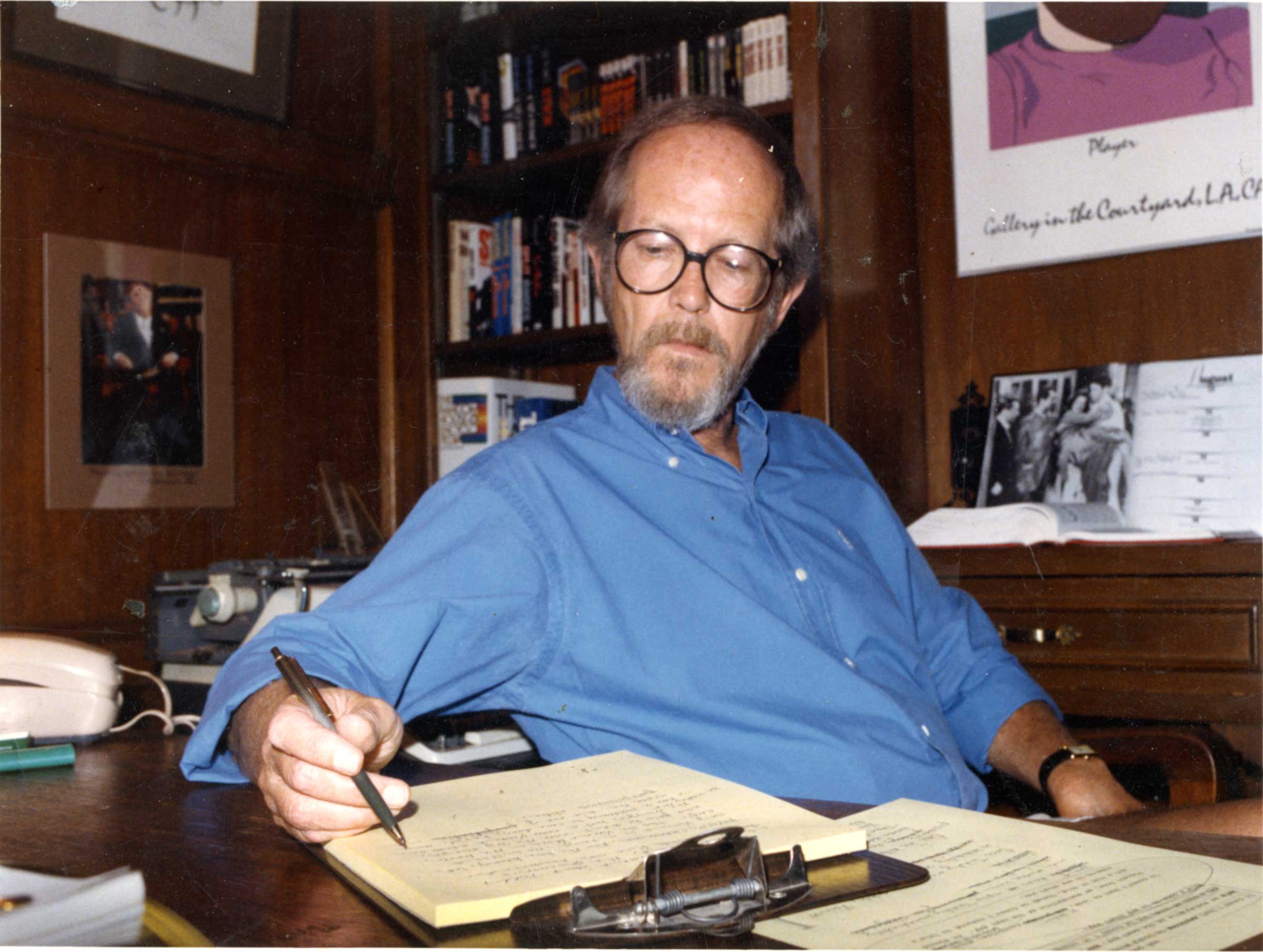
  • Elmore Leonard Movie Adaptations Portrayed the Quirkiest Miami

    Elmore Leonard Movie Adaptations Portrayed the Quirkiest Miami

    1995 was the year I was first introduced to Elmore Leonard through the movie based on his book, Get Shorty. It looked like the sequel of the recently released Pulp Fiction which also starred John Travolta as a tough guy in a criminal underworld. While like Pulp Fiction, Get Shorty had plenty of violence and snappy pop-culture infused dialogue, it also had something a bit different, that was emblematic throughout films based on Leonard’s works the strongest sense of place.

    The movie Get Shorty  starts out in Miami Beach on the coldest day of the year. Only in South Florida would cold bother someone as much as it does Chili Palmer (the loan shark played by Travolta). He’s so desperate to get back his leather jacket stolen by another gangster that he punches him right in the nose. This other gangster Ray Barbini played by Dennis Farina is the kind of mustached, obnoxious guy who laughs at his own jokes that I could very much imagine at The Rascal House harassing the waitress that there wasn’t enough complimentary cole slaw on his table.

    Get Shorty is filled with snappy, character revealing dialogue with plenty of pop culture references. It’s littered with characters who don’t blink at violence. Archetypes who might seem out of place in other cities but fit right in with the flashy machismo that was ever present in the South Florida of 1995.

    In 2013 I interviewed a performance artist who was also influenced by Leonard, who had at the time recently passed away. This artist, Tim Youd, had a schtick where he would go to a location where a famous novel took place and retype that novel page by page, word for word on his trusty typewriter. For the week of 2013 Art Basel he holed himself up at the Aqua Hotel on Collins Avenue, the same street where the book Get Shorty starts, and retyped every word from that published book.

    Elmore Leonard Movie Adaptations

    Leonard had other disciples who made great films based on his work with a strong sense of place. The afore mentioned Quentin Tarantino followed up Pulp Fiction with Jackie Brown, which was based on the Leonard book, Rum Punch. Headlines were made that Tarantino cast the African-American Pam Grier to play a character written as Caucasian. Just as big a deal was that the story was relocated from the Miami and Palm Beach of the book all the way to Los Angeles. Tarantino said in interviews he didn’t know Miami and thus the movie would ring false. Los Angeles was his city and he felt a relocation would allow him to do the story justice. In my mind it is the most sentimental and human of Tarantino’s works, perhaps he wouldn’t have felt as comfortable telling such a story in a city he didn’t know.

    Just as great was the 1998 movie Out of Sight based on the Leonard novel with the same name. Out of Sight starts out with a prison break in the Everglades when a career bank robber played by George Clooney is busted by federal marshal Karen Sisco played by Jennifer Lopez. Unlike many Miami based movies of the 1990’s, many actors are portrayed by Hispanic and African-American actors, showing a truer representation of our multi-cultural city. Before the movie moves up to Detroit mid-way through, the cinematography also depicts the stifling and blistering heat of our city, that many Miami based productions ignore.

    More recently there was an entertaining television show Justified and its even more recent sequel Justified: City Primeval, both featuring the Leonard creation U.S. Marshall Raylan Givens. Like Get Shorty and Out of Sight, Justified starts out in South Florida before moving on to Kentucky and Detroit. While its time in South Florida is limited, it is treated as an entirely different world, than Appalachia or the Rust Belt. The lighting is more washed out and unforgiving in the South Florida scenes, dark clouds hinting at a storm on the horizon.