Category: News

  • GableStage’s Both Sides Now is a Sleepy Lovely Lullaby

    GableStage’s Both Sides Now is a Sleepy Lovely Lullaby

    GableStage is following up the interesting King James with Both Sides Now, a sleepy two-person show dedicated to the music of folk legends Leonard Cohen and Joni Mitchell. It’s not a play or a musical and we’re not even sure it’s cabaret. Let’s call it a show or cover band performance.

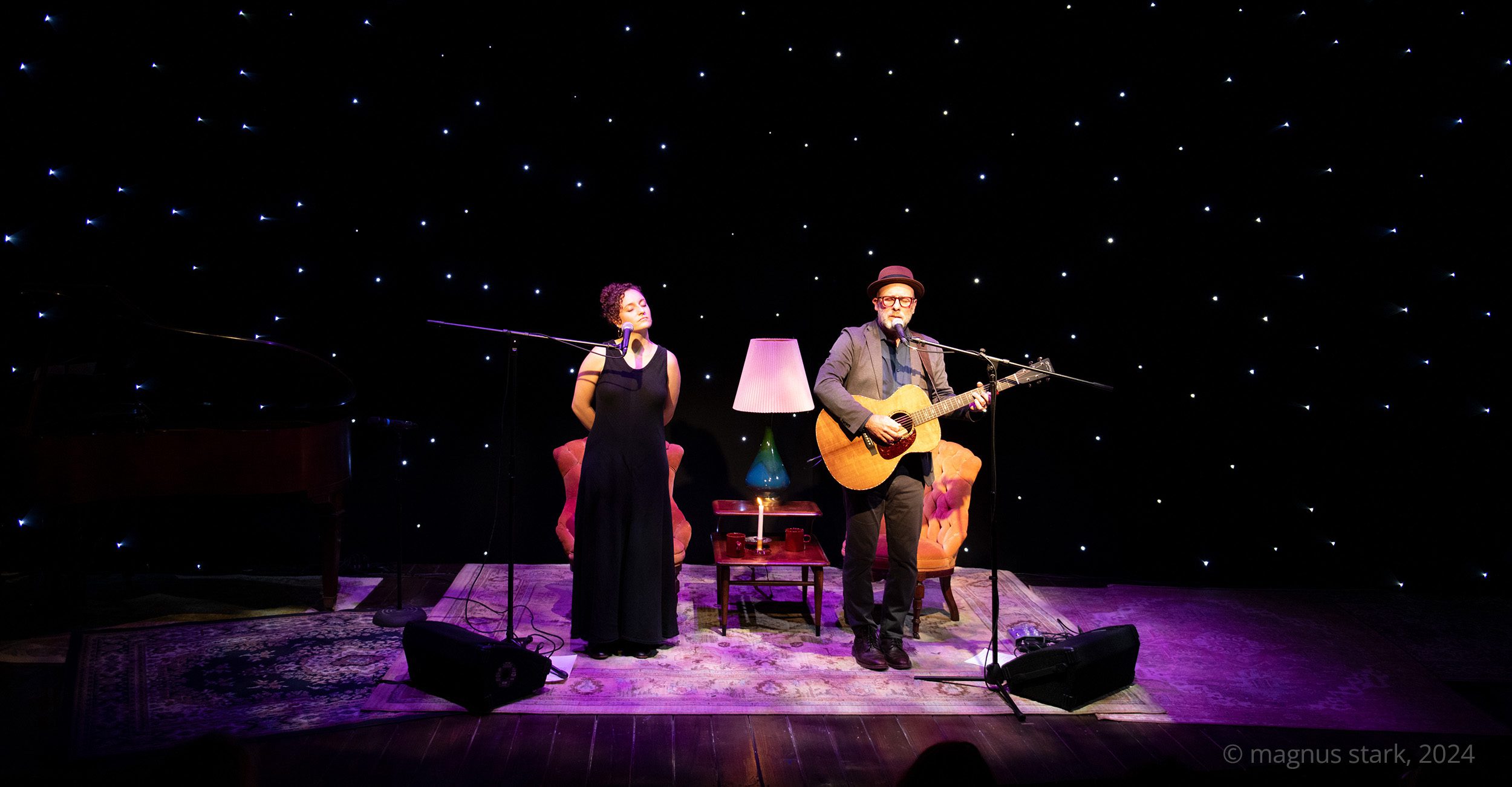
    The show features Frost School of Music alum Danielle Wertz & singer / songwriter Robbie Schaefer  taking turns singing rearrangements of beloved folk ballads like Cohen’s “Suzanne” and “Hallelujah”  and Mitchell’s “Both Sides Now” and “Big Yellow Taxi.” The show features sixteen songs and runs seventy-five minutes with no intermission.

    Joni Mitchell and Leonard Cohen are two of America’s most iconic songwriters. They were prolific poets and expert storytellers. Mitchell wrote 213 songs and Cohen 278 – what a catalog! But they are not the most upbeat musicians.

    They are subtle storytellers with beautiful unique voices.

    Schaefer and Wertz have lovely voices, although different from whom they are covering. Schaeffer does not emulate Cohen’s raspy  voice and Wertz, although classically trained, doesn’t capture Mitchell’s whimsical lightness.

    Both Sides Now is a peaceful homage, a feel-good, intimate performance honoring two American icons. It’s a carefree 75-minute stroll backwards down the memory line.

    It’s an intimate cabaret.

    Both Sides Now Deep Dive

    To go deeper, Both Sides Now somehow takes two low-key musicians and makes them even more mellow. The show is devoid of energy and enthusiasm – rife with personal anecdotes that don’t have enough to do with Mitchell or Leonard. Our narrators speak in an NPR-like monotone more akin to a sleep podcast than a musical performance.

    It would have been great to learn more about the folk legends or at least why our narrators chose the songs they chose. The set is very minimal, just a piano, and two seats, a coffee table with a candle. Some visuals would have been informative. Perhaps a simple screen with license free images or videos of Cohen and Mitchell in the public domain.

    Something visual to immerse the audience and educate (or remind) us about the subjects because our narrators don’t do it.

    Lighting Designer Tony Galaska did a beautiful, subtle, and low-key job on this production. Galaska gave us something but we needed more to be immersed.

    Both Sides Now feels like a low-budget placeholder for the theater’s season – a holiday transition before a much grander production with Appropriate.

    Give Artistic Director Bari Newport credit. She likely wanted to do something with music (just like last year with Old Wicked Songs), plus they are battling state wide budget cuts. Both Sides Now is probably perfect for GableStage. It’s stress-free, caters to their older audience and it’s low-budget. Plus, ticket sales appear very robust as many of the shows are almost sold out. So, bravo to them!

    It’s just that Both Sides Now could have been So Much More.

    And we can’t wait for Miami to see Appropriate – to that we say hallelujah!!

    Both Sides Now

    Both Sides Now is playing until January 5.

    For more info and tickets click here.

    This article was published with the support of the Miami-Dade County Department of Cultural Affairs and the Cultural Affairs Council, the Miami-Dade County Mayor and Board of County Commissioners.

  • The Eulogy in Me

    The Eulogy in Me

    There they all were…

    Everyone was there.

    My Mom’s whole side of the family, or what was left of it, in the Mount Nemo Jewish Memorial place or whatever. The venue for funeral services off of Bird Road at the Jewish cemetery.

    Pretty full room, I gotta say. And it was worse than I thought.

    I had pictured it for years now.

    This was the place we were my pop and I were thinking of doing the service for my mother’s passing.

    Her name was Sande Garcia…or Sandra Alva Atkins, at birth.

    But now, 15 years later, it’s for my Uncle Marty. I’ve known him my whole life. He was married to my mother’s only sibling. Her older sister, Adrienne.

    Aunt Aiddy died of cancer when I was in my late teens. It was a long, slow, extremely Cancery death.

    I was devastated, but didn’t know how to process it. I guess I never figured that part out, really. It was my first close loss since my grandmother, my “Abuelita” on my dad’s side, passed on my 10th birthday.`

    Aunt Aiddy died at home. Peacefully, of course.

    Nobody goes out swinging from Cancer.

    I remember they had me sit in a dark room with her, alone, just after she died.

    I guess it was to kind of a, say-goodbye-and-deal-with-death situation in an old-skool, and in retrospect, pretty unhealthy way.

    No discussion after or anything like that.

    There ya go. Death.

    Figure it out, kiddo.

    Marty then married his Colombian secretary at his insurance company not too long after the tragedy. She brought family in tow. Mother, son & daughter. The ladder soon to be mothers and fathers of their own not too many years later.

    Instant grandkids.

    We couldn’t blame Marty, really. He dealt lovingly with her battle with the disease. Right there by her side till the end.

    Old Marty “deserved to be happy,” Aunt Aiddy once said shortly before she gave up the ghost.

    I remember that the family really came together when my mom’s sister died. Or they seemed to, I guess. When I was growing up I always hated family functions, for either side of the family.

    “Family first, Eric. There’s nothing more important than your family.” My Cuban father would look deep into my eyes and tell me when I bitched about going to some holiday bullshit get together with all of them. He said it like he was really telling me something. Each time.

    But as my mother started wading deeper into the cold water of Early Onset Alzheimer’s, they started disappearing. Fast.

    It’s an uncomfortable disease to be around. People tend to avoid Alzheimer’s victims like they’re contagious. Like they are peering into their own mortality. Tethered by only their memories of what they did, where they went, and who they thought they were.

    If they peer too long, they see themselves. Alone forever in their own minds. No one wants to see that.

    My father, Victor Garcia, his mantra to me changed years later. It was usually prompted by me asking where the hell everyone went that could have helped just a little with our terrible, yet loving burden.

    We were drowning.

    Where was our “support system”, I think they call it these days?

    With his  Cuban accent, as he’d look into my eyes the same way he used to, “it’s just us now, Eric. It’s just us.”. Again, like he really meant it.

    But not as intense this time.

    He was tired. He was so fucking tired now.

    The service commences at Mount Nemo…

    The mood is stereotypically somber. The Rabbi sucks. Youngish, late 30’s maybe. Nice looking, tall, but semi-awkward. Ill prepared, he mentioned he forgot his notes and glasses.

    The guy was stringing clichés together with wholesale proverbs like a shitty necklace your kid would make at summer camp out of yarn and shiny, plastic beads. Just burning time up there while I wondered what he’s getting paid for this.

    Finally, Marty’s children spoke first. My older cousin, Michael, was first. Aunt Aiddy’s only son.

    I always liked him. He was a bit older than me and we never hung out much. But he turned into a good guy with a beautiful family and they live in Texas. They weren’t much help when the caregiver bullets were flying around me, but they had a good logistical excuse at least.

    My cousin, Jan, was next up. Aunt Aiddy’s only daughter. She was the reason I was there. She was the only reason.

    “Janela”, as my mother called her, is the only one who bothered to check on me when things were rough. She’d come visit my pop with her twin daughters sometimes when she could. Back when my pop was old and alone.

    It would make his goddamn day. I owed it to her. Out of respect for Jan, and therefore my folks.

    The rest of the grandkids on Marty’s second family’s side began to speak next. All early 20’s for the most part. They were up there in a big group, in support of each other. Taking turns on the microphone. They were all crying. Crying hard.

    My Uncle Marty was 91 when he died. He was blessed with not one, but two families that adored him. He made a ton of money with his company, and he died with his family from both sides around him. More than just about anyone could ask for.

    These fucking kids were crying like he was an 18 year old track star that got hit by a bus. Is this the worst they all had been though so far? What did they know about pain? What did they know about loss? What did they know about sacrificing yourself and 18 years of the backend of your youth with your life as a not-top priority?

    Fifteen years earlier, when we were planning Sande’s memorial, I had the most beautiful speech prepared. It was perfect. I pictured it in my head a thousand times. The whole thing.

    … I’d have on a brand new, black suit. Fresh haircut too. Super tight. I’d stand by my mourning father and greet everyone one by one at the door. We’d all mill around for a while. Drink bad coffee.

    Everyone would tell me they were sorry and maybe tell me a little story of sometime my Mom was being maximum Sande. Before she changed, of course. Before we really needed them.

    My father would speak first. There’s no way he makes it though his eulogy. No fucking way. I’d bet a year’s rent on it, easy. I’d make sure he gets to his seat ok, and then I’d glide on up…

    “I’d just like to ask everyone… Where were you?

    Where were you when we needed you? Where were you when SHE needed you?

    Now you come in here. All dressed up. Looking sad. Ready to eat the buffet. I have a handful of chairs up front for those who belong here.

    You know who you are.

    The rest of you, get the fuck out.

    You know who you are too.”

    Short and sweet.

    Stone faced and emotionless I would stand there as the confused Jews slowly made their way out.

    That was my plan and that was my fantasy.

    But I made the mistake of telling a family friend about my surprise attack eulogy.

    Once my father found out, all plans were cancelled.

    He didn’t need that shit.

    It wound up being just a simple get together at the house for the few that mattered, or for the most part at least.

    It was probably for the best.

    I know my mother would not have wanted that out of me. But, if you knew my mother, you would know that she ABSOLUTELY would have done just that if she were in my place.

    I am, and always will be, my mother’s son.

    But as I sat there at Marty’s memorial, suppressing my anger, my rage, wanting to literally scream out loud from the hypocrisy…. I thought about it.

    I really looked at everyone. These were not bad people. These were mostly good, kind people. Everyone just doing the best that they can.

    Maybe I was the bad guy.

    Maybe that was a reason I didn’t feel like I belonged. Like I was owed something that will never be acknowledged or repaid. Perhaps I had changed. Transformed by my own self-righteousness.

    Was it worth it for me to keep dragging two dead bodies around? My mother and my father. Weighing heavy with bitterness. Trudging forward for all these years, and all the rest to come. Never looking up.

    Watching the sweat drip down to the soil every day. Yes. Yes it was. It’s the least I could do. Literally.

    It was the very least of me.

    But it was mine.
  • Lincoln Road Hustle is a Must-See. No, Literally, Bro, a Must-See

    Lincoln Road Hustle is a Must-See. No, Literally, Bro, a Must-See

    Miami New Drama begins its season with Lincoln Road Hustle, a wonderfully entertaining immersive satire set along Lincoln Road. The play is co-written by documentary filmmaker Billy Corben and playwright Harley Elias. It features an all-star cast of local talent and is directed by Michel Hausmann.

    Lincoln Road Hustle is a rip-roaring immersive satire. It is the most Miami thing you will ever see, bro. You do not want to miss this experience.

    Highly original, it’s drenched in Miami history and lore. Written in a fast-paced, machine gun fervor of pun after pun, using metaphor, hyperbole and irony to rise into beautiful absurdity. Its satire at its best!

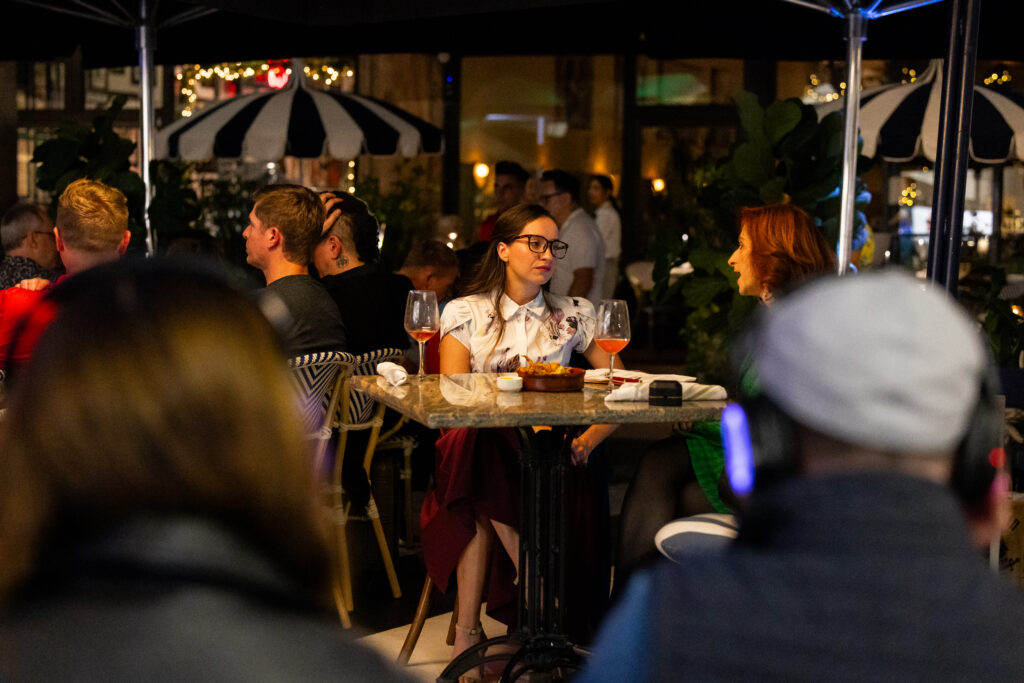
    Mr. De Leon is the most influential developer in Miami, and a direct descendant of Ponce himself, the father of the “Ponce” scheme. We (the audience) gather at a press conference to announce the arrival of the De Leon Casino, a high rise luxury casino and development project coming to the Beach (sound familiar Genting Group). The audience then breaks off into five groups to continue the immersive theatrical experience. Armed with color-coded silent disco headphones, we rotate from short play to short play, from location to location.

    Lincoln Road Hustle Spoiler Free Plot

    The red group:

    Scene 1: Inside an abandoned store front on Lincoln Road

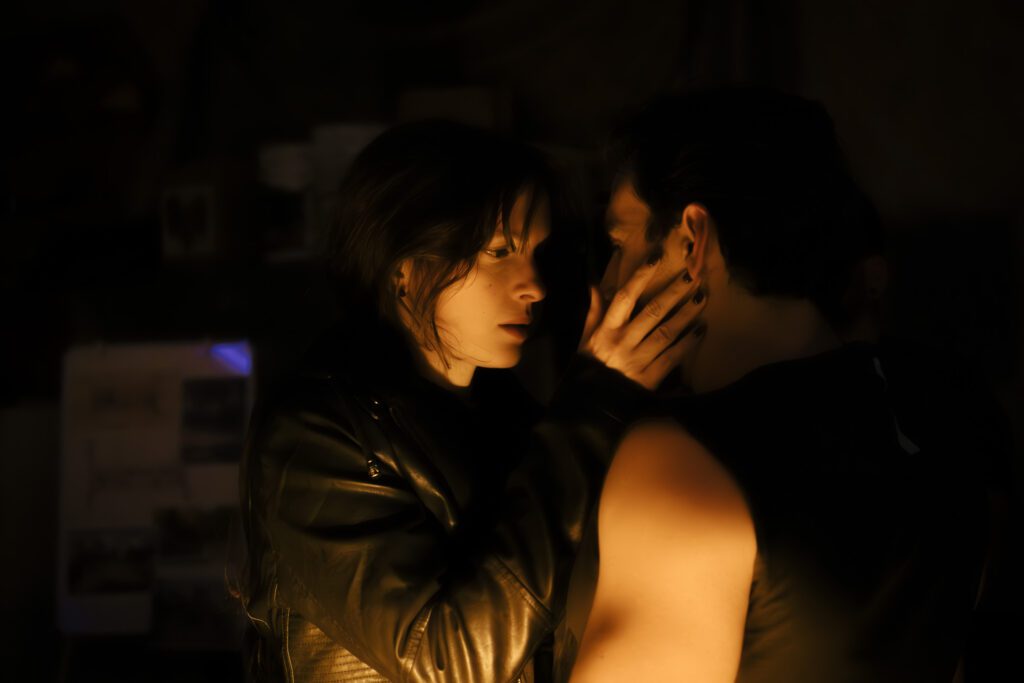
    The heist (a mysterious envelope, a midnight robbery, I went to FIU not MDC, Tequesta fossils, steamy chemistry, Bird Bowl and Flannigan’s)

    Portrayed by Kaelyn Gonzalez and Gabriel Salgado with humor, intensity, range and pretty good chemistry.

    Scene 2: Outside Issabella’s restaurant in the middle of Lincoln road

    The brunch (a ring, a prenup, Only Fans, Patty Sucia, Ropa Vieja, if I ring my bell, what lovely feet, rollerbladed)

    Portrayed by Irene Adjan and Kristie Millie Valdez with tension, humility, humor and hidden secrets. This scene has to be hard for the actors, including Kristian Bikic, because they are acting in an open restaurant. Miami New Drama only reserved one table for the run. If the restaurant is at capacity, as it surely will be, the actors must face a lot of potential distractions.

    Scene 3: Outside the Britto gallery by the fountains

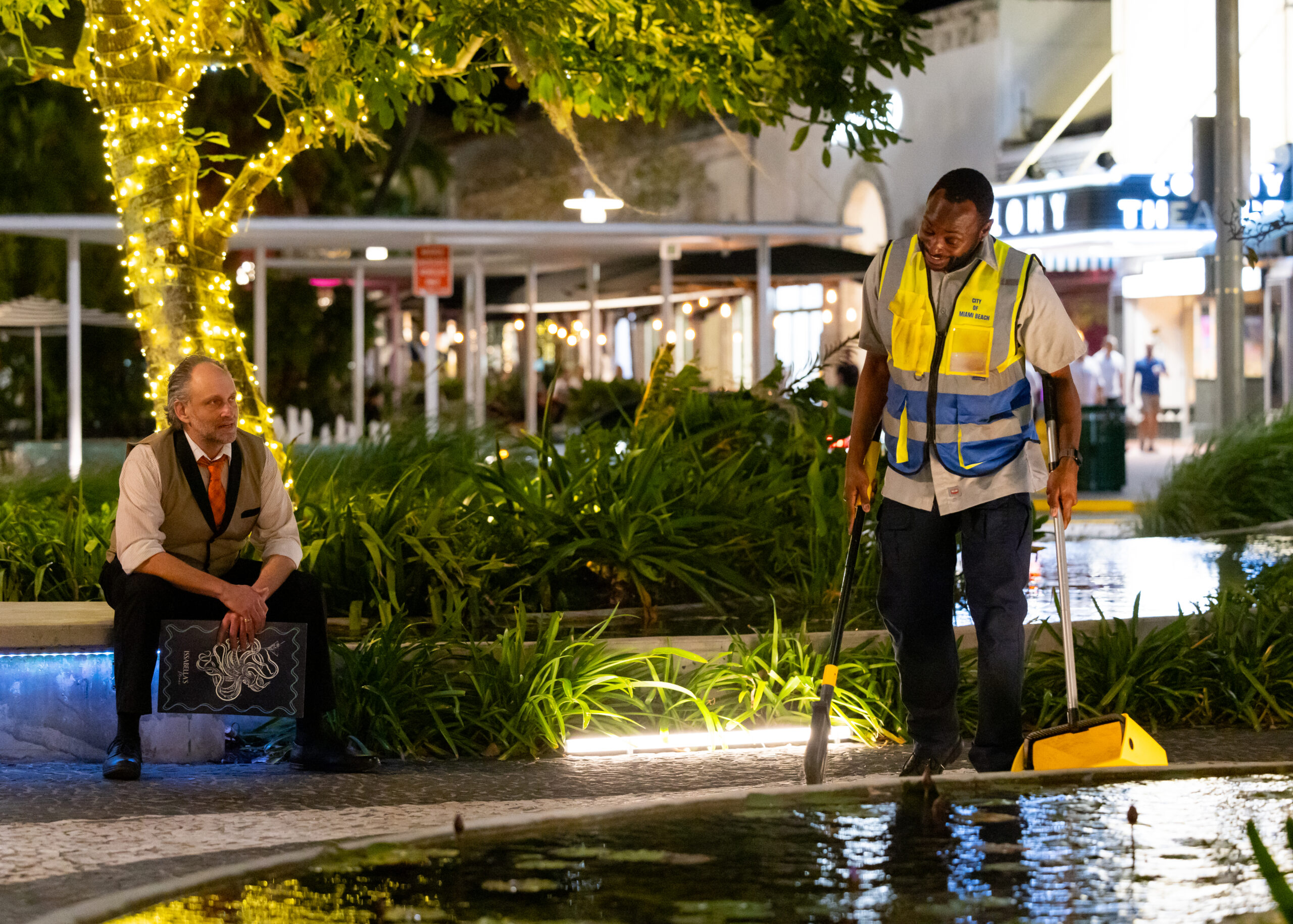
    The suckers (poop dance, lost and found, the broom, build it, Messi, a Gen X deejay, that’s what friends are for)

    Portrayed by Jevon Jacobs and Gregg Weiner with range, compassion, honesty and synergy. This scene was not really funny but it was so good as it explored adult male relationships, which is ironic because Weiner just finished a play at GableStage King James with the same themes. Their location is also set in a weird wind vortex on Lincoln Road that must be challenging at times for the actors.

    Almost Home Miami

    Scene 4: Inside a new fancy restaurant

    The influencer (croquetas, super literally mid, Venmo me, a food fight, Key Lime pie to die for)

    Portrayed by Carmen Peleaz and Marcella Paguaga with intensity, sweeping range, and pitch perfect comedic timing. This was my favorite scene because of the acting and the intensity of drama that occurs. Pelaez and Paguaga compliment each other well and it must be demanding, especially for Paguaga — you’ll know why when you see it.

    Scene 5: Outside an empty store near Alton Road

    Mr. De Leon (never be afraid to pitch, Brazilian butt lifts, the clinic, handcuffs, valium and the big reveal)

    Portrayed by Steve Anthony and Carlos Fabian with flair, drama, and amazing instincts.

    Scene 5:  Outside back at the beginning with the entire audience reunited

    The Groundbreaking (The goon, a dick weed, hi, dad, Columbus, Ohio, a resurrection, the 40 year old tooth, the developers always win)

    Portrayed by the ensemble with a dab of chaos and calamity.

    Lincoln Road Hustle Is Brilliant

    This play works on so many levels.  It’s brilliance isn’t only the excellent writing, superb acting and directing, layered and meta plot, but it’s the production.

    We are in the middle of Lincoln Road as the city walks by looking at us as if we were mannequins in a storefront window.

    This is different than 7 Deadly Sins during COVID when the boulevard was dead. Different than Museum Plays, which was an intimate night at the museum.

    This is risky out-in-the-wild theater and it works. Give immense credit to Michel Hausmann for taking such wonderful chances. And the cast. Wow. This production is filled with familiar faces, a who’s-who of local talent, a deep roster of the best actors in Miami. All performances were rich and perfectly balanced, just pitch perfect. But most of all this play works because of the writing.

    Billy Corben is an American treasure as a filmmaker and one of the funniest most informed people you’ll ever meet. His fingerprints are all over this play. But it is playwright Harley Elias who feels like the engineer of this meta satirical universe. This production feels like a novel and credit Corben and Elias. It’s wonderful details, like the podcast.

    As we are escorted between scenes, if you choose to keep your headphones on, there is a podcast featuring Billy Corben interviewing a real archeologist about preserving Miami’s history over development. There’s another scene in the podcast where Billy is sparring with De Leon the developer. It’s hilarious. And the commercials during the podcast.

    It’s all brilliant and layered like a novel.

    They created an actual website to highlight the pending casino project. They created another website shining a light on De Leon’s crimes.

    This level of immersion and interactive theater is world class and fun, just like the city we call home.

    Miami. Your-ami. Our-ami.

    Lincoln Road Hustle

    Lincoln Road Hustle is playing until February 15th.

    For more info and tickets click here.

    This article was published in part with the support of the Miami-Dade County Department of Cultural Affairs and the Cultural Affairs Council, the Miami-Dade County Mayor and Board of County Commissioners.


    Photo by Furiosa Productions


    Photo by Morgan Sophia


    by Morgan Sophia


  • Bob’s News and Books in Broward: Haven for the Working-Class Intellectual

    Bob’s News and Books in Broward: Haven for the Working-Class Intellectual

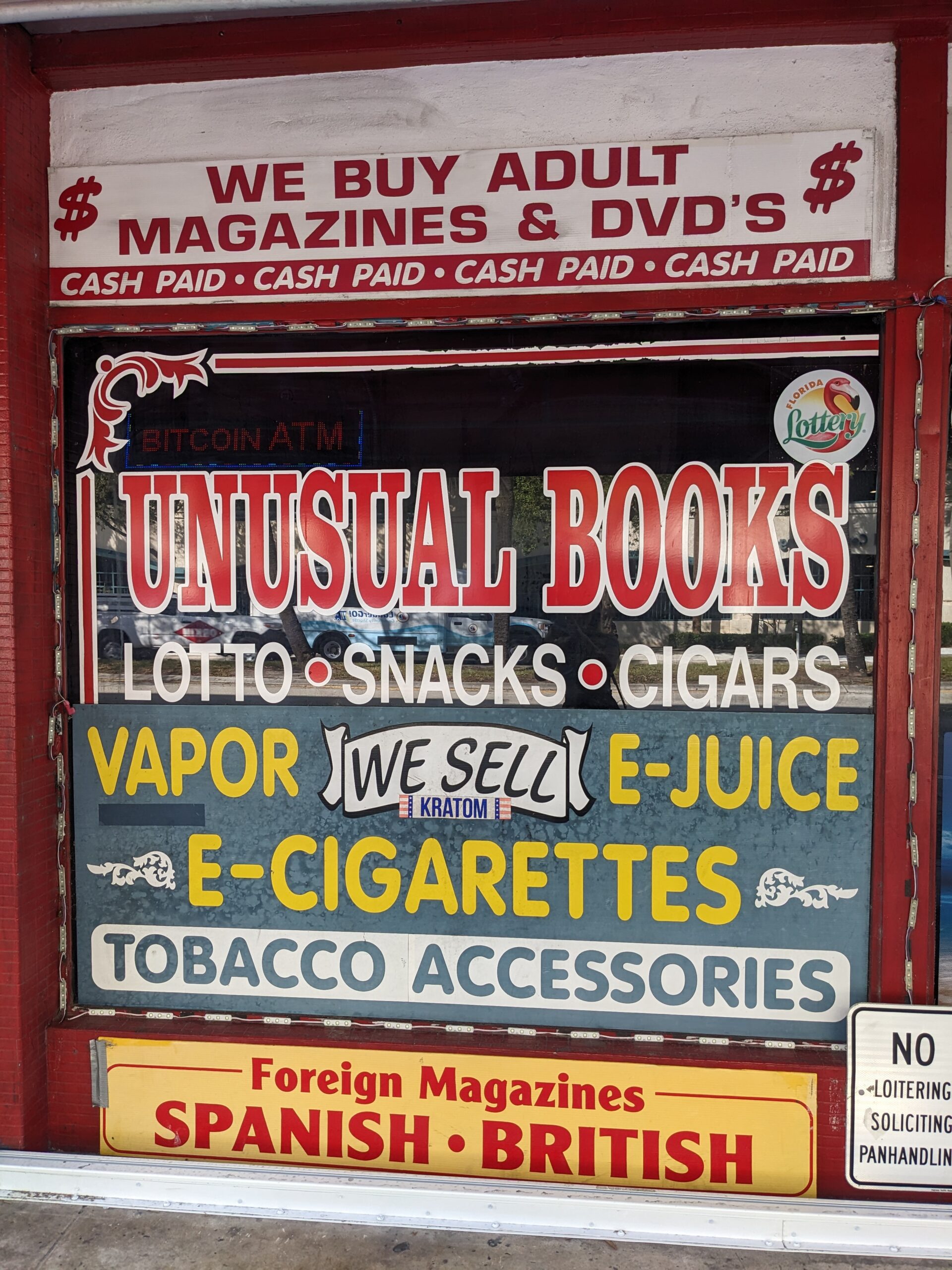
    Nestled between the courthouse, bail bond agencies, and endless array of sleazy criminal defense firms is Broward County’s best bookstore: Bob’s News and Books.

    Undeniably an “indie” bookstore, that adjective is nevertheless far too precious and fails to capture the air of subversion that the intellectually inclined restaurant worker would delight in: detailed guides on esoteric BDSM practices are displayed near copies of PIHKAL and TIHKAL, the Bhagavad Gita, and a healthy selection of JFK assassination conspiracy works. To quench your thirst for knowledge, you can crack open one of their finest male potency boosting energy drinks or a refreshing Natural Light. Truck stop Viagra is also in no short supply, but neither are texts by Freud, Jung, or Adler.

    These are simply the material trappings of Bob’s. The real soul of the place is in its center row of “Banned Books,” literature which has all been banned somewhere at some point in time, a company that includes Lady Chatterley’s Lover, Tropic of Cancer, The Satanic Verses, Last Exit to Brooklyn, and Justine, among others.

    The curation and environs are an important reminder that the fight for our first amendment rights doesn’t always look like democracy activists educated at elite schools or staid, soft-spoken librarians but most often has the lowbrow gloss of “The People vs. Larry Flynt.”

    Bob’s News and Books

    Banned literature in Florida remains a hot topic, which Bob’s revels in, as each newly controverted piece of literature earns a place on its shelf there. For some works of literature, prizes such as the National Book Award, the Man Booker Prize, or the PEN are the highest possible honors. However, to earn a place on the center row shelves at Bob’s, one must have offended the sensibilities of the masses.

    The Streisand Effect of banning literature has done more to increase literacy and education amongst the typically apathetic than any other campaign ever has. If you want average people to really get interested in reading any book, the best thing to do is ban it.

    As a true indie bookstore in the best tradition, however, Bob’s has long been a friend to the working-class intellectual writer, and they sell many local writer’s works. Unlike most independent bookshops, Bob’s is a proud throwback to the era of the 1990s Times Square newsstand, with a back room to boot, where pornography and gore pull in a curious passerby, who may just walk away with a copy of James Joyce’s Ulysses.

    In a time when the concerns of real life, which are often unsightly, are cleaned up by online algorithms which scan for keywords rather than content and context, Bob’s remains a pillar of press freedom and an exemplar of what intellectual life looks like in local Broward County.

  • Time for Better Days

    Time for Better Days

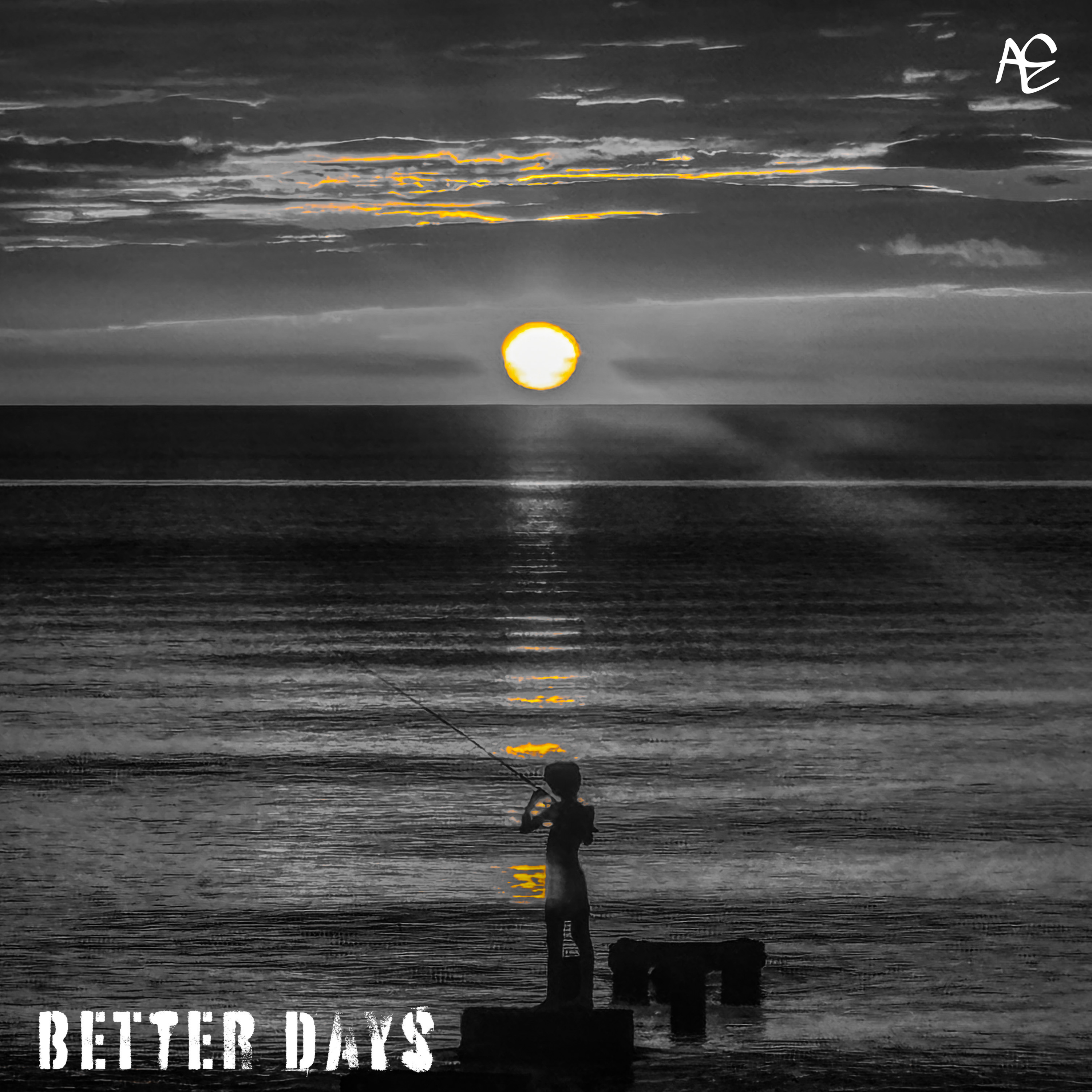
    There’s a single incident that motivates a lot of my new album, Better Days.

    Senior year at Miami Killian I got into my first “serious” (for high school) relationship with a girl named Vero. Vero had a friend named Karen and I had a friend named Justin and when Justin and Karen met one day and started dating, we thought this was the most amazing goddamn thing on the planet. And it was fun for a couple of months, until the day Justin and Karen were painting his room and Justin’s cousin Jonathan came over and beat them both to death with a baseball bat.

    We were there that day, Vero and I, just after the murders took place. Standing not inside the house but out front, knocking on the door and wondering why our friends wouldn’t open up even though twenty minutes ago they were the ones who invited us over for spaghetti. We wouldn’t find out about their deaths until later when the news broke on TV, after we’d already left Justin’s house pissed that they’d bailed on us. It would be another couple months before we found out Justin’s cousin was on the other side of the door that afternoon while we were knocking, standing amidst the carnage with the bat in his hands, waiting.

    I still sometimes have this recurring nightmare of knocking at that front door, only in the dream the door opens and before I can react the bat hits me right in the face.

    This all happened almost twenty-five years ago, which is long enough now that I feel obligated to say the phrase “a different time.” The memories of back then are dream-like, the edges of the pictures frayed, specific details buried beneath years of layered synapses. I’m guessing if you were in or around Miami at the time you might remember the story, but I wouldn’t fault you if you didn’t.

    Crazy shit’s always going down in Dade County, right? Dalé.

    Growing up in Miami is odd because much of what this city is and what it represents is not meant for children. Mine’s was not a unique experience; talk to most people who grew up down here and you’ll hear any number of crazy stories that would lead to pearl-clutching amongst the residents of smaller, less crowded towns. I used this rationalization back then to force myself to move on from the murders, vowing not to make this the defining moment in my life. I’d just started as a freshman at FIU a few months before, on a computer science scholarship. I was eighteen, whole life ahead of me.

    By the following summer I’d lost my scholarship and landed on academic probation after two semesters of failing all but one class (Calculus, shit you not).

    Following a tense meeting between myself, my parents and my advisor, I wasn’t too keen on going back to school. In fact, I was perfectly fine spending afternoons serving tables and nights getting drunk with my coworkers before inevitably passing out somewhere in a dreamless stupor. So that’s exactly what I did, for over a year.

    The next summer I had a sit-down at a Barnes and Noble with a friend who was worried about me and she suggested I try writing about what was going on in my head. Get the thoughts out so I could maybe see them clearer, organize them better. So I did. Within a couple of months I was enrolled at Miami Dade College (it was still Miami Dade Community College back then) as a Journalism major, and within two years I had my associate’s degree and an acceptance letter to Florida State University. In my personal statement for my application I mentioned what had happened to Justin and Karen, a sheepish justification for all those F’s on my freshman transcript.

    At FSU, I majored in English with a Creative Writing track which required a few writing workshops. In one, I wrote a first-person essay about Justin and Karen’s murders, beginning in the hours leading up to their deaths and ending after my testimony at their killer’s trial in which I was asked to identify the victims in pictures of their dead bodies. It was the first time I’d really sat down and examined what happened to them in any detail, and the draft I submitted for workshop was way too long and way too self-involved. I vividly remember how I felt coming in to class the day my story was up for critique, the butt-clenching fear looking around the room at these literary wolves waiting to technically rip the essay apart the way they had already done to a few of our classmates (senior- and graduate-level writing workshops are brutal).

    Instead, I received (along with uncomfortable and discomforting stares) some genuinely good advice on how to make the story clearer and easier to read.

    Back at my laptop, I used the notes to rewrite the essay and—at the urging of my professor—submitted it for a department writing competition in which I took first place. The next semester I submitted the essay as part of my graduate school application, which is how I ended up with a master’s degree and a teaching career.

    And for a lot of those years, that shit ate at me.

    The idea that I had let happen exactly what I’d told myself I would not let happen. My entire career hinging on me writing about my friends’ murders. Death becoming the catalyst of my life.

    I don’t remember when I first heard the term “imposter syndrome,” but I remember immediately identifying with it, like that meme of DiCaprio from Once Upon a Time in Hollywood sitting on a couch holding a cigarette and a beer, pointing wide-eyed at the TV. Felt it in and after grad school, felt it when I landed a Managing Editor gig in Manhattan (sounds more glamorous than it was), felt it when I got the teaching position I currently hold at my alma mater, and felt it most recently when I published my first novel, Riders in Disguise (a Jitney publication).

    The only thing that’s ever quieted these internal objections is writing more. More articles, more short stories, more novels. And not just writing, no. Anything that took both time and creative energy. Spent a whole summer making an ad for the unpublished novel I wrote as my graduate thesis, an ad that at one point featured me in my underwear pretending to be drunk on my bedroom floor (this video has mysteriously vanished). Bought my first guitar in graduate school and am now fairly competent (people who’ve heard me play know “competent” is doing a lot of work there). Tried to start a blogging series, three articles a week, made it a couple of months before that shit got old. Spent a decade working on Riders in Disguise, part of a planned trilogy. Got on GarageBand and made some beats, which led to some lyrics, which turned into Autonomous Entity and a couple of albums, the newest of which is why I’m writing this essay (Better Days, December 13th). All while adhering to this addictive routine that always required a project, a creative process, an external purpose. A mental back scratcher, the sharper the prongs the better. Or a factory, cranking out products with the primary goal of just keeping those machines running.

    The mechanisms. For coping.

    As many would expect—especially when teenagers are involved—Justin and Karen’s murders were hard on a lot of people, primarily their moms and dads, aunts and uncles, siblings and cousins. However, in the sense of the general population, it’s hard to connect to even the most heinous deaths or the people caught in the ripple effects when you don’t personally know these people. Even harder to connect to the comparatively—for lack of a better term—mundane clashes with mortality.

    An uncle dead from prostate cancer when I was twelve.

    A friend on the way home from school drowning in a canal at sixteen.

    A cousin dead from a rare allergic reaction in his early thirties, the same rare allergic reaction that would kill a friend a couple years later.

    My little sister, dead from Covid at thirty-two.

    Words on a page, I know.

    As an author and Creative Writing professor, I get this. The details of such matters are evergreen, in the way all things mortality-related stay interesting. But once those details are known and the shock value runs its course, nobody wants to stick around for the mental collapses, the lost grips on reality, the disillusionment, the existential dread, the painful and arduous treks through the barren maze that is Grief. Wading through that stuff takes time—that most precious of commodities—and a whole lot of it. And the only way to interest a stranger in something that takes that much time is to present it from a uniquely thoughtful perspective.

    Which takes time.

    Better Days is my perspective on time, past and present, good and bad.

    It’s about how time eventually surrounds grief, encapsulating it in a bubble that grows thicker and thicker each day, until you can barely see the scars anymore. It’s for the 40-year-old hip hop enthusiasts who maybe still got some shit from the past they haven’t completely dealt with, and for those who have dealt with their shit but in the process may have forgotten what things were like before. It’s for people who wax nostalgic about life before the internet even though they’ve been in this current state of society for so long the old world seems like a fantasy.

    It’s for the people raised in a crazy city who also didn’t realize how crazy their city was until they met people from much less crazy cities.

    Time does heal all, but the bigger the wound the longer that healing process takes. Half of us can’t even sit through an entire TikTok video, much less a recovery process that’ll take years with no set expiration date.

    That shit? You gotta handle that on your own, bruh.

    Unless…do it got a hook?

  • Iguanas, Leeches and Bloodlines –  A True Story

    Iguanas, Leeches and Bloodlines – A True Story

    Imagine it’s 1995 in Miami. The sun is setting, casting that beautiful, hazy orange glow over everything, the kind that makes the city look like it’s on fire. I’m driving west down NW 36th Street, heading into the heart of Miami’s neighborhoods, the streets a patchwork of sounds, smells, and people congregating at the ventanitas that serve Cuban coffee shots. As I turn south on Northwest 27th Avenue, I merge onto the bridge, and that’s when I see him.


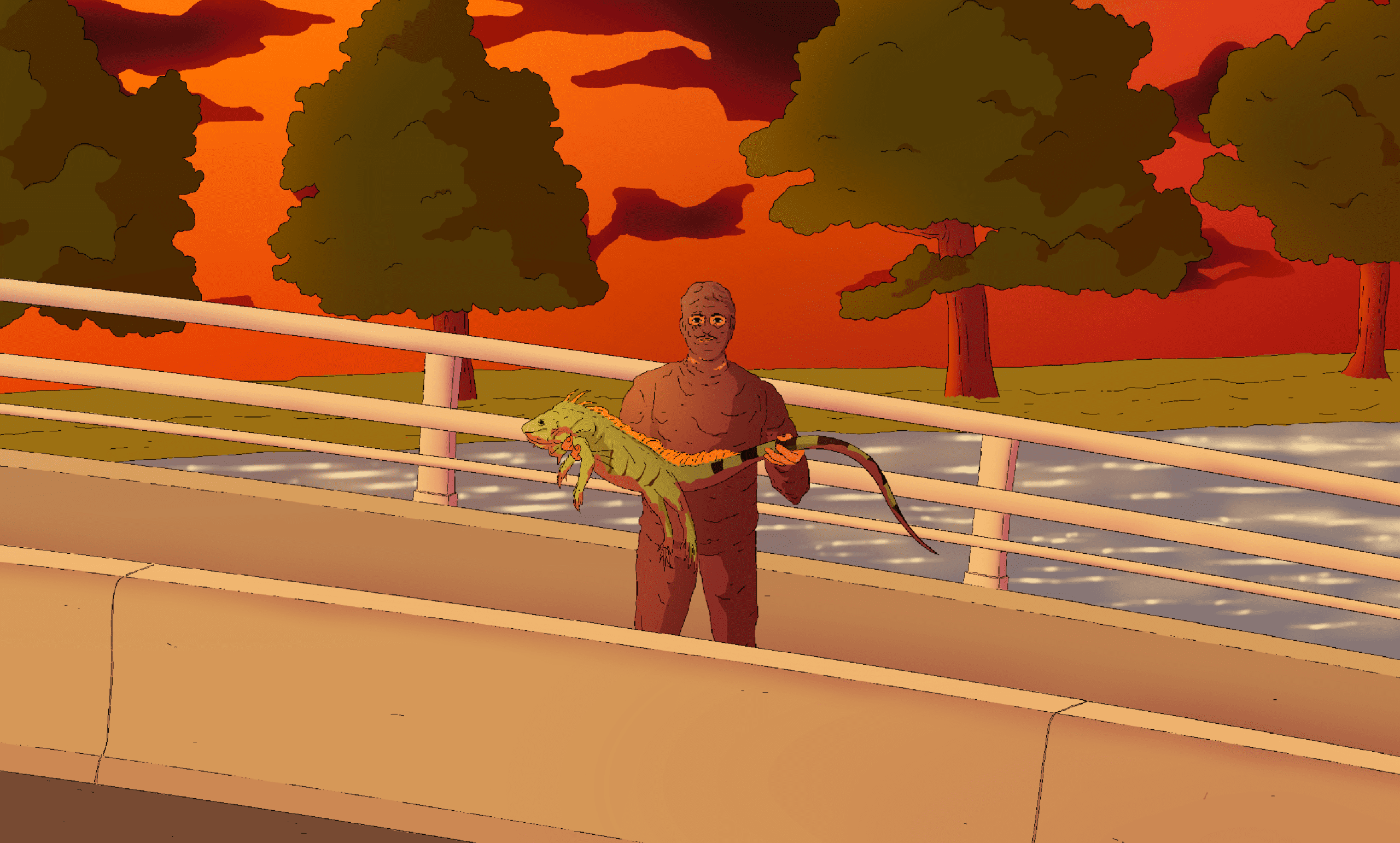
    At first, it’s hard to make sense of what I’m looking at. A man stands on the right side of the road, entirely covered in mud, clutching something massive in his arms. I slow down, as does everyone else, and through my passenger window, I get a good look. The man—mud dripping from his face, caked to his boxers—is holding a giant iguana in an embrace. It’s a wild, surreal sight, and I murmur to myself, “Oh, shit… That looks like my fucking uncle.”


    Yep, you heard right—my uncle. Untamed, raw, a force of nature in his own right. Growing up, I’d always thought I was different from him, like I didn’t carry that same streak of wildness. But maybe, and perhaps, deep, deep… deep down, a part of that untamed spirit lived in me too.


    I kept on driving, that image stuck in my mind. Later that day, he told me the whole story over a pack of Camel cigarettes.


    It all started when he was crossing the Miami River with his buddy, Beto. They were cruising along, not a care in the world, when my uncle spotted it—an enormous and delicious iguana sunbathing on the top of a tree branch that hung over the water, a prize if there ever was one. Without a second thought, he yelled for Beto to pull over, and they quietly parked by a park. My uncle, always one to follow his instincts, walked nonchalantly around under the bridge, stripped off his boxers and waded into the mud-slicked river, determined to catch that iguana. What he hadn’t counted on was how much of the “water” was actually thick, sticky mud.


    When he was in position, he signaled to Beto, motioning for him to scare the iguana out of the tree. Beto did as told, and in a flash, the creature leapt from the branch with jaws wide, sharp white teeth flashing, diving straight at my uncle’s head. My uncle caught it mid-air, but the iguana was so big and powerful that it pulled him under, sinking him deeper into the muck as they wrestled, man and beast locked in a muddy struggle.


    The commotion must have looked insane to anyone nearby. Sure enough, a neighbor from a retirement home had seen the whole scene and called the cops. By the time my uncle stumbled out of the muck, victorious, the police were waiting for him.


    He stood there, mud-caked, leeches clinging to his skin, and the officers, unsure how to react, finally asked what he planned to do with the iguana.


    “I’m going to eat it,” my uncle replied, dead serious.


    The officers exchanged glances. One of them commented that he’d heard iguana meat was a delicacy in some parts, but they urged my uncle to let the creature go, explaining that the locals had a certain fondness for the iguanas. Reluctantly, he released it, watching as it slipped back into the water, like a small, scaly alligator.


    “Thank you sir, you can go home now.” One of the officers said. 


    The officers, still standing by the bridge, watch my uncle as he begins to move away, but their attention is drawn to something that wasn’t there before. A subtle glint of red. It’s small at first, just a trickle, but it’s enough for them to notice.


    “Sir, there’s blood on your body,” one of the officers calls out, his tone more urgent now. “There’s a little bit of blood coming out of you. What’s going on?”


    Before my uncle can even respond, his friend Beto, who has been standing off to the side watching the scene unfold, suddenly points at my uncle’s back. “Hey, Salvador! You have leeches on your body!”


    Leeches? My uncle freezes mid-step, his brow furrowing as the realization hits him. He looks down at his arms, at his legs, at his back—and that’s when he sees them. These enormous, thick leeches, clinging to his body like silent, insidious parasites. They’re long—three to four inches at least—and their bodies are bloated, swollen with the blood they’ve been sucking out of him. They’re everywhere. His arms, his sides, his legs. 


    The officers step back a bit, their faces twisting in both shock and discomfort. “You’ve got to get those off,” one of them says, his voice now full of concern. “You’re going to get sick from that. You need to wash yourself immediately before you get an infection.”


    But my uncle doesn’t seem phased. He just shrugs, his usual nonchalance creeping back into his demeanor. “Ah, don’t worry about it,” he says, brushing it off like it’s no big deal. “This is nothing.”


    He reaches down and starts rubbing his hands over the leeches, slowly but steadily pulling them off one by one, squeezing them between his fingers and throwing them to the side. The mud and blood mix together, creating a grotesque smear on his hands. He walks over to a nearby coconut tree, and with a smooth motion, begins to rub his back against the bark, trying to scrape the remaining leeches off.


    The sight is unreal. The blood and mud smear against the rough tree, dripping down onto the ground in streaks. The officers, standing nearby, can only watch in stunned silence as my uncle goes about his business as if he’s done this a hundred times before. His back is raw against the tree as he scrubs the last of the leeches off, and when he straightens up, there’s blood dripping from the raw areas on his skin where the leeches had been.


    The smell of mud, blood, and sweat hangs heavy in the air, and for a moment, the scene feels surreal. It’s one of those strange, uncomfortable moments in life that doesn’t quite fit into reality. There’s something primal about it, something that feels like it belongs in another world.


    Finally, my uncle stands up, wiping his hands on his pants, looking at the officers. “See? No big deal,” he says, with a grin that’s almost too casual for someone who just had leeches feeding on him in a muddy river. The officers exchange a glance, unsure of how to respond to the bizarre turn of events.


    “Alright, sir,” the officer says slowly, still processing what he’s just witnessed. “Just… be careful. Go wash up. That could’ve been dangerous.”


    My uncle just nods, a flicker of amusement in his eyes. “I’ll be fine,” he mutters, turning away. He starts walking back toward his car, the mud still drying on his body, and Beto follows behind him, shaking his head in disbelief.


    For the officers, it’s just another bizarre day in Miami, but for my uncle, it’s just another story to add to the collection. A man, a giant iguana, some leeches, and a whole lot of mud—just another thing he lived and experienced. 


    See, it’s that wild energy, that instinct to survive on his own terms, was woven into the fabric of who he was. 

    These days, each time I drive down 27th Avenue and over that bridge, I can’t help but wonder—how much of him is in me? Am I as untamed as my uncle Salvador? Is that same Crocodile Dundee spirit hidden somewhere in me, waiting for the right moment or iguana to surface? I don’t know yet. I don’t know. To me, my uncle Salvador is the living difference, between boys and men. I don’t care what anybody says. 

    illustration by Nila Duranza
  • Miami Space Rock Heavies SUMO Set to Release Third Album

    Miami Space Rock Heavies SUMO Set to Release Third Album

    The vacuum of space is an almost perfect void, where sound cannot travel due to the lack of a medium. In this silent expanse, temperatures vary dramatically depending on exposure to sunlight or shadow; objects in direct sunlight can reach scorching temperatures over 250°F, while those in shadow can plummet to frigid lows near -450°F. This extreme environment, characterized by its silence and thermal extremes, challenges both human exploration and technology.

    But it also inspires imagination.

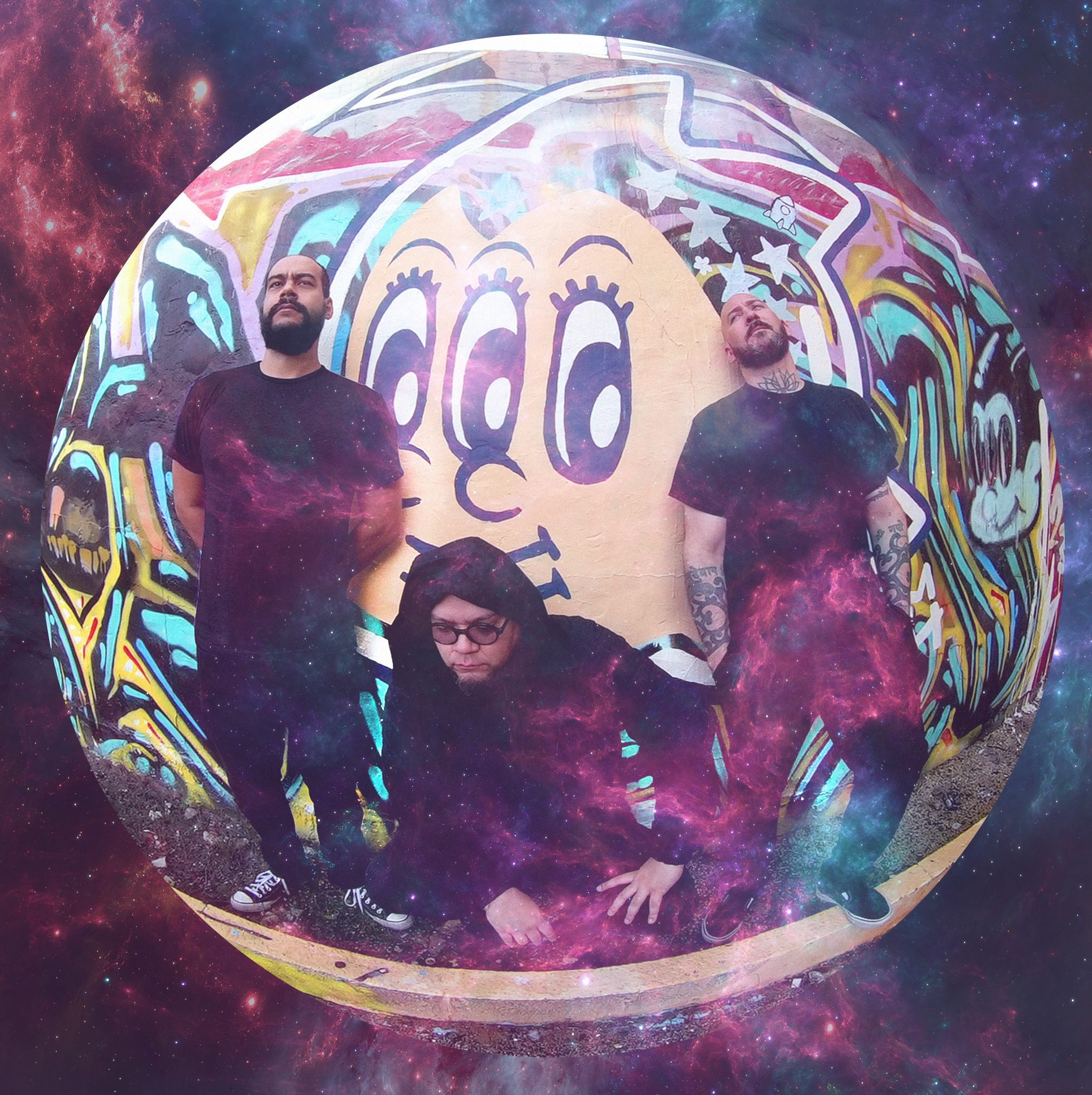
    It’s no mystery that mostly instrumental Miami band SUMO identifies with the most ethereal subgenres of rock n’ roll: post-rock, space Rock, shoegaze, and experimental. Helmed on guitar by Chris Salazar and bassist Amado Ventura, the lineup now counts on Hector Mojena behind the drums.

    Years ago, I referred to the band as a “sum of its parts forever locked in the turbulent cycle of creation and destruction,” a description I continue to stand behind. I continued the description by juxtaposing opposite forces, forces that all makeup the larger canon of science fiction and man’s relationship to space exploration. I can only think of 90’s darlings Failure having a stronger connection to all that lies beyond the stars.

    This time around, I’ll add that in my opinion, they have now surpassed former locals, The Axe & The Oak, as South Florida’s foremost eternal tinkerers. And I say this with the utmost respect for their process and methodology – a friendly jab at the length of time between releases and the few opportunities to see them live during the year. But I guess that if I must take the spirit of outer space into consideration, we haven’t exactly learned how to fold space and hyper jump between stars yet. So patience will be the key.

    SUMO New Album

     SUMO’s upcoming third album, the aptly titled III, drops December 13th and was recorded by Jonathan Nuñez at Sound Artillery Studios. Before we discuss the music, I’d like to point out the creative choices behind the cover’s design. In other releases the band has adhered to style. For the ATMOS EPs, they’ve maintained name placement with backgrounds showing planetary approximation. For their first two albums, they’ve gone with a 60’s vibe that incorporates the labyrinthine look of their logo. For III, I’m getting a weird cross between the Cube movie series, LeMarchand Boxes, and Marvel’s tesseract that can somehow also be a postcard from a beachside town – all that simply from choosing a cursive font for their name. 

    Maybe I’m reading too much into that. I probably am.

    The album takes listeners through an unrelenting sonic odyssey opening with “Alyssa” and then weaving a textured landscape of tonal odes to constellations and galaxies. The journey intensifies as it winds toward the haunting lead single, “Shadow of Antiope,” a track that effortlessly ebbs between feelings of nostalgia and pounding rhythms that rumble with unrestrained heaviness. Easy standouts “Eta Carinae” and “Cygnus” tie it all together after the appropriate disruptions of their micro-homages to the Search for extraterrestrial intelligence (SETI) with “SETI 3” and “SETI 4.”

    Founded in 2013, SUMO has independently released two full-length albums (ONE in 2018 and TWO in 2021) and three ambient singles (the ATMOS series) on their own label, Rikishi Records. All are available on sumomiami.bandcamp.com.

  • Weird Music Night Is Tonight at Satellite Art Show

    Weird Music Night Is Tonight at Satellite Art Show

    Who is John O’Donnell and why go check out Weird Music Night happening at Satellite Art Show?

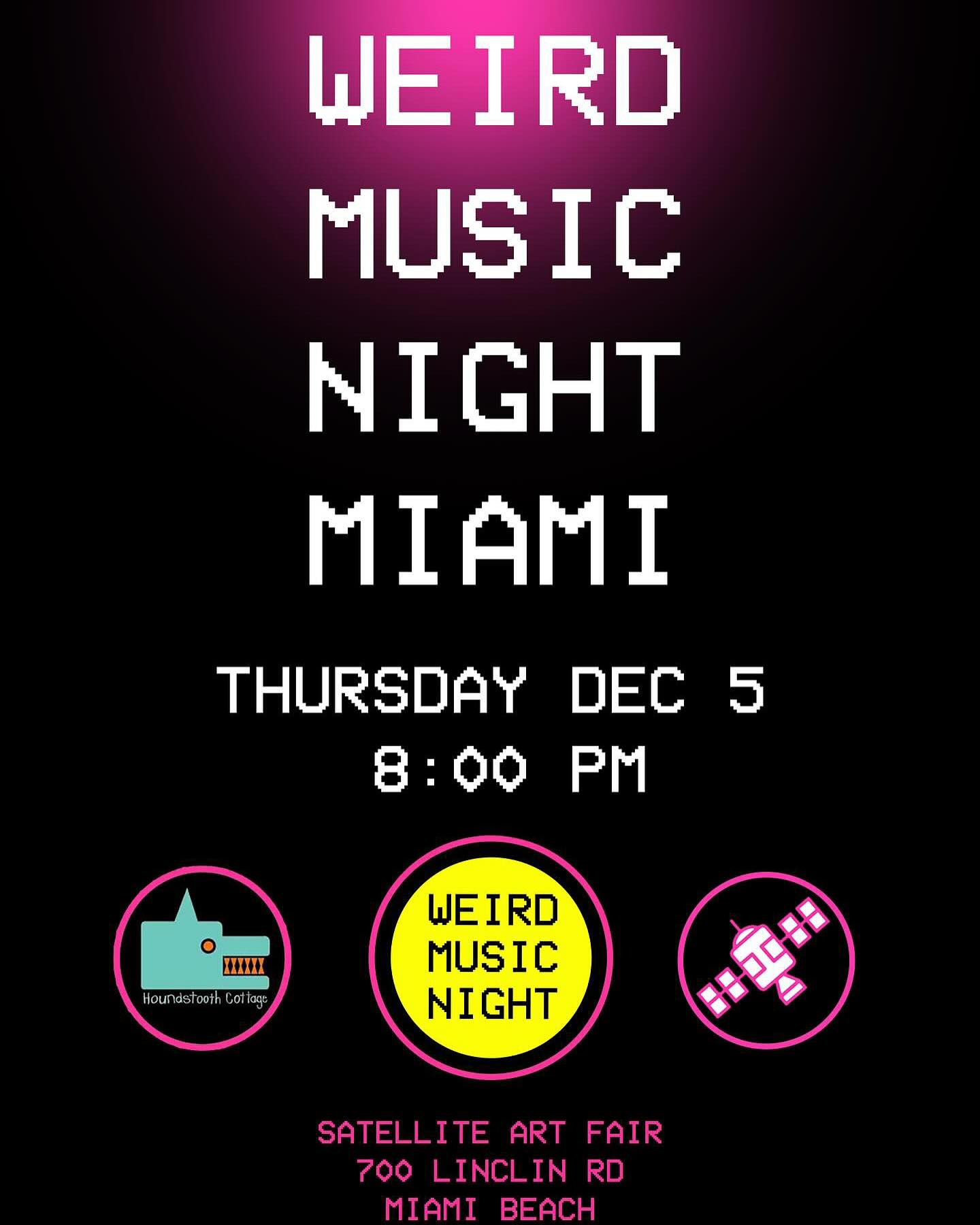
    When you think of Satellite Art Show you find a group of creatives that seem to be from a  fairytale of fantastic creatures. People spiraling from all places set the mood for a breathtaking landscape to experience art.  John O’Donnell who is curating Miami’s Weird Music Night happening at Satellite Art Show at 700 Lincoln Road tonight, Thursday, December 5, hopped on to The Jitney as we got to know a little about his own art practice that stretches you to travel into a continuum that is boundless.

    What made you start  Weird Music Night?

    John O’Donnell: “Weird Music Night” is a monthly event that started at Ely Center of Contemporary Art. The focus is on sound based experiments and performance and puppetry that is activated by sound. Most people in attendance are performers/musicians/puppeteers.

    The concept is inspired by the diverse punk scenes of the 1980’s and the mythology surrounding Japanese noise music.

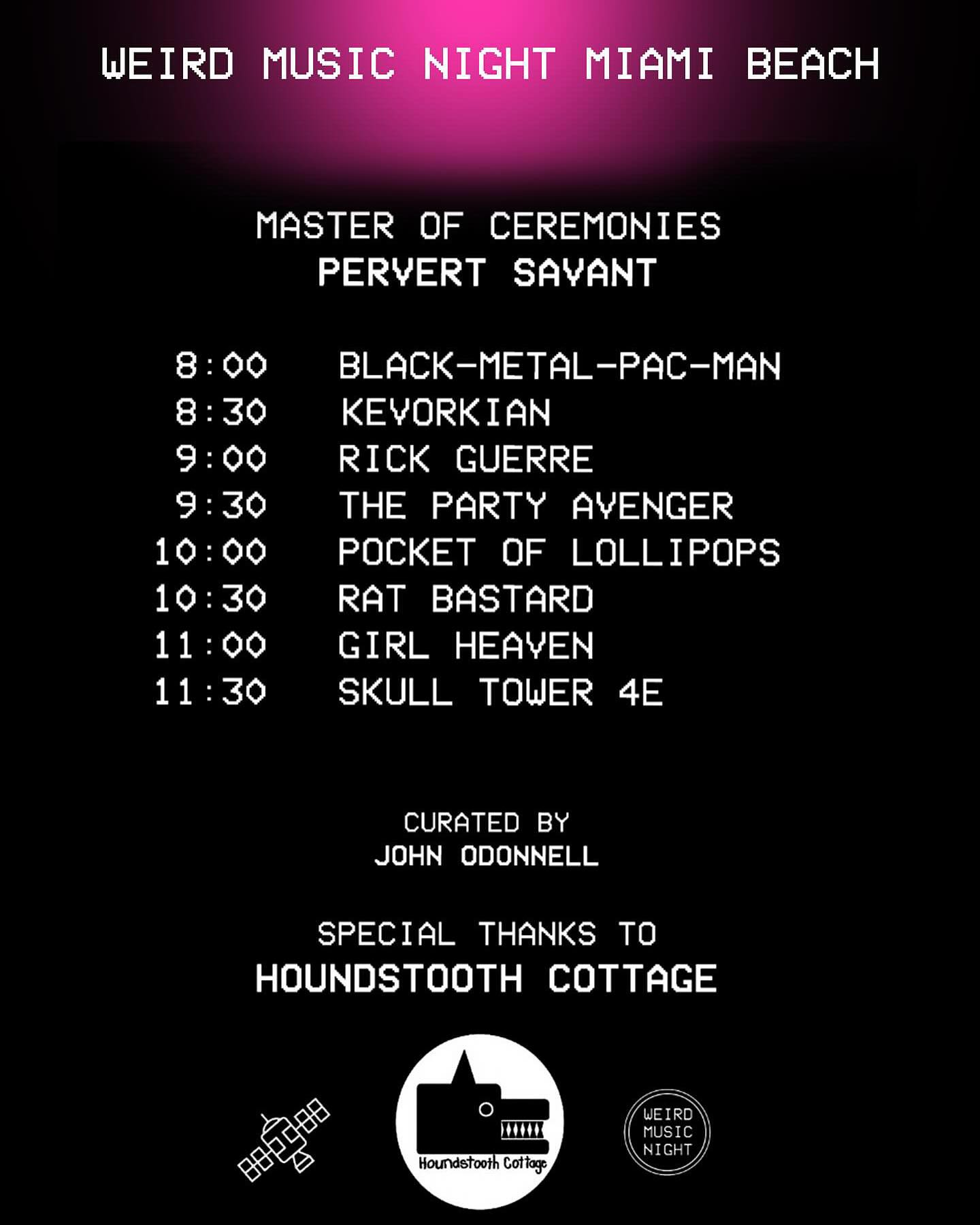
    We know you have gathered some Miami locals to collaborate on your “Weird Music Night” with other members from across the globe. I wanted to share with our audience some facts about your lineup and the event starts promptly at 8pm.  We know one of your performers Girl Heaven recently performed at III Points, but also had a glorious performance under a bridge with a small gathering. Rat Bastard is a legend in Miami, he is  not just known for his guitar he is the Noise King and he created the International Noise conference which happens in Miami every February. Other acts we are excited to see are The Party Avenger and if you know then you know, but if you don’t know you better come to find out. You can also expect Performances by Rick Guerre, Kevorkian,  Pocket Of Lollipops, Black-Metal-Pac-Man, Skull Tower 4E plus I heard a few surprises for the Thursday Dec 5, Satellite after party could pop off at any moment. Well enough about Thursday I have another question. We have looked at your other projects and performances. Can you narrow down what someone should expect, can you talk about some of the characters?

    John O’Donnell (aka Pervert Savant) is a multidisciplinary performance artist and curator whose work explores themes of absurdity, consumerism, and cultural symbolism. Based in Connecticut, O’Donnell’s practice spans performance, installation, and visual art, often blending humor with critical commentary on contemporary pop culture. Drawing inspiration from Dada and Surrealism, his performances—like the upcoming Filet Minion: Banana Horse Meat—use ritualistic actions and iconic imagery to critique how we engage with and assign meaning to mass-produced symbols.

    This ambiguity is central to his artistic vision. Rather than delivering a specific message, O’Donnell’s work acts as a mirror to contemporary society, allowing viewers to project their own understandings and emotions onto it. His use of irony and perpetual innuendo creates a space where cultural critique coexists with humor and spectacle. This is evident in his performances, where he often embodies quirky, surreal characters that reference societal issues in exaggerated, cartoonish ways. By making his work accessible and playful, O’Donnell invites art enthusiasts and casual viewers to engage with his pieces, bridging the gap between high art and everyday entertainment.

    This performance will be shared at Satellite Art Show.

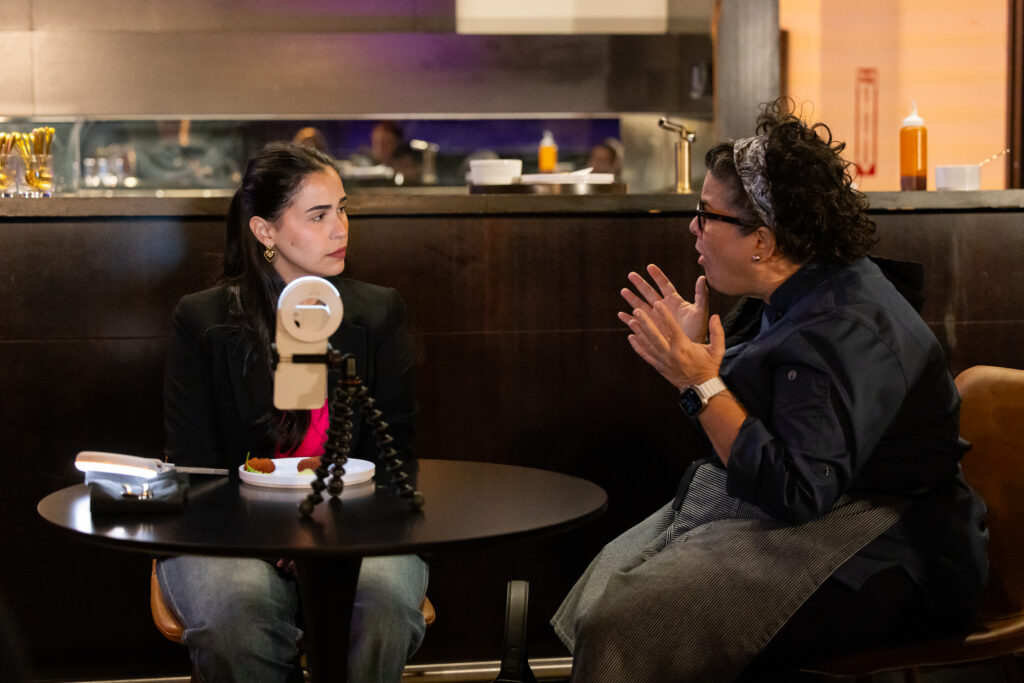
    Can you tell us how you prepare for one of your performances?

    This performance project is a life’s work, it is about life, and it is about the performance of existing as an artist in a capitalist system.  A reason I wanted to commit to such a long and intentional endeavor is because from my experience as an artist and an art educator, I have witnessed dozens of artists dabble in performance and not commit to it long enough the yield the intellectual and cathartic results they anticipated.  I wanted to commit to the life of an artist, I wanted to live a new life span as a reflective and thoughtful artist who followed vision with actions, who designed a path, who embarked on a journey and learned about myself along the way.  I wanted to prove that I was serious about performance art and to oddly “stand up for what I believe in” which is living an examined, creative, and intentional life guided by an ethos of my own design.  Of course, my design is an amalgam of things I have read, seen, heard, and lived.

  • A Christmas Moment

    A Christmas Moment

    Christmas morning, 1983.

    The world smelled bright, and my fireplace ski sweater was a happy necessity. The temperature was in the 40s. This was an anomaly in hot, hazy Hialeah. But I was not surprised by the luck. It only cemented my faith, my reason. Driving down the crowded, colorful streets, I felt grateful, generous and anxious. A tender joy swirled like an eddy against my better judgment. We were told to come, but I was still agitated in joy. The conflict was exhilarating, my body inclined slightly forward in John’s passenger seat, the hopeful position of natural momentum. It was all so right for the season, so warm in the coolness, so bold in uncertainty.

    I kept looking at John, smiling, seeking encouragement without needing it, a certain path welcoming the unknown. He reassured me. He was older and wiser. He was my “second”, should my quest end in a duel. He was my older brother to My World’s older sister, reluctant chaperones, completely unattracted to each other, but always willing to live through the filter of Us. Maybe it gave them hope. And it was the only way they allowed Her out of the house.

    I was delivering Christmas presents on a day like no other, a day years in the making. There was a voluntary invitation some weeks before, as if somehow, during my first few months in high school, there was acknowledgement and confirmation that I was worth the trouble, a viable suitor, a possible contender. She wanted to see me on Christmas Day. Nothing else comes close. Weeks of selfless shopping and saving had been devoted to this enterprise. All my busboy tips from Windows, a seafood restaurant on Main Street in Miami Lakes (later to become Shula’s Steak II), every penny from my paychecks at $2.13 an hour, every minute of every day since early December—all of it exhaustively applied and arduously expended on this lovingly painstaking task.

    Both packages, meticulously wrapped, sat on my lap.

    New Romantic offerings for a pair of reluctant virgins. The Duran Duran collection, skillfully selected and designed for Big Sister, shined with clear cellophane, purple satin ribbon and fresh publication glossiness—a sleek pictorial biography of the band at its core. For My World, The Police basket arrangement, a task that drew blood, gleamed with shiny buttons, a fresh copy of Synchronicity, and tiny, autographed guitar picks. The basket handle jangled with the delicate pings of a ponderous silver keychain, a metal Cerberean trinket sporting three pewter-blond, attitude-laden charms. They filled me with ghastly satisfaction: I would soon fuel the sisters’ rapacious obsessions and my crippling jealousy. My World’s Sting fetish was way too steamy for my taste, but it was a small price to pay for domestic and emotional admission.

    We arrived at their home and walked to the door. Everything looked clean and orderly. We were expected, and care had been taken for the dwelling’s exterior to look presentable. It was a relief, and I rang the door buzzer. Big Sister opened the door and beckoned us to enter. The house smelled of roasted meats and dying flowers. We were served soda and waited patiently for Her entrance.

    She entered on a glide, perfumed the air and brightened the room. Her nervous smile came closer, and she planted a lipglossy peck on my inflamed cheek. My base muscles weakened but my chin took it like a champ. We looked at each other, shy but famished. We saw no one, nothing else. Our lustrous, stubborn gaze was unbreakable, the tunnel connecting us: an ethereal particle accelerator. I presented them with their gifts. There were cries and tears and countless hugs and cheek kisses. They took their time opening the ornate basket arrangements, their contents, the personally chosen colors, accents and decorative flairs—the thought behind every item and its placement. After some time, we announced that we’d go for a spin around the neighborhood. Loud sounds came from her parents. We ignored her mother and the litany of rules and superstitions. We walked out of the house, every step deliberate but otherworldly. We commandeered the back seat, and there was zero resistance from the others. It would have been futile and maybe dangerous. We drove away expectant, trembling in the cold and fear.

    “Merry Christmas Darling” came on the radio.

    Karen Carpenter’s delivery on that recording, so beautiful and sad, poignantly marked my present yearning and the unlikely nostalgia of a fifteen-year-old. I first heard this song in the third grade, when Martha, a sixth-grade choral goddess, transfixed me with her honeyed rendition during our 1976 holiday show. Hearing the song always reminded me of my first tender feelings for an unattainable girl, that vestal seraphim impaled with grandeur atop my Christmas tree, eternally out of reach.

    My smile underlined a stuffy nose and full eyes, for as the melody worked its taffy, it slowly dawned: I had a shot. Slim and heartbreakingly fragile, but tangible, possible and ready to be pursued. I looked at her. There was a single tear-track down her left cheek. She was looking out of the half-lowered window, smiling so real and true—an angelic trance—smiling at a world that was never big enough to contain us. A band of cold air blew in, thrilling us, blowing its festive chill inside the warmth of incubation. My eyes stayed on her face, sending it all, praying for this thing to live, begging all that mattered to let it. “The lights on my tree, I wish you could see. I wish it every day,” Karen sang. How many nights had I heard this song with her portrait burning in my vulnerable psyche? My hand, palm down, rested by her thigh, only my left pinky making wispy contact. Denim had no effect—a deficient barrier. I felt all of her, everything she was and meant, and all of me, too, in the mystical, static electricity of near-touch.

    We drove around for hours, we laughed and talked, and she cried some more. We sang, too. She asked about my favorite Christmas. I told her it was this one—this day, this moment. She didn’t believe me, but I looked into her eyes and restated my truth. Then she believed more than anything. I did mention another Christmas many years ago. It was, without question, the most important and memorable before this day.

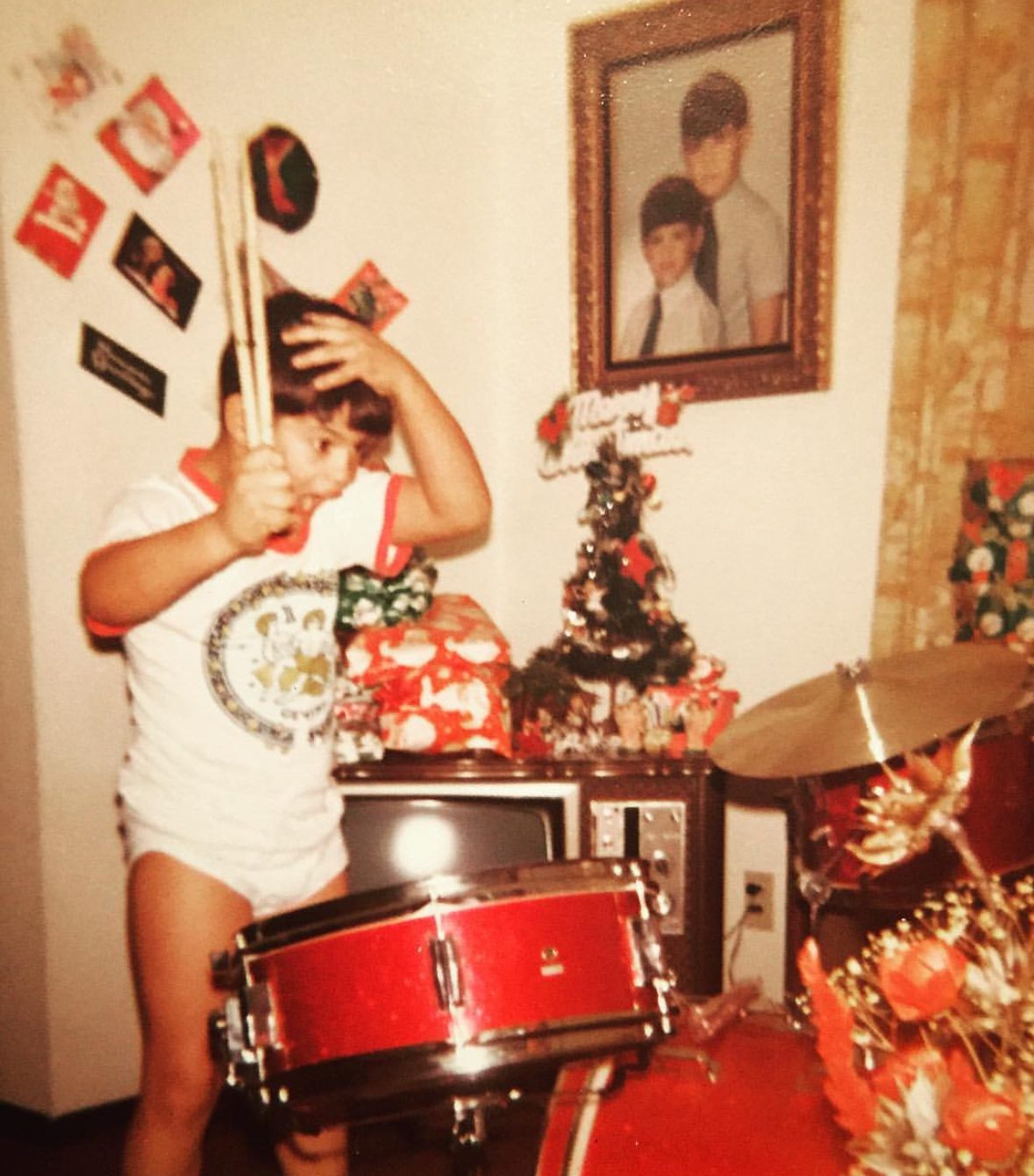
    I was eight. My big present that year was my first drum kit.

    Red sparkle. AYAR, a rare brand. It was the best thing that had ever happened to me. And my parents were not fighting. In fact, I’d stayed up the night before, deep into Christmas Eve, wide-awake on the top bunk, listening to the hushed voices, the harmony of purpose, the lost echo of affection, the clinking of ice in my father’s Bacardi, the rustling of paper and muffled shriek of pulling tape, the remnants of love. That made her sad, and I took her hand.

    Again, I told her that this day was the one, a Christmas I never thought possible. We gave in then. The front seat disappeared. We lost inhibition and merged, our bodies one in the blazing afternoon sun, bracing against the unlikely cold made only sharper against the white, vinyl backseat of John’s 1979 Pontiac Grand Prix. We held on for dear life, knowing it all already. The beginning, the middle and the end. We held like the strong nuclear force, love physics binding us together—subatomic particles helpless against the laws of nature—keeping the universe from falling apart, even if just for a spell.

  • Dan Hosker Music Continuum Is This Sunday

    Dan Hosker Music Continuum Is This Sunday

    This article originally appeared in PureHoney Magazine. Check them out here.

    “Support your scene!” is the battle cry for everyone who appreciates the musicians in their midst, the creative locals that work to make their corner of the world more livable. Rob Elba remembers the scene he stepped into South Florida in the late ’80s, after playing in bands in New York and Boston, as an assemblage of “freaks and outliers” united not by a particular sound or genre, like Seattle or Athens, but by location.

    “The thing with South Florida was just that it was so isolated from the rest of the country,” Elba says. In this geographical bubble, Elba marveled “that anyone had the balls to play original music as opposed to covers.” Yet that’s what was going on from the late ‘70s onward — punks like Elba, metalheads, noise churners and rockers of every stripe doing their own thing for audiences off the radar of many national tours.

    Singer-guitarist Elba and his former Boston bandmate, multi-instrumentalist Dan Hosker, jumped right in. Their comradeship in bands including the Holy Terrors lasted into the new century, and came to a devastating end with Hosker’s death in 2012 after a car accident. Elba saw to it that Hosker’s influence would live on by founding the Dan Hosker Music Continuum, a scholarship fund for high school students pursuing the arts. The centerpiece of DHMC is an annual fundraising (but free-admission) concert in South Florida that celebrates the ragtag, unsinkable, sonically all-over-the-map scene, with Hosker as one of its truest supporters and sustainers — a prolific, roving player in countless bands and projects. “Everybody fucking loved him,” Elba says.

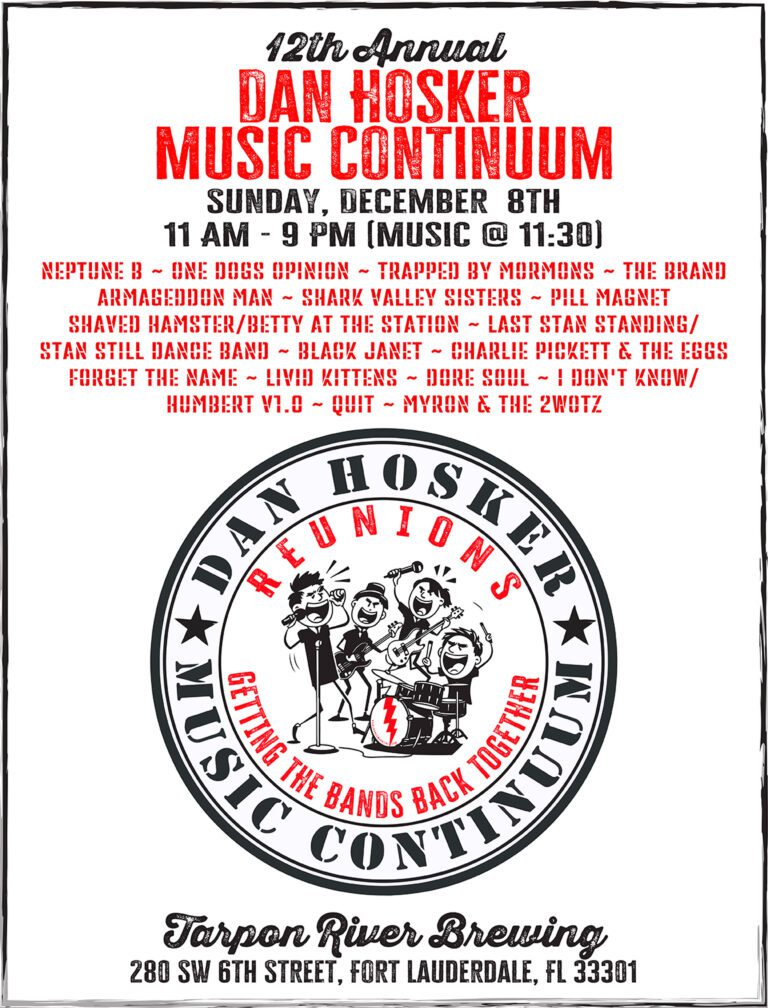
    Elba made one rule for Dan Hosker Music Continuum 12 on December 8 at Tarpon River Bend in Fort Lauderdale:

    It has to be a band reunion; no current groups or ones that never broke up need apply. “Before I knew it, we had 18 bands,” Elba says. Seventeen are playing, making the reunions-only version of DHMC the event’s biggest to date. It’s a CVS receipt of bands that defy genre, space and time all the way back to the late 1970s.

    There’s Forget the Name, who formed in 1984 and had a breakthrough of sorts to everyday South Florida when they featured in an advertisement for the now-defunct Burdines department store chain. There’s Charlie Pickett & the Eggs, the roots-punk combo that was championed by Peter Buck of REM and gained a cult following that persists. There’s Livid Kittens, tri-county mainstays in the 1990s fronted by the vixenish Paige Harvey. Their song “Flying” landed on a CMJ magazine list of 1000 Greatest Indie Rock Songs of All Time in 2004.

    Friends of the Kittens, Pillmagnet are also on board. Featuring previous members of Jack off Jill and Morbid Opera, Pillmagnet played their first show in 1996 at Churchill’s in Miami and put out a cassette-only release produced by Mark O’Toole of Trapped by Mormons, loud, fun garage punkers who will also at DHMC 12.

    I Don’t Know/Humbert V1.0, really the official band of Hialeah, are regrouping, as are punk scorchers Neptune B, fire-breathing swamp rockers One Dog’s Opinion, indie pop combo The Brand, dystopian destructors Armageddon Man, and alt-rock princes Dore Soul.

    There’s Myron & the 2Wotz, from the restless brain of noise-rock maestro Rat Bastard. There’s QUIT, whose skate-punk tracks hit hard 30 years later. Last Stan Standing/Stan Still Dance Band harken back to the scene’s earliest days, while Shaved Hamster/Betty At The Station and Black Janet feature stalwarts of the scene, some still jamming in other outfits. Finally, there’s Shark Valley Sisters, Elba’s post-Terrors outfit with Load drummer Fausto Figueredo.

    Every scene has an ebb and flow that sees new people enter and others step away to tend to life’s responsibilities. Elba lives in Los Angeles and counts himself “happily retired” from band life (DHMC gigs excepted). Some of his peers and forbears are no longer with us, their absences lending to the mythos of bands that are talked about today with high praise and tall tales of good times. “When you’re in it, you’re don’t appreciate how special our scene was,” Elba says. “I’ve never met a more interesting cast of characters.”

    Dan Hosker Music Continuum 12 runs 11am-9pm Sunday, December 8th at Tarpon River Brewing in Fort Lauderdale. Admission is a free, all ages welcome. facebook.com/DanHoskerMusicContinuum