Category: News

  • A Thousand Full Moons – Excerpt from New Novel

    A Thousand Full Moons – Excerpt from New Novel

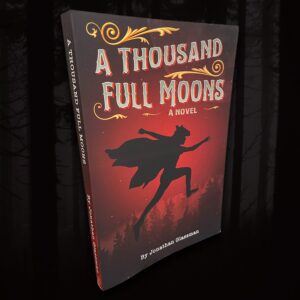
    Below is an excerpt from Jonathan Glassman’s new novel A Thousand Full Moons available to purchase by clicking here.

    In a small room off the back of a large book store in Manhat- tan, Leigh Buttonwood pulled a piece of paper out of her pocket. Tattered and folded several times over, child-like writing on the paper read “Two Robots” above a whimsical sketch of two humanoid robots sitting on the roof of a small cabin in the woods, looking up at the stars.

    There was a sublime electricity in the air that Leigh Buttonwood loved. She had butterflies in her stomach as she nervously glanced at her watch. Sipping her tea, she held up a fresh new copy of Wolf Boy & The Doubleback Giant, Volume II to inspect the vibrant cover art.

    Shirley Kleinhofer, Leigh’s agent, slipped in the room, closing the door quickly behind her.

    “It’s a bigger crowd than we expected,” Shirley said as she brushed her hair out of her face.

    Leigh stood up, “I’m ready.”

    This was Leigh’s first book signing. She wasn’t ready to face the crowd, but she would do it nonetheless.

    The first Wolf Boy & The Doubleback Giant graphic novel had been selling well while the publishers were pushing volume II to be released world-wide in one week. There were 250 advanced copies waiting for Leigh to autograph. She decided against reading excerpts as it wasn’t her style. She did not like attention. She was doing it to get out of Oregon for a bit and help her forget the last few years. She didn’t want to forget Silas or Daniel, or even the Giant. She just wanted to forget how things ended and leave behind the unanswered questions surrounding what happened to her young son, Silas — the muse for Wolf Boy.

    Shirley led her down a narrow hall, past a break room where the smell of coffee was thick, and finally, to the doors that broke out to the main lobby. As Leigh stepped out into the large bookstore, the crowd pushed forward and camera flashes exploded in her face.

    The wood paneling and high ceilings reminded Leigh of the old ornate libraries she frequented as a child. Book displays had been moved and red velvet ropes helped to organize the jubilant crowd as they were funneled toward a large mahogany desk in the center.

    Shirley shook the store manager’s hand, while a young store clerk extended her hand to suggest Leigh have a seat behind the desk. Stacks of Wolf Boy & The Doubleback Giant, Volume II were spread out on the desk with a mug full of pens. The mug had a picture of a wolf on it, silhouetted by the moon (not an official product of the Wolf Boy line).

    Leigh smiled and waved at the crowd. Shirley sidled up for a few photos. The store manager snuck in for a shot or two as well.

    When the camera flashes subsided, Leigh noticed dozens of small children lined up, both boys and girls, wearing wolf headdresses and fur capes, emulating the Wolf Boy. Most of the costumes were brummagem, unrealistic replicas, but she was overly humbled and pleased to see a sea of children, and even a few adults so inspired by her son, Silas. But quite suddenly, her nerves were further tested as the crowd pushed forward and people started yelling questions.

    “Have you seen Wolf Boy lately?” Yelled a portly man holding his young daughter.

    “Is his dad still in jail?” A hawkish woman interrupted.

    Shirley moved forward, raised her arms up and shushed the crowd, “Please folks, let’s all take a step back and save your ques- tions for when you reach the front of the line!”

    A meek girl of about eight years old led the line and shook with excitement as she held a tattered copy of the original Wolf Boy book. Shaking with anticipation, she stepped forward with her mother and father.

    “Hi there, sweetie, thanks for coming and being a fan of Wolf Boy,” Leigh said with sincerity. “What’s your name?”

    “I’m Jennifer! I just love Wolf Boy. He’s so cute!” The girl slid her old copy forward on the desk.

    “Nice to meet you Jennifer,” Leigh said as she opened the old copy and started to write: “To Jennifer, howl with me!”

    Leigh slid it back, “And you get the new book today too, honey.”

    As she’d signed, the girl’s mother leaned forward and whispered, “Is the boy living with the crazy grandmother? Because that’s where he seems to fit, no?”

    “Live with? Ma’am, Wolf Boy lives under the stars,” Leigh said with a smile.

    “Yeah, ok,” the mother said incredulously.

    After a dozen or so signatures and brief conversations around delusional interrogations from parents, Leigh saw the face of a small boy poke around the corner of the line, about twenty people back, with the most perfect wolf headdress and face paint. It was so perfect, in fact, that her stomach dropped and she almost yelped out loud, thinking it was Silas. The thought of Silas in New York City was preposterous though.

    When Leigh looked up, a boy of about twelve years of age stepped forward with his mother. He also had a tattered copy of the first volume of Wolf Boy and held it open to a particular page. He came around the side of the desk to be beside Leigh. The store clerk whose job it was to keep people organized began to stop the young boy from coming around the desk, but Leigh motioned that it was fine.

    “I’m Chad and I can’t tell you how many times I’ve stared at this picture, wanting to run through these forests with Wolf Boy.”

    He pointed to the page, where there were three action cells— artwork that was Leigh’s favorite.

    The text on the page read: “Wolf Boy left the wizard that day, not sure if they were still allies or not…”

    The first cell showed Wolf Boy in action, easily scaling a large tree.

    “As he crouched on the back of the battered fuselage of an old aban- doned plane, the giant shifted, and the vines holding the plane up in the air stretched and groaned under the pressure. Wolf Boy adjusted his wolf headdress and pounced forward…”

    The next two cells showed Wolf Boy sliding down the forty-five degree angle of the old fuselage, while the eye of a giant peeked from the cockpit. The final cell was Wolf Boy, baring his teeth, face to face with the giant’s puffy face.

    As the boy slid the graphic novel across the table for Leigh to sign, it split open to a page near the back. It took Leigh’s focus out of that crowed room for a moment that felt like an eternity. The first cell of the multi-panel sequence beheld the most whimsical drawing, despite being a still image, it was almost as if it had move- ment. Years after she first saw it, Leigh was still baffled by the trickery of the art. The cell was bursting with color, with just the right combination of action and drama — Wolf Boy was hurdling across a boulder, almost jumping off the page. Skimming the out- stretched paw of a ferocious mountain lion, he was spinning a shep- herd’s sling with a glowing rock in its launcher. Not far behind, but slightly over the precipice of the mountain side, was Golnaar the Giant, watching like a semi-protective father. The giant was giving Wolf Boy the space he needed to prove that he could defend himself in the dangerous Whulakian Woods of Oregon.

  • III Points Preview (If You Don’t Like EDM music)

    III Points Preview (If You Don’t Like EDM music)

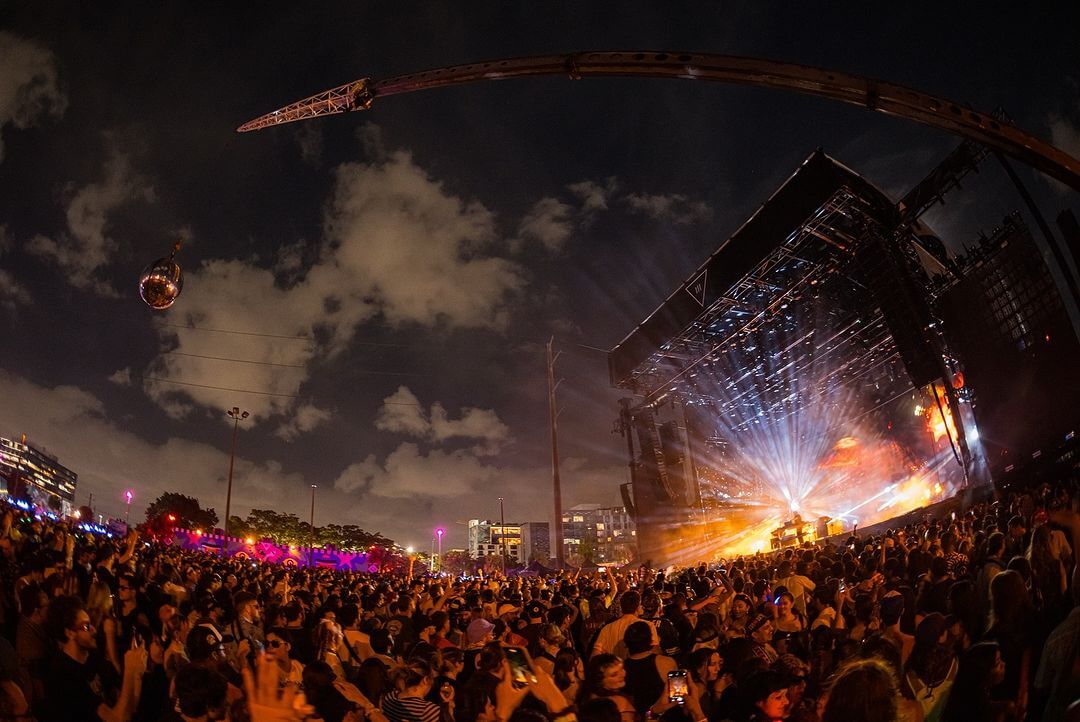
    Yay — Miami has made it to mid-October again, and you know what that means: our III Points preview is here. The weather’s subtly starting to shift, and suddenly the next six months feel like Miami’s golden season — culturally, vibe-wise, weather-wise. III Points kicks it all off.

    We’ve been to almost every III Points (missed the very first one), and while EDM and DJ sets aren’t usually our go-to, the festival always throws curveballs. If you’re more into punk, rock, reggaetón, anything unplugged or less computer-driven, there’s always something in the mix. This year’s lineup is stacked. Here’s what we’re excited for:

    1. Phantogram — Their sound is a dark, swirling cocktail of dream pop, trip hop, street-beat rhythm and psychedelic guitars that pulls you into introspective cinematic spaces. They are playing at 7:05pm at Sector 3 on Friday.


    • Turnstile — This Baltimore hardcore outfit brings the energy you didn’t know you were missing. Their riffs are sharp, their breakdowns are built for bodies in motion, and they somehow make hardcore feel inclusive. This banger launches 1040pm on Saturday at the Mind Melt stage.


    • Amyl and the Sniffers — Unapologetically loud and full of swagger, this Australian punk-pub-rock crew is raw, ferocious, and fun. Frontwoman Amy Taylor stages dives, spits lines, and leads a band whose live shows feel like volcanic eruptions in tight spaces. They play 1230am on Saturday night, Sector 3.


    • Darkside — Darkside crafts deep ambient electronics blended with murky guitar textures. Their music breathes, expect shimmering, introspective grooves. 9pm, Mind Melt, Saturday.


    III Points Preview


    • MK.gee — A low-fi alchemist of alternative R&B, MK.gee’s music feels intimate, raw, and unpolished in the most intentional way. He layers glitches, moody vocals, and unconventional pop forms into something that’s both delicate and infectious. Fresh off a weekend at Austin City Limits, they play 730pm, Mind Melt, Saturday.  We can’t wait!!


    • Thundercat — Bass virtuoso, jazz explorer, funk whisperer — Thundercat’s sets are like cosmic journeys. Expect high-speed melodic flights, playful experimentation, and a groove so deep it feels like it’s pulling you into another dimension. Friday night, Mindmelt, 845pm.


    • L’Impératrice blends Parisian disco, funk, and synth-pop into sleek, cinematic grooves. Their music glows with vintage glamour and modern cool, effortlessly danceable and deeply romantic. Few bands make sophistication sound this fun. Friday, Mind Melt, 1015pm, right after Thundercat.


    Culturally, this weekend in Wynwood is electric just for the vibes. Stroll through art, people-watch, catch a hidden set or surprise DJ drop. Even if none of those names were yours, it’s worth being there just to soak it in.

    For more info and tickets, click here.

    Or take a listen to the official III Points preview playlist.


  • Concert for Gastón Adanto – Argentinian Musician Detained by ICE

    Concert for Gastón Adanto – Argentinian Musician Detained by ICE

    It all began with a collaboration.

    Miami singer and songrwiter, and community organizer Andrew Frix, known for his long history of charity events, was the one who made this concert and even this story possible. After hearing about his friend, Argentinian songwriter Gastón Adanto, having an ordeal with ICE detention, Frix decided to bring together artists, friends, and neighbors for a night where music could turn pain into purpose.

    When Frix contacted me, I thought he wanted to talk about an event, his new songs, a gig, maybe an album. But when he mentioned ICE detaining a local Miami musician, everything shifted. What unfolded wasn’t just the story of a musician, it was the portrait of a man whose life and art have been braided with endurance, gratitude, and a smile that refuses to fade.

    He told me about his beginnings in Miami: playing guitar on Lincoln Road, chasing that pulse of this is where I belong. Later, he showed me old footage that was grainy, alive, full of color. Even then, there was something unmistakable in him: that gentleness, that unbreakable light.

    Then came the weeks in detention—first in what inmates call “Alligator Alcatraz,” then in El Paso for a month. Showers were rare, food scarce, time a blur. Yet he smiled even while remembering it, because faith, he said, was the only way through.

    “I always believed I was going to get out,” he said softly. “But not everyone does.”

    We spoke about language—the usefulness of English, the intimacy of Spanish, and the one that has always sustained him: the language of the heart. His family in Argentina never told him to give up and come home. His faith shone brighter with each passing day, showing his kindness in the form of encouraging words…That’s what kept him going.

    Now out on bail, facing legal fees that would overwhelm most people, Gastón is finding his way back through music—with the help of friends like Frix. The concert they’ve built together isn’t just a fundraiser; it’s a celebration of community, resilience, and love.

    For Gastón, music was never about money. It was devotion. A way of holding onto himself when everything else was taken. And maybe that’s why—even after everything—his smile hasn’t broken.

    For Miami, this night is an invitation. Showing up, buying a ticket, lending your voice in applause—these are more than gestures. They’re declarations of what this city truly is: loyal, tender, and fiercely alive. Through Andrew Frix’s vision and Gastón Adanto’s courage, Miami has the chance to show its heart.

    Music for a Cause: Gaston takes place Friday, October 17 at Savage Labs in Miami. Tickets are available by clicking here.

  • Scotchy’s Sundays Come to a Close… For Now

    Scotchy’s Sundays Come to a Close… For Now

    It started out as a reason to wear pants again….

    The world had stopped about four years ago. But pandemic hysteria was starting to simmer down, and venues were trying to get back on their feet again while observing the new guidelines, sort of. Either way, Florida was going to Florida, so shit started opening up again down here, asap.

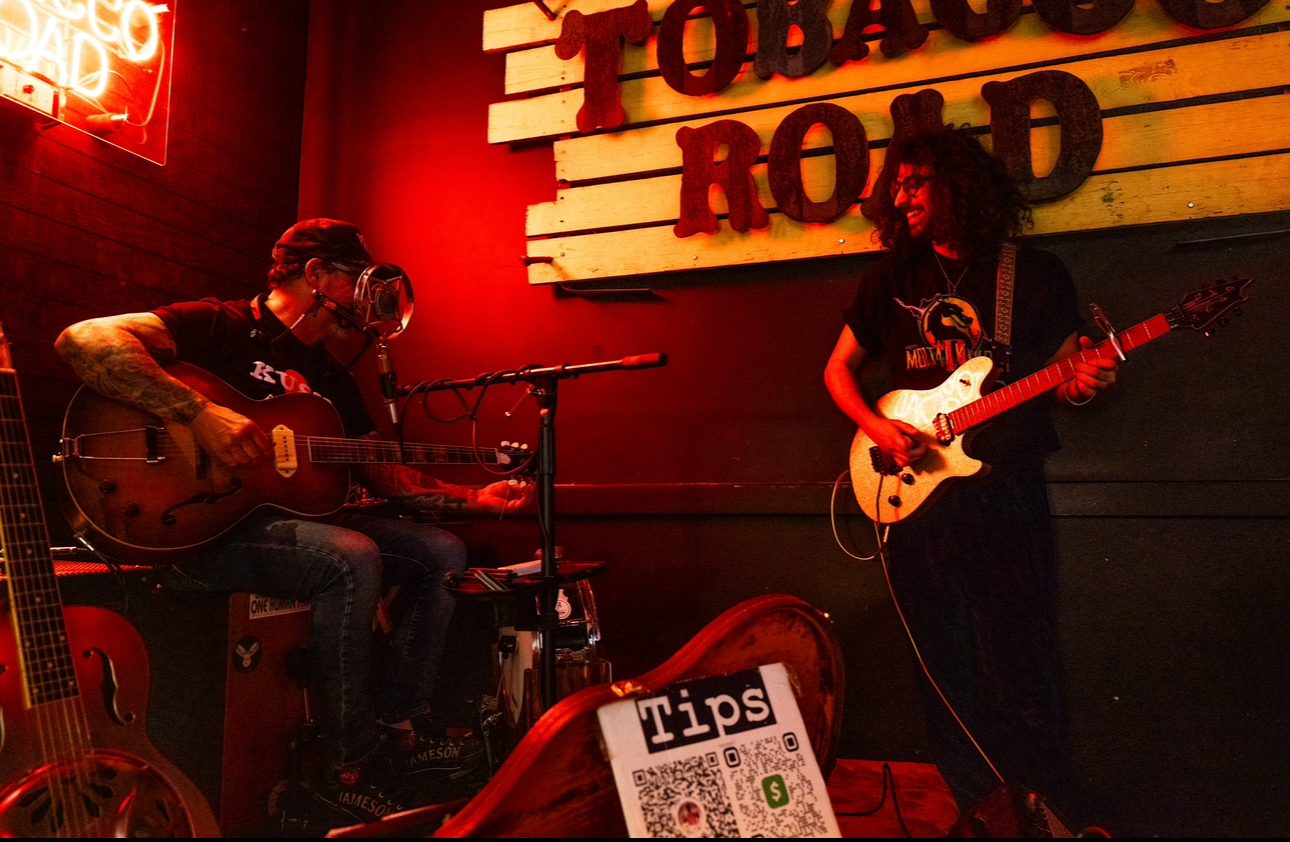
    I got a text from someone at Kush, Brickell, (formerly known as Tobacco Road). They wanted to know if I wanted to play every Sunday night as my one-man-band, Uncle Scotchy.

    For those not familiar, my Uncle Scotchy setup consists of just me playing the drums with my feet while playing the guitar and singing/playing harmonica all at the same time.  I play mostly original, “Blues” type songs that I have written, as well as some standards that I play in my own way. No popular covers, and no apologies. I just do my thing.

    I had just spent the past year of drinking Jameson in my house with just the awesome company of my little dog and playing the occasional “virtual” gigs online. But now I had a real gig! A weekly too! Weekly gigs like that are gold for solo musicians. Even in the best of times.

    It was finally time to put some pants on, leave my house, and play some live music again. Even though it wasn’t really Tobacco Road anymore, this venue was particularly appealing to me.

    I’ve been coming to Tobacco Road to see live Blues since I was in my late teens. I eventually was hired to book the bands there for the last three years it was open. All that nostalgia made it even more special.

    The gigs were kind of hit and miss at first. Sometimes there was just a few people eating who didn’t want to hear my bullshit. Sometimes the place would get rocking and the tips pouring in.

    The staff at Kush-Brickell, although it may have changed over time, was always super cool to me. They made me feel like part of the family from the beginning.

    Not long after I started playing my new weekly gig, venues started hiring full bands to play again. My four-piece band, Juke, was back in business as well.

    Fortunately, I had just brought in a new guitar player into Juke who just moved back to Miami. A shredder by the name of Harold Trucco.

    Harold started joining me on my solo, Sunday shows. At first it was just for shits and giggles. But we gelled musically and the two of us started forming a unique sound.

    As one of the former managers said to us once in a thick, Venezuelan accent, “Ju guys are lie ham an cheese!”

    There was a brief period that they decided to put live music on hold, but soon they asked me back. When they did, we worked it out so that Harold would be in the budget. We were then an official duo. A dark, Bluesy cloud, and some lighting.

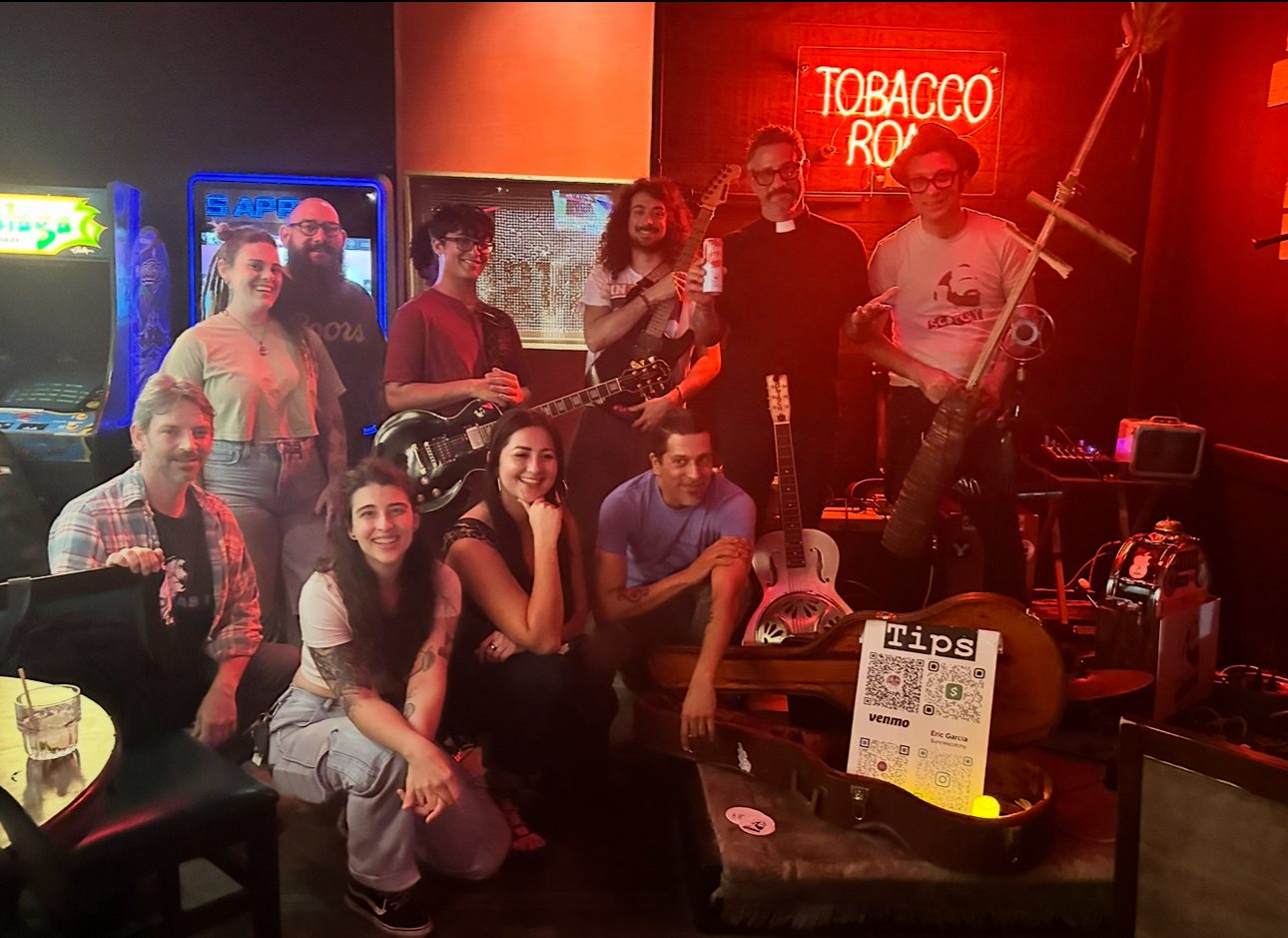
    Although the night was still sometimes hit and miss, Harold and I started having a regular cast of characters come to our weekly shows. Some friends, some musician friends, and some were just music lovers looking for something cool and different that they could dig.

    A fourteen-year-old aspiring musician who plays guitar and lives in the area started coming every goddamn Sunday. His name is Pablo. Pablo loves truffle fries and Pepsi. He’s eighteen now, and we consider him our official mascot.

    Sometimes “Pablito” would sit in and play guitar with us. Eventually a whole bunch of different talented local musicians would come play as well. It wasn’t an open jam. I didn’t want any riff raff. I liked to call in “an invitational”.

    After Harold and I played a few songs, I’d let the guest musicians get up and do their thing to workshop songs they were looking to play on their gigs. My guests would play their bangers too. The nights really became a vibe.

    Between the special guests, the locals, and the sometimes weirdo drunk patrons of Kush-Brickell, I never knew how the night was gonna go. But I do remember smiles. Lots of smiles.

    After four years of playing every Sunday night as Uncle Scotchy along with the amazing Harold Trucco (also of The Lab), it’s time for a change.

    This coming Sunday night, October 12th at 10 pm will be our last show.

    It will be bittersweet. But I have nothing but love for the staff, all the people who came to listen to us, the people who didn’t come to listen to us but loved the music anyway, our friends who came to support us, our friends who came to play with us, my guitar player/truly great friend, Harold, and especially Matt Kushner.

    This night was Matt’s idea, and I did my best to create a special musical experience with the opportunity he gave me. I only wish that more people in Miami recognized and realized what Harold and I created and laid down every damn week.

    It was a gem tucked away in Brickell. In Miami, no less. The city I love and was born in as a 3rd gen “Miamian”.

    Four years is a long time for any weekly for a musician. It was a blessing.

    The coolest thing about it is something that I appreciate above all else. The thing that made our Sundays well worth loading all my shit in my car every Sunday night, setting it up, breaking it down, and loading it back in my car for the late-night ride home.

    Something that most musicians would kill for… They never told us what to play.

  • Poetic Ruins Reverberate in Edouard Duval-Carrié’s Marvelous Alchemy of History

    Poetic Ruins Reverberate in Edouard Duval-Carrié’s Marvelous Alchemy of History

    The following essay was commissioned by Carlos & Olga Saladrigas Gallery at the Ignatian Center for the Arts, Belen Jesuit Preparatory School, for catalogue documenting the exhibit “The Alchemy of History: Vision of Edouard Duval-Carrié.” For an earlier example of writing about Edouard Duval-Carrié, be sure to see my forthcoming book Miami’s Art Boom: From Local Vision to International Presence, published by University Press of Florida. October 30 launch for book is with Books & Books at Coral Gables Congregational Church, 3010 De Soto Blvd, Coral Gables. At 2 pm November 23 for the Miami Book Fair, a panel discussion on Miami’s Art Boom takes place at the Freedom Tower, Miami Dade College, 200 NE Second Avenue, Miami.

    Celebrated writer Alejo Carpentier made a fateful trip to Haiti in the early 1940s. It prompted him to write his classic 1949 novel The Kingdom of this World. That novel reverberates in art by prominent Haitian-born, Miami-based artist Edouard Duval-Carrié. Both have been transfixed by the clashes of culture and history amid the art and soul of Haiti.

    Carpentier was entranced by the lore and drumming of Haiti’s Vodou religion, by the “poetic ruins of Sans-Souci,” the early nineteenth century palace ornate with Baroque European grandeur and built for the first King of Haiti. In his preface, Carpentier wrote that the novel reflects an encounter with “the all-too-real enchantment of the land of Haiti,” with what he calls “the marvelous real.” The Kingdom of this World is hailed as the first example of magical realism, a landmark in Latin American literature.

    For Carpentier, these sights and sounds embodied the bloody, bold story of the Haitian revolt against slavery from the mid-1700s to 1804. His novel portrays how Haiti became the world’s first free Black republic and first independent state in the Caribbean.

    Speaking in his Little Haiti studio, Duval-Carrié bemoaned the poverty, political corruption and deadly violence now wrenching his native country. Haiti has a very rich history, he emphasizes. “Haiti can be so much in the avant-garde of thought. Carpentier created a genre of writing that stunned the world,” he said.

    For years, the vivid writing of The Kingdom of this World has left its mark on the artist’s own vivid imagery. Like Carpentier, Duval-Carrié offers a panoply of historical portraits and fantastical imagery, woven with allusions to Vodou spirits.

    Such images bring to life the artist’s abiding inquiry into the intricacies of Haitian past and present, into the churning legacy of the Haitian Revolution. “The Alchemy of History: Vision of Edouard Duval-Carrié” presented by Carlos & Olga Saladrigas Gallery at the Ignatian Center for the Arts, Belen Jesuit Preparatory School, assembles over 40 works encompassing 13 years of his career, from 2010 to 2023.

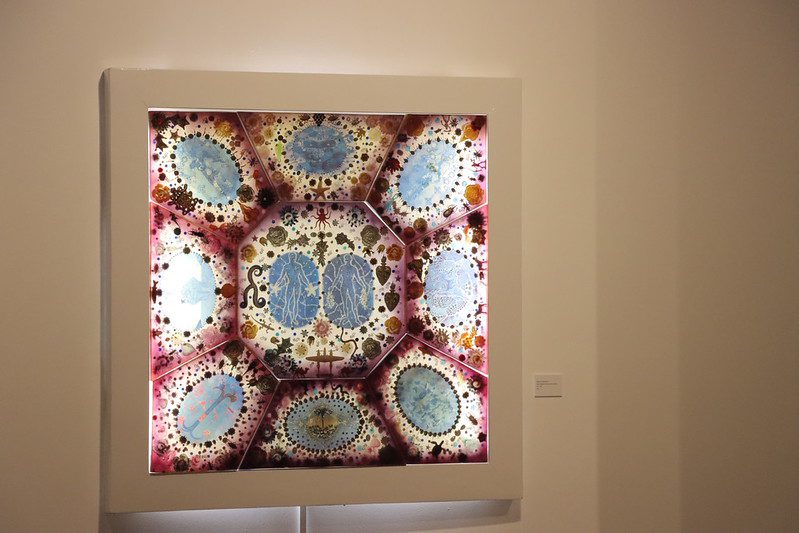
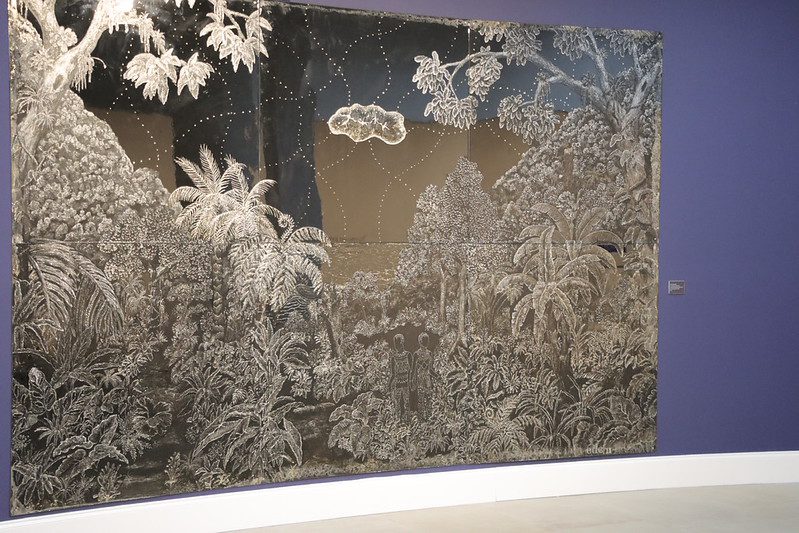
    Duval-Carrié has brought his artistic sensibility to inventive painting, printmaking, and sculpture. This exhibit’s primary focus, however, is devoted to engravings and etchings. They are encased in artist frames embellished with contrasting Rococo flourishes and neoclassical geometric patterns. Such lavish framing of these figures and symbols integral to Haitian history only seems to suggest an aristocratic aura. The art itself evokes a history bent on the destruction of French colonial power.

    His engraving on Plexiglas “Mackandal S’Envoie” (2017) illustrates the artist’s vision of an astonishing event in the novel. Carpentier recounts how the rebel slave Mackandal is said to have metamorphosed into various insects. In the artist’s engraving, Mackandal’s eyes resemble spiraling curls of centipedes. Crowning this hybrid creature are antennae rendered as two curving palm fronds—a symbol in the ancient world for honor and victory. Duval-Carrié shows the rebel slave’s spirit as a bizarre insect soaring high above Haiti to escape being burned at the stake.

    Makandal is revered for leading a violent, seminal slave uprising in 1757 in Saint-Domingue, the French colony in the western region of the Caribbean island Hispaniola. While at the time the uprising may have seemed unsuccessful, it’s considered an important precursor to Saint-Domingue’s transformation into the country of Haiti in 1804.

    Before 1804, Saint-Domingue generated the most riches among colonies in the French empire. An estimated 40 percent of sugar and 60 percent of coffee imported to Europe were harvested in Saint-Domingue. That wealth exacted a terrible price. Plantation owners of Saint-Domingue were considered among the most cruel and vengeful in the Americas.

    “The French never got over the fact that they lost the crown jewel of their dominion,” says Duval-Carrié.

    Duval-Carrié is intrigued by how idyllic images of Haiti and the Caribbean were created by those who had never visited the region or maintained a blind eye to Blacks if they did. His own printmaking offers a severe rebuke to that seductive imagery. It was, he has said, “totally propaganda. One has to remember that these were plantation economies with slaves. This was the whole period when there were hundreds of thousands of people from Africa creating all the wealth in Europe because at that time sugar was a major staple. It was what oil is today.”

    For his 2014 solo show “Imagined Landscapes,” featuring paintings and sculptural chandeliers at Pérez Art Museum Miami, sixteenth century European engravings by Theodor de Bry were an inspiration.  Growing up in Haiti, Duval-Carrié remembers that his early school books were still illustrated with engravings of Indigenous people in the Caribbean by de Bry. “They were lily white and had these fantastic plumes on their heads,” he recalls. “They were more fantasy than anything else.”

    At Belen, he upends this mode of flagrantly mis-educational illustration with prints imbued with his own take on the “marvelous real.” Some prints are inspired by prominent figures in Haitian history, like the “President Series” (2020) and “Important Women Series” (2020).  In palest blue, these finely detailed, mirror-bright engravings on Plexiglas confuse the eye. As you look at them directly, your own face becomes reflected on the Plexiglas print. As a result, your face metamorphoses into a self-portrait merging with a portrait of a woman or man who was influential in Haiti’s fight for independence.

    Duval-Carrié underscores the profound relevance of Haitian and Caribbean history by creating prints in shades of cobalt blue Plexiglas that act as mirrors. Moreover, he underscores that Haitian and Caribbean history belong to the larger history of the Americas and to world history.

    Intense shades of cobalt blue recall the Caribbean. Such gorgeous blues remind us that picturesque Caribbean waters once witnessed the horrific Middle Passage. During the years 1526 to 1827, over 12 million Africans were transported to the Americas on cramped vessels. Over 10 million survived to confront hard labor and untimely death on plantations, many in the cane fields of Haiti.

    Duval-Carrié is pleased to present his art at Belen Jesuit. Belen students, many likely future leaders in Miami, could benefit from a broader understanding Haiti’s cultural history, he believes, given Miami’s large population with deep ties to Haiti. “That’s why I am doing this. There is so much to unpack,” he says. He looks forward to talking with teachers and students about how his art addresses the legacy of colonialism. Students need to recognize “how important and destructive political power can be.”

  • Fort Lauderdale International Book Fair Announces 2026 Edition

    Fort Lauderdale International Book Fair Announces 2026 Edition

    Join us for an unforgettable day of literary discovery on Saturday, January 31, 2026.

    On Saturday, January 31, 2026, Fort Lauderdale International Book Fair, Incorporated, will host the much-anticipated Fourth Annual Bookfair at Esplanade Park in Fort Lauderdale, Florida. This exciting event promises to bring together book lovers, authors, publishers, and literary enthusiasts for a day of inspiration, knowledge, and fun.

    The event is open to people of all ages and is a must visit for anyone who loves reading and learning. Set-up will start at 7am and will continue until 11am. The event will be from 11am to 5pm.

    The bookfair will showcase local talent and offer an opportunity for attendees to connect, learn, and engage with the world of literature. Fort Lauderdale International Book Fair promotes literacy in the community by showcasing local authors. It allows people to meet authors and speak to them about their experiences as authors. The event has live music, food trucks, author readings and signings, an interactive art station, a raffle and much more. There is also an opportunity for student volunteers to get community service hours.

    Don’t miss out on this exciting event! Visit www.ftlbookfair.org to learn more and register for updates. For media inquiries, please contact: The Book Fair at ftlbookfair@gmail.com

  • Comedian Tony Hinchcliffe Brought Sass to Fort Lauderdale

    Comedian Tony Hinchcliffe Brought Sass to Fort Lauderdale

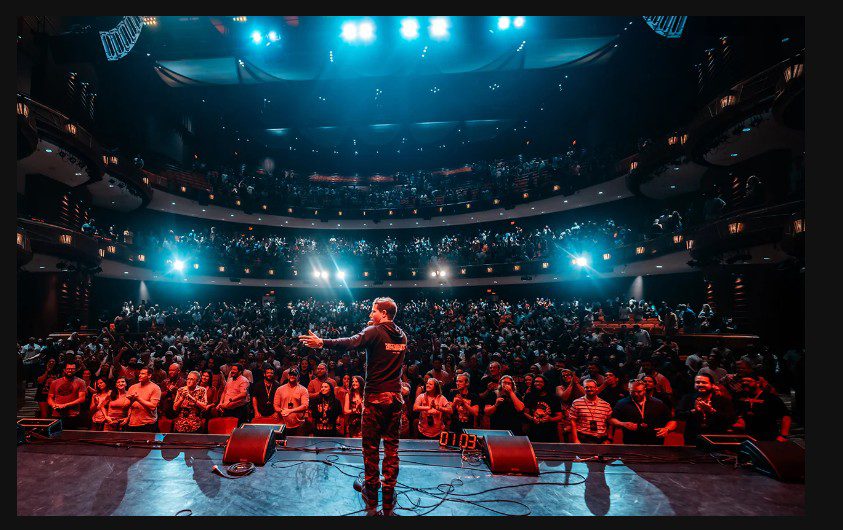
    Tony Hinchcliffe is a Youngstown, Ohio born comedian and host of the Kill Tony podcast. He made waves at a Trump rally in 2024, where he jokingly referred to Puerto Rico as a “floating island of garbage.”

    Hinchcliffe styles himself as a “man of the people.” It was Hinchcliffe himself who announced from backstage, “The show will start in five minutes.” I can think of nothing more Northeast Ohio than to DIY your own backstage announcement.

    Tony is wiry, funny looking, and worked so hard to get out of Youngstown, all the way to Los Angeles before finding his current home at The Comedy Mothership Joe Rogan created in Austin, Texas.  My first introduction to him was the Tom Brady roast on Netflix.  Nothing was off limits then, or now.

    Tony’s style has been called “roast comedy,” but there is much more depth to his act.  For a peek inside his dark, twisted soul, Julia (my 17 year old daughter) and I made our way from Boynton Beach to The Broward Center’s Au Rene Theater, a 2700 seat venue.  Much more cost effective than visiting his live podcast in Austin, Texas.

    We were in the upper balconies, “the well-behaved poors” I think he called us.

    His opener David Lucas, who I usually like on Kill Tony and on his own podcast, fell flat with mostly sexually graphic material.  It failed to land with Tony’s more conservative fan base (including this embarrassed dad).

    However, Timmy No Brakes (Tim Stiefler) was a pleasant surprise to the lineup of three total comics for the night.  He came into the KIll Tony universe earlier this year with a character that seems one part Andrew Dice Clay, and one part Andrew Dice Clay imitating Andrew Dice Clay.  “Timmy” did some amazingly entertaining crowd work, demonstrating his depth as a comedian, improviser, and writer.

    What makes Tony so lovable is the contrast of his vitriol rolled up into a sweet, harmless, wiry looking little package.  It’s like the gentle giant trope, in reverse.  For the record: I’ve known some not-so-gentle giants.  Yes, Tony is an abrasive little fellow.  But there’s a deep love and vulnerability that underlies all of his surface revulsion at various groups of people, his own people included (Italian Americans).

    One thing I always appreciated about Howard Stern was that he introduced a wider audience to folks that many of us rarely interact with: drug addicts, mentally disabled people, little people, etc.  Though Stern made jokes about and with these people, he gave them a visibility and a voice that others didn’t.

    Tony does this effortlessly on Kill Tony and in his standup.

    “I look at different races and cultures, that’s exactly what makes America special. The fact that we could all get together and come together and laugh.”

    On his YouTube / Netflix show, Kill Tony, Hinchcliffe has given his enormously influential spotlight to comedians of every color, disability (mental and physical), and gender.

    Early into his act, Tony said, “It’s crazy times people, we’re gonna talk all about it.”  The “it” on my mind was Charlie Kirk, whose assassination just days earlier was dominating the national conversation.

    He described the gun he bought after moving to Texas: “It’s like having a second d*ck. The first thing I did when I got it home was I put it in my mouth.”  Depending on our perspective, he said, we could take this as a gay joke or a suicide joke.  “I’m here to tell y’all once and for all I ain’t gay.”  I pray he’s not really suicidal.  The world needs Tony.  He even looks like a little court jester.

    Regarding Amy Schumer: “It was cool to see Brandon Fraser win an Oscar.”

    In a move I’ve never seen before, Tony put the microphone on top of his bar stool, and scraped it across the stage. It sounded like a deep-sea audio recording.  “That’s Amy Schumer communicating with her family,” he announced to hearty laughter after an extremely innovative stunt.

    “I love all the different cultures,” Tony said. “I love it all. Where’s my proud Latinos at tonight? It was louder 8 months ago.”

    On Donald Trump’s signature: “It looks like Lizzo’s heart rate.”

    Berating the crowd, Tony said: “I guess you guys are getting an extra long show thanks to the absolute unbelievably low IQ of this audience.”  We laugh because it’s funny.  We laugh at ourselves, and this laughter, on this night, is much needed.

    On Charlie Kirk: “Among the best people I’ve ever met.  A good friend. I partied with him in the inauguration. We had a good old time. He was just nothing but nice.  A lot of these people at that time were shying away. I didn’t know whether they could hang out with me or whatever, he was the total opposite, absolutely nothing but welcoming.  And hung out with me and Kid Rock.  We had the best time.”

    On Charlie Kirk’s assassin: “Can you imagine the shock of that father when he realized that his son was banging a trans person? Not even the scariest thing he ever shot into, you know what I mean?”

    On Canadians: “They were cute back in the day, right?  They were our little retarded cousin.”

    “Football’s back – so great, so many great athletes.  I don’t know about you guys but I think that Travis Kelce might be the next OJ Simpson.”

    Tony closed saying it was “an unbelievable fucking time – we always have fun here in Florida.”

    I will tune into the Netflix special, if only to see how it evolved from the live show. Tony Hinchcliffe’s irreverence is needed, now more than ever.

  • New Jitney Book Out Now: Biscayne Inferno by The Biscayne Poet

    New Jitney Book Out Now: Biscayne Inferno by The Biscayne Poet

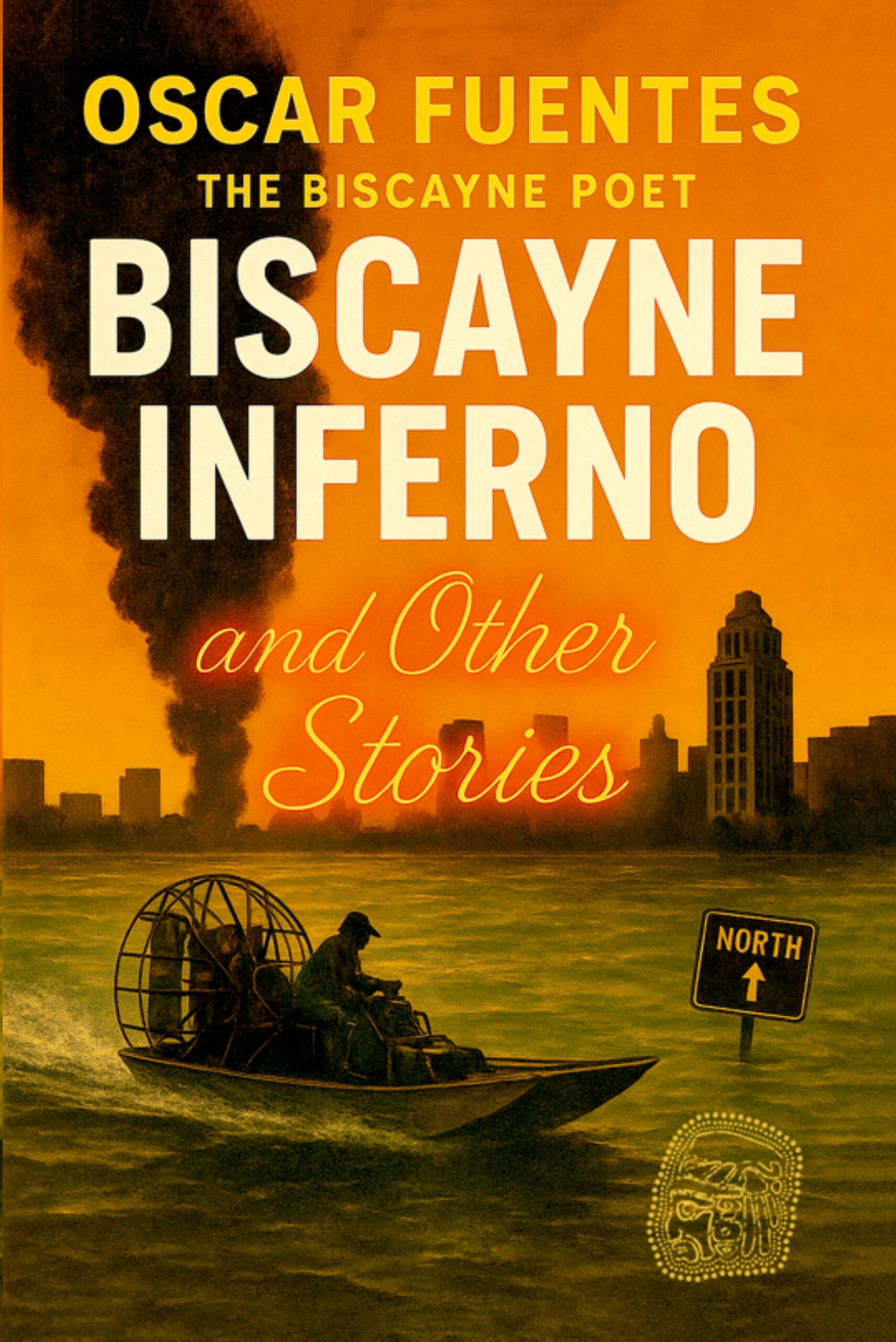
    Biscayne Inferno and Other Stories is a hallucinatory blend of apocalyptic noir and Miami mythmaking, where the city itself becomes both crucible and character. In the title novella, Biscayne Inferno, Oscar Fuentes, The Biscayne Poet, plunges readers into a drowned Miami, a surreal landscape of ghost typewriters, floodwaters, and shattered lives. Through visceral, cinematic prose, he crafts a world where survival collides with memory, and every choice echoes with violence, love, and longing.

    Alongside Biscayne Inferno, Fuentes delivers a collection of short stories and poems that move from raw urban grit to intimate lyricism, revealing Miami as both paradise and inferno, a place where history, myth, and personal ghosts converge.

    For fans of speculative fiction, literary noir, and poetic storytelling, Biscayne Inferno and Other Stories is a vivid, unforgettable descent into a city on fire and underwater, told by one of Miami’s most original voices.


    PRAISE FOR BISCAYNE INFERNO

    “With the verve of an outsider artist’s naïve audacity, the tumble-forward verbal dance of an urban Jack Kerouac, and a sense of noir that’s all his own, Oscar Fuentes, The Biscayne Poet, has created another wild ride through the mythic territory of South Florida and beyond. Hold tight, Surrealists!”

    – Michael Hettich, Author of A Sharper Silence and The Halo of Bees

    “With this brilliant selection of short stories and poems, Oscar Fuentes presents a dystopian noir that doubles as a subtle warning against what Miami could become if we let it go quietly into the night.

    Biscayne Inferno is a haunting must-read.”

    — Asha Elias, Author of Pink Glass Houses and The Namaste Club

    “Biscayne Inferno and Other Stories is a revelation. For years, Oscar Fuentes has been pounding out poetry on his legendary typewriters, mesmerizing audiences with his jazz-infused spoken-word performances and bringing the spirit of the Beats to everything Biscayne. Now, in his new collection of fiction, he once again makes Miami a character-shining a dark light on our city, channeling its stories, and daring us to look away.”

    – Mitchell Kaplan, Founder and President at Books & Books

    BUY BOOK HERE

    AUTHOR BIO

    Oscar Fuentes, known as The Biscayne Poet, is a Miami-based multidisciplinary artist, curator, and author of eleven poetry and prose collections. Born in Manhattan to Honduran immigrant parents, his work explores themes of family, memory, and legacy. His typewriter poetry was recently featured on Bravo’s The Real Housewives of Miami, and he currently serves as poet-in-residence at 1 Hotel South Beach. Fuentes is promoting Poetry City, a new collection inspired by the rhythms and stories of Miami. In 2023, he received the inaugural Miami-Dade Mayoral Poetry Commendation. He is recognized for his distinctive persona, driving a 1974 Dodge Dart with a trunk full of vintage typewriters and wearing typewriter ribbon for a mustache.

    BUY BOOK HERE


    BUY BOOK HERE


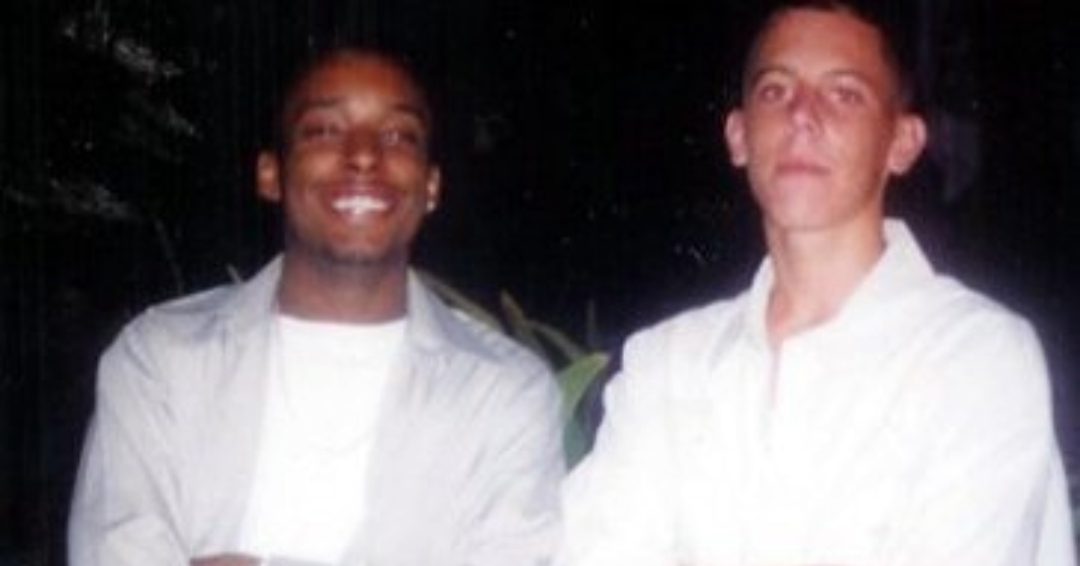
  • Knocking at the Door – Remembering Justin and Karen

    Knocking at the Door – Remembering Justin and Karen

    November 17, 2002

    Miami, FL

    As soon as Melly answers her cell phone, I know I’m not getting laid today.

    Leaning back in my seat, I look around the food court at Dadeland Mall, disappointed. Melissa says something into her cell, listens to the response from her best friend Karen and laughs, her curly brown hair bouncing on her shoulders. She crosses her legs and her spring dress rises up her thigh. On the other end of the line, Karen’s voice is a faint chirp.

    Melissa puts the phone to her chest and looks at me.

    You mind if we chill with Justin and Karen?

    Justin is my boy, and Karen and I have come to a tentative truce over the past few months since graduation, since the last time Melly and I broke up. I enjoy their company.

    However, chilling with them right now is not what I had in mind for this Sunday afternoon.

    I nod anyways. Smile.

    Yeah, let’s go.

    We pull up to Justin’s mom’s house and park behind his two-door red Nissan. A week or two ago, Justin did donuts in it outside Karen’s mom’s crib with me in the passenger seat gripping the arm rest, absolutely sure we were about to die. The car’s parked under an adjustable basketball hoop hanging over the driveway that I‘ve dunked on a few times (though my short ass had to lower it to get up there).

    I shut off the engine and Melissa hops out, heading up the stone walkway to the front door. I trudge behind, hands shoved in my pockets.

    Melissa glances at me. What’s wrong?

    Nothing.

    She rolls her eyes because she knows it isn’t nothing, but she knocks on the door anyways. We wait a few seconds and nobody answers. Melissa mutters under her breath and pulls her phone out, dialing Karen’s number. She leans back against my chest as she raises the phone to her ear, the curve of her butt pressing against my pelvis. Her hair smells like vanilla.

    The phone rings and rings until she hangs up with a sigh. She knocks on the door again. A faint light peeks through the blinds in the window next to the entrance.

    Maybe they left?

    They called us twenty minutes ago, she says.

    Doesn’t look like they’re here.

    Justin’s car’s right there, she says.

    Then where are they?

    Melissa looks up at me, her eyes unreadable.

    You know Justin’s the one who told Karen to call? Said he misses you.

    I’ll call him, I say, pulling out my cell and scrolling the contacts.

    Melissa knocks again as I dial Justin’s number. I see a shadow move but assume it’s a trick of light. Something shuffles, like feet, and I assume it’s the wind, carrying a leaf or something.

    The line rings once, twice, three times, voicemail.

    Nothing.

    Call the house phone, she says.

    I call and the phone rings and we hear it through the door. There’s a click, and Justin’s mom tells us to leave a message. Melissa groans. I suck my teeth and bang on the door, then rap my knuckles on the window.

    You’re gonna break it, Melissa says.

    We look like we’re trying to rob the place, I say. Where the hell are they?

    Melissa says nothing.

    I walk around the side of the house to the wooden fence separating the front and backyard. Following behind, Melly hisses.

    What are you doing?

    Checking the backyard, I say, grabbing the fence and pulling myself up.

    What if they’re having sex? she asks.

    I look back at her, knee up on one of the fence posts. Melly’s grinning. I face the backyard again. Grass needs a cut. Screened-in pool, some floats lying around. A hand appears on my back and I glance down at Melissa standing beside me now.

    Forget it, she says. They bailed on us.

    A mischievous look’s prominent in her eyes. I take another glance at Justin’s backyard, the grass glistening in the fading sunlight.

    Dropping back to the ground, I let Melissa pull me to my car.

    Justin’s Nissan dwindles to a blood-red stain in the rearview as we drive away.

    Pulling into the parking garage across from Melissa’s place, we park in a spot blocked from street view by some pillars. We’re joined by three other vehicles on the third floor, all empty with one of them rusted and missing a tire. I shut off the engine and unbuckle my seatbelt as Melissa leans across the center console, kissing me and putting her head on my chest. She rubs my leg and looks out at the sky.

    I brush a hand across her knee.

    We kiss lightly at first, the kisses turning heavy and then we’re in the backseat. The move is awkward and clumsy, full of grunts and giggles and apologies. Her skin’s clammy against my palms and her hair gets in my mouth. It takes a moment to get the condom on before her hands are grasping my back, mouth against my ear.

    We lie there after, steadying our breathing, pants bunched at my ankles, dress a thick belt of fabric around her waist. I pass her underwear over and she nudges me with a smile as we get dressed and sit with the faint music on the radio.

    They never called us back, she says.

    I look over at her. What?

    Justin and Karen, she says. They really just bailed on us.

    I squeeze my eyes shut. That’s what you’re thinking about?

    No, babe, she says, but I’m already pushing the car door open, stepping out and slamming it shut.

    Melissa pops out the other side a second later. Babe.

    Forget it, I grumble, buckling my belt.

    The Miami evening roars around us: speeding cars, exhaust fumes, oncoming headlights, fading taillights, skyscraping condominiums. My eyes and nose and ears respond and it’s like a reset button, the familiarity of home. When I face the car again Melissa is back in the passenger seat. I climb in the driver’s side and look at her, reach out to touch her hand and she moves it to her lap.

    I’m sorry, I say. Call them, see where they’re at.

    I wanna go home, she says.

    I hold my hands up.

    Whatever you want.

    I have math homework anyways, she mutters. I need your help.

    I start the engine.

    We’re in Melissa’s room going over her homework when my cell phone rings. I pull it out and check the ID and Melly pauses mid-sentence to look over, both of us reading the name: Yameliz.

    Melissa’s eyes flick to me. Why is she calling you?

    I shrug, heart racing as I picture the argument that is one thousand percent forthcoming. Yameliz, a former friend, is what we call a hot-button issue in our relationship. For many reasons, some reasonable, some not.

    I press Talk and there are sobs on the other end of the line.

    I frown. Yameliz?

    They’re dead, Pat, she squeaks out.

    I frown harder. What?

    Justin and Karen, she says. They’re —

    I don’t hear the rest because I hang up and throw the phone on the carpet.

    What did she want? Melissa asks.

    I open my mouth and the phone rings again. I snatch it up.

    What the fuck? I yell. What game is this?

    Instead of Yameliz though, there’s the gruff voice of Yameliz’s boyfriend, Paco.

    Put on Channel 7, he says.

    My phone beeps as the call disconnects and I pull it away from my ear, staring at the screen.

    Melly’s glaring at me.

    Quietly, I pick up the remote and point it at the television.

    The TV flickers on. Two clicks and—

    Breaking News: Double Homicide

    Above the caption, a news camera centers on a house surrounded by yellow tape and a damp, glistening lawn that needs mowing. Droves of people stand outside the taped-off area, the sheen of police red-and-blues lighting up their faces.

    I stare at the TV wondering why Paco told me to put this on, and I’m just recognizing the house when Melissa screams in my ear, jumps up and stumbles out of the room.

    The TV camera zooms out to include a two-door red Nissan in the driveway. Underneath an adjustable basketball hoop.

    The house looks different through the lens of a news camera. Not like the place I’ve been to so many times before but like a movie set. Justin’s mother and father stand on the porch where Melissa and I stood less than two hours ago, crying and hugging each other, and I want to believe they’re actors.

    The camera shifts to a reporter, her voice inaudible beneath Melissa’s moans from the hallway. The caption beneath the reporter changes:

    Breaking News: Teenage Couple Murdered in Perrine

    A wave of nausea hits me suddenly and I jump up, spasming out a heave like I’ve been punched in the gut, the force knocking me back onto the bed. I take a few breaths and push myself up again, staggering out the door to the hallway. Melly’s gone, the hallway empty.

    Steadying myself on the wall, I move to the living room, rounding the corner to find the TV out there also showing Justin’s house. Melissa’s grabbed her mother, Paulita, and both of them stand howling by the couch. Francisco, Melissa’s dad, sits stone-still on his recliner, eyes glued to the television. He picks up the remote and raises the volume, hands visibly shaking, his normally tan skin gone gray.

    The reporter’s words hit like an inside pitch to the face.

    “…victims beaten to death with a blunt object. Authorities are searching for a suspect…”

    Suddenly everything in me goes numb. Joints, appendages, organs, every brain cell, frozen. I stand stone-still for who knows how long before breaking the trance to look at the apartment foyer, where Frankie’s golf clubs sit behind the door. Walking over, I grab a nine iron out of the bag and grip the rubber handle, testing the weight. It calms me, brings a little bit of feeling back.

    I open the front door and I’m almost out of the apartment when a giant hairy arm appears around my waist, pulling me back inside. I glance at Frankie, and he’s staring at me with this hard, tear-streaked face. I look down at his arm holding me back and I try to pull away. Frankie flexes, burly chest and beefy arms picking me up.

    I drop the golf club and every bit of restraint falls with it.

    Spinning, I try to push Frankie off me but he drags me back into the living room and I don’t even realize I’m screaming until my throat starts burning, and even then I can’t stop. Can’t stop fighting Frankie either, clawing at him, punching him, kicking him but his arms don’t budge. I flail like a fish on a deck but he still carries me down the hall, pulls me further in when I try and grab onto the door handles as we pass, my wails inhuman now, not a sound that could possibly be coming from me, like… what the hell is that?

    Frankie pulls me into his and Paulita’s room and throws me on the bed, holding me down.

    And boy, let me tell you. Right then, I hate him.

    Fucking hate him.

    I hate him and because this is his and his wife’s room I hate Paulita too.

    I hate Melissa and I hate Yameliz and I hate the news and the reporter who told me Justin and Karen are dead. Hate Justin and Karen too, for being dead, and whoever killed them for the same reason. I hate them all, everybody, everything with a passion so furious it feels like it might melt me from the inside, beads of sweat running down my forehead and mingling with the tears that I can’t see through, no matter how much I blink.

    But most of all I hate myself for wanting this all to just go away, for wanting to not give a shit because not giving a shit has got to be better than this, screaming with my head buried in a comforter while Frankie holds me down and whispers in my ear repeatedly like a fucking monk in some Tibetan mountain

    — okay, brother, it’s gonna be okay, brother, it’s gonna be o—

    And I want him to stop because it’ll never be okay.

    Even in this state I can see that.

    It will never be okay that Justin and Karen are dead because it’s exactly the opposite of being alive and healthy and doing donuts in a red two-door Nissan and playing basketball on an adjustable hoop. It’ll never be okay that they were probably dead while me and Melly were having sex in a parking garage across the street because I was too preoccupied with that to notice my friends have been murdered, which has directly led to me being pinned under this heavy Cuban man with beer on his breath who won’t stop telling me it’s going to fucking be okay.

    I let out a full-body shudder and go limp. My eyes blur and my cheeks twitch.

    The first heave is the worst, bile rising in the back of my throat. My chest convulses and a thunderous sob erupts from somewhere deep in my soul, somewhere I’ve never accessed before.

    I cry until I can’t breathe then I pass out.

    Eventually Frankie gets off me and Melissa takes his place, rubbing my shoulder and weeping quietly to herself, both of us lying there with our eyes closed.

    Jonathan Nodal, Justin’s cousin, made the initial 911 call that evening, claiming Justin and Karen were already dead when he arrived sometime before sunset. Police showed up soon after and immediately got into the obvious questions, like why is there blood on top of your shoes, Jonathan, if you showed up after they were dead?

    Jonathan’s story quickly unraveled and he eventually confessed to murdering both Justin and Karen with a baseball bat, starting with Justin in his bedroom before moving on to Karen in the living room. While Jonathan killed Karen, a half-beaten Justin crawled towards the front door, where Jonathan finished him off.

    Jonathan later told police he heard me and Melissa knocking at the door. That he was standing right behind it when we did.

    He wanted to let us in, he told them.

    But Justin’s body was in the way.

    Prior to today, I didn’t know Jonathan by name. But when I see his mugshot in the detective’s office, I remember a day two or three years ago when me and some friends — including Justin — were playing basketball behind the high school a couple of blocks from our cribs, as we tended to do a couple times a week. This particular day, Justin was accompanied by a kid named Jon, who he said was his cousin.

    Justin had handles and a decent jump shot. Jon did not.

    Jon could barely hold a basketball without dribbling it off his knee.

    It quickly became apparent after choosing teams that Jon was going to be a non-factor, essentially making it a two-on-three matchup.

    Afterward, we all stood around drinking Gatorade and talking about the game. All of us except Justin’s cousin, Jon, who stormed off towards the parking lot.

    We asked Justin if Jon was okay.

    Justin brushed him off.

    Dude’s weird, he said. Gets moody sometimes.

    Sitting next to Melissa at the police station, I don’t remember driving here. I do remember the nightmare I had last night, same one from the night before. I’m alone on Justin’s porch knocking endlessly until Jonathan opens the door and greets me with a baseball bat to the face.

    That’s how it ends, every time. Hell of a way to wake up.

    The detective calls Melissa into his office and I peck her on the cheek as she leaves. We’ve both agreed to exclude the sex from our statements. It isn’t lying, I don’t think, not exactly. More an omission of insignificant details.

    The case is a sure thing anyway, seeing as Jonathan already confessed. Though there’s still no motive. I tell myself a motive doesn’t matter. Justice is justice. It doesn’t make me feel any better.

    Melissa comes out a while later and sits back down. I get up and walk in the detective’s office, answer his questions without much elaboration.

    When did we get to Justin’s house? Around six-thirty.

    What time did we leave? A few minutes later.

    Where did we go after? Pause. Home.

    Melissa cries quietly in the car when we’re done. I don’t try to console her. I honestly don’t know how. Instead, I drop her at her place and head home, pop a Xanax and lie on my bed until I zap out.

    Sitting in the State Attorney’s office staring at a row of photos dated years ago, I wonder how I can make it all go away.

    A flash of anger rises, and I get the urge to reach over this desk, grab this lawyer by his fucking tie, and strangle him with it.

    I stare at my fists, willing them to unclench. Think about the violent tendencies lying within us all.

    In the hallway, Melissa’s waiting for the photos to be taken away so she can come back in without breaking down. I study them and my throat tightens. He asks questions and I answer with a dry mouth and blank stare.

    Yes, I know what their parents have been through.

    Yes, I know. I don’t want them to see these either.

    Yes, I can identify the deceased.

    That’s Karen, but her arms and legs were tan before, not purple.

    That’s Justin, but his face wasn’t all swollen and bruised last time I saw him. He was clean cut, brown eyes and a baby face. Nineteen but looked younger, you know?

    What was he like? Cool dude. Really cool.

    The prosecutor takes the pictures away and calls Melissa back in. She doesn’t look in my direction until we’re walking down the stairs outside the courthouse and she stops me. She’s gained a little weight since I last saw her. Makeup covers the bags under her eyes. She puffs a cigarette and it looks odd on her.

    I puff mine.

    How have you been? she asks.

    I shrug. Okay.

    She nods. Same.

    I don’t believe her. I don’t think she believes me either.

    Sitting at the witness stand in a courtroom staring at those damned pictures, I identify my friends, turn my head and close my eyes.

    When I open them again, there’s a newspaper in front of me, an article on Jonathan’s verdict and sentencing.

    Close my eyes again and I’m back in front of Justin’s old house, sold to a new family. I watch from my car, my backseat packed with the remaining possessions that I couldn’t fit in the U-Haul my parents are driving up to Tallahassee, to my new apartment and life at FSU.

    I want to go knock on the door, ask if I can come in and just look around. But there’s a minivan in the driveway now, and the basketball hoop’s gone.

    So, I drive to the cemetery.

    Park and climb out, walk across the landscape of death and plop down cross-legged on Justin’s grave, staring at the inscription on the headstone. The grass has grown in and the plot doesn’t look fresh anymore. I pull out the letter I wrote him and tell him, out loud, that I loved him, that I loved them. I tell him I still have a lot of love to give but I don’t really know how to access it anymore.

    I sit there crying by a three-year-old grave and feel stupid for it, because I’m still here.

    I say goodbye and leave the letter under a rock next to the pot of flowers his mom and sister keep fresh.

    Sit in my car for a while, eyes closed.

    Then I drive away.
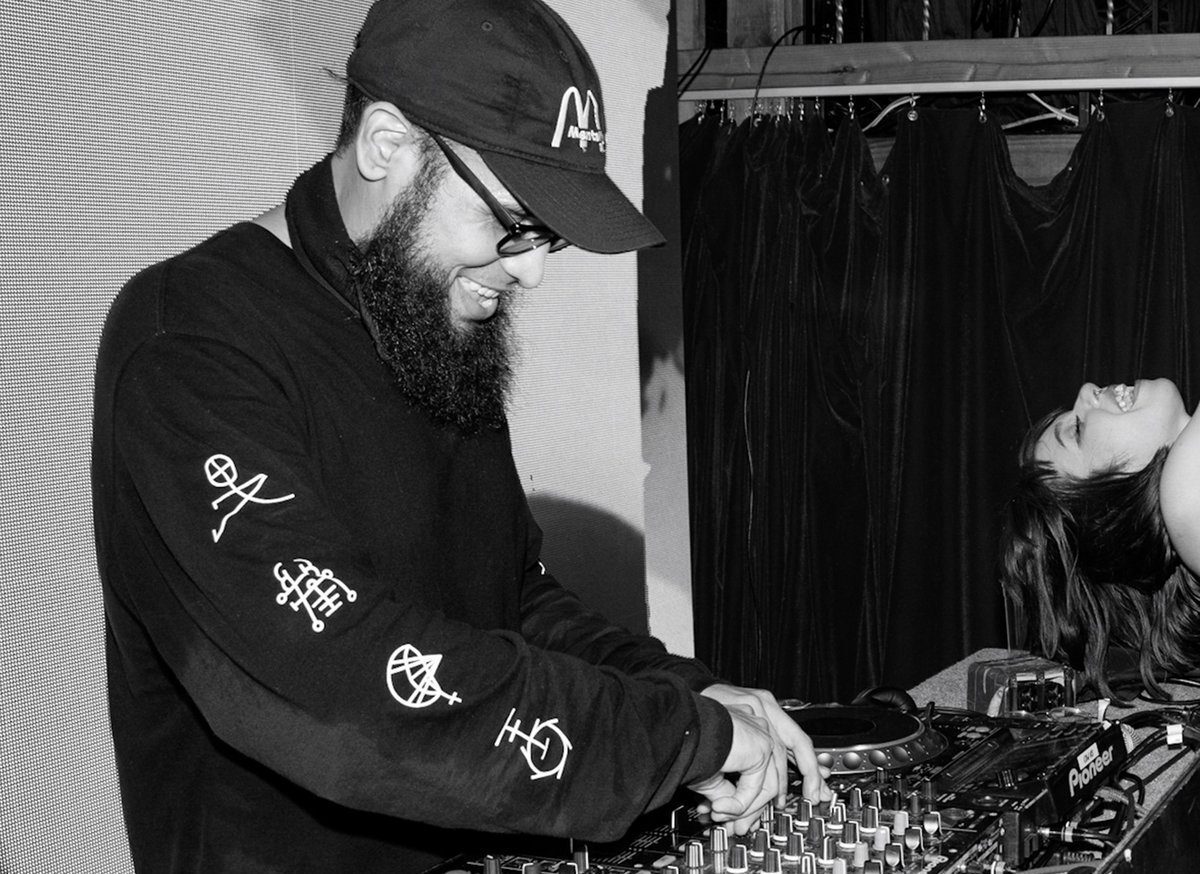
  • Lamebot’s “Acid Baile” is Miami Music That Bends Time

    Lamebot’s “Acid Baile” is Miami Music That Bends Time

    Miami is a city built on loops. The tide, the traffic, the basslines thumping through cracked warehouse walls. Time doesn’t flow here, it circles, it drips, it’s sticky.

    Which is why Acid Baile, the new six track EP from Lamebot on Otto Von Schirach’s Bermuda Triangle Records, feels like such a perfect Miami document.

    It doesn’t just play. It cycles, seamlessly looping the closing track back into the opener, daring you to ride again.

    The focus track, “How Much Was 1g?”, drops like a rollercoaster on fast-forward. You got galloping basslines, high-pitched timbales, percussion cues ripped from bass and Latin house. It’s trippy and inducing. At 3am at a Miami club the room will go feral, some kid might actually levitate.

    But this isn’t a rave weapon. It’s architecture.

    The title track “Acid Baile” is a sub-heavy storm, vocals cutting through wandering riffs until the whole thing locks into a relentless groove.

    “Touge” swerves like a midnight drive through mountain switchbacks, jagged snares, distorted synths, curves so sharp they feel dangerous until the euphoric acid release hits. And closer “Chaindrift” stretches the trip into house-inflected territory, a slow dissolve that loops you back to the start like time never existed in the first place.

    That’s the manifesto hidden in the music: repetition, release, forward motion. Rave as religion, chaos as teacher. Lamebot sharpens his fusion of baile funk, acid, and Miami bass into something darker, sharper, more expansive. It’s a sonic trip for the heads who know the night never ends.

    Lamebot Acid Baile Drop

    Acid Baile drops this fall through Bermuda Triangle Records, available on all streaming platforms with a limited vinyl pressing for the collectors who still believe in wax. The EP is six tracks deep, structured like a continuous mix, clocking in just under 25 minutes. It’s short enough to replay, long enough to lose yourself. It’s Miami music at its core: underground, unpolished, undeniable.

    We caught up with Lamebot to ask him about a recird release party. “I don’t have a traditional release party lined up, but I’ll be celebrating it through my monthly radio show, Strange Waves on Jolt Radio. That’s kind of my hub for showcasing new sounds, local producers/djs making waves in the scene, and it feels right to premiere Acid Baile there. Plus, I have been working it into my sets and will be part of future tour dates — so the dancefloors will definitely get the first taste.”

    Look for Lamebot to support the drop with shows across town.