Category: News

  • Cashmiere Kitties is this Saturday at Locust Projects

    Cashmiere Kitties is this Saturday at Locust Projects

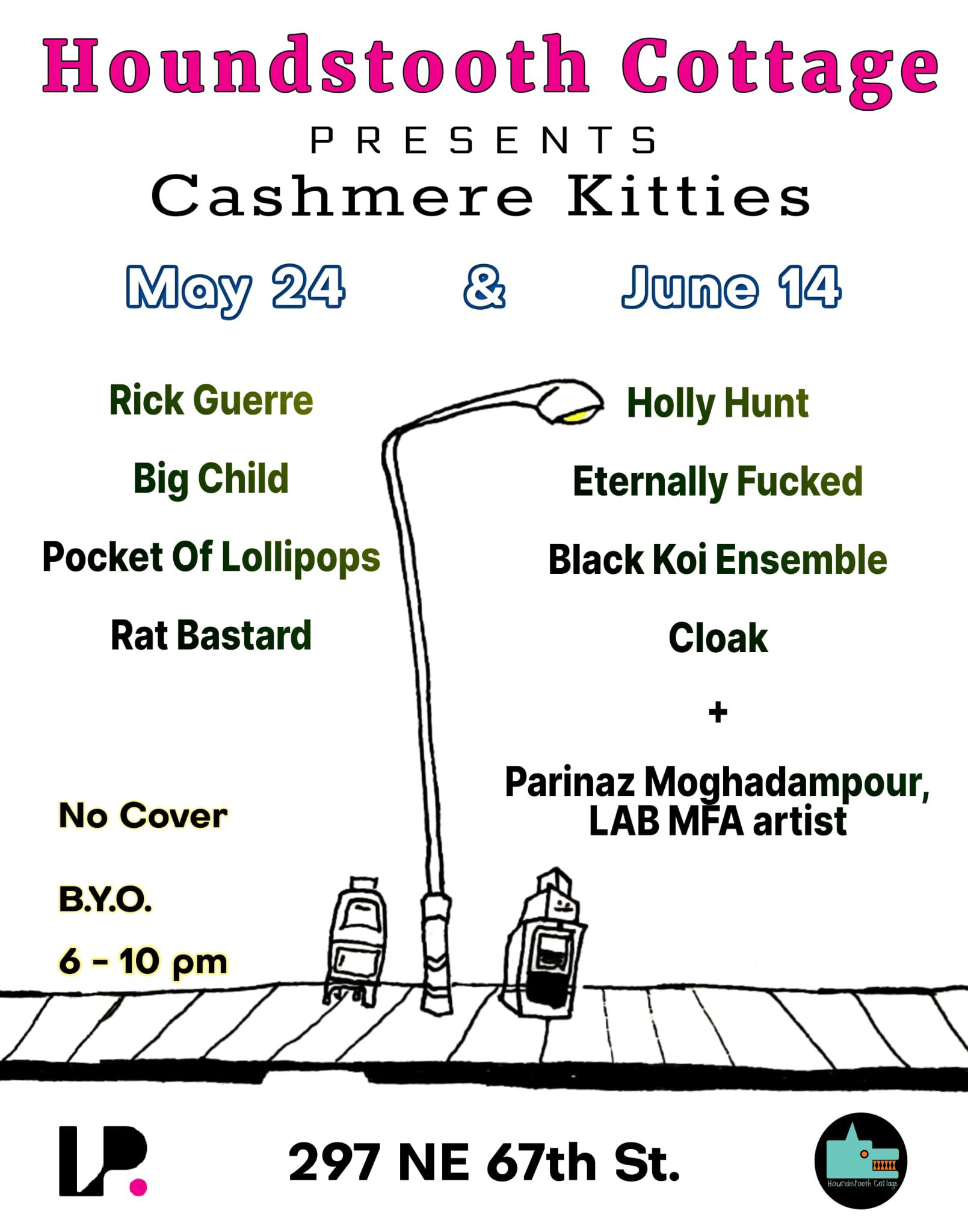
    Houndstooth Cottage will be hosting its Cashmere Kitties event at Locust Projects on Saturday, May 24 and Saturday, June 14 from 6-10pm. This is a free all ages event that will feature up to five acts each night.

    Cashmere Kitties is a mind-expanding, consciousness-warping satellite music festival, curated by Pocket of Lollipops the posh-punk South Florida outfit made up of husband-wife duo Maitejosune Urrechaga and Tony Kapel, who are also visual artists, authors, and run the Miami based label Houndstooth Cottage. The couple began experimenting with music as part of an audio visual art installation, eventually collaborating on lyrics. On the drums (Kapel) and the bass (Urrechaga) to refine their sound.

    Cashmere Kitties is a luxurious psychedelic event that showcases bands from a broad spectrum of genres and age ranges out of the bars and live music venues in Miami and in front of audiences that may not necessarily have had a reason to mingle.

    Saturday, May 24’s event will feature performances by Rick Guerre, Big Child, Pocket Of Lollipops, and the one and only Rat Bastard.

    Saturday, June 14 will have sets by Holly Hunt, Eternally Fucked, Black Koi Ensemble, and Cloak.

    You’ll also be able to check out the opening for Locust Projects LAB MFA artist Parinaz Mghadampour.

  • Theo Von Fails to Bring the Heat to Kaseya Center

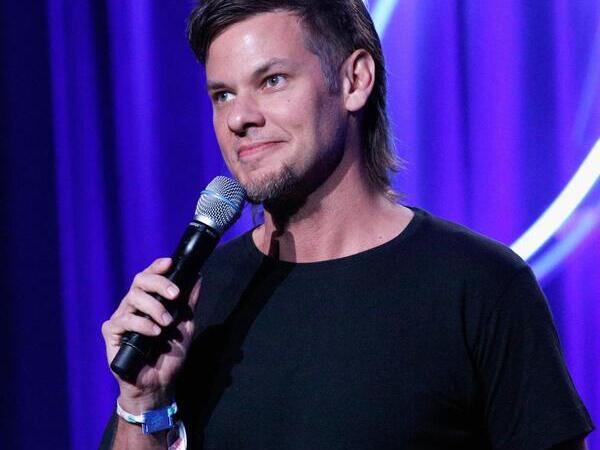
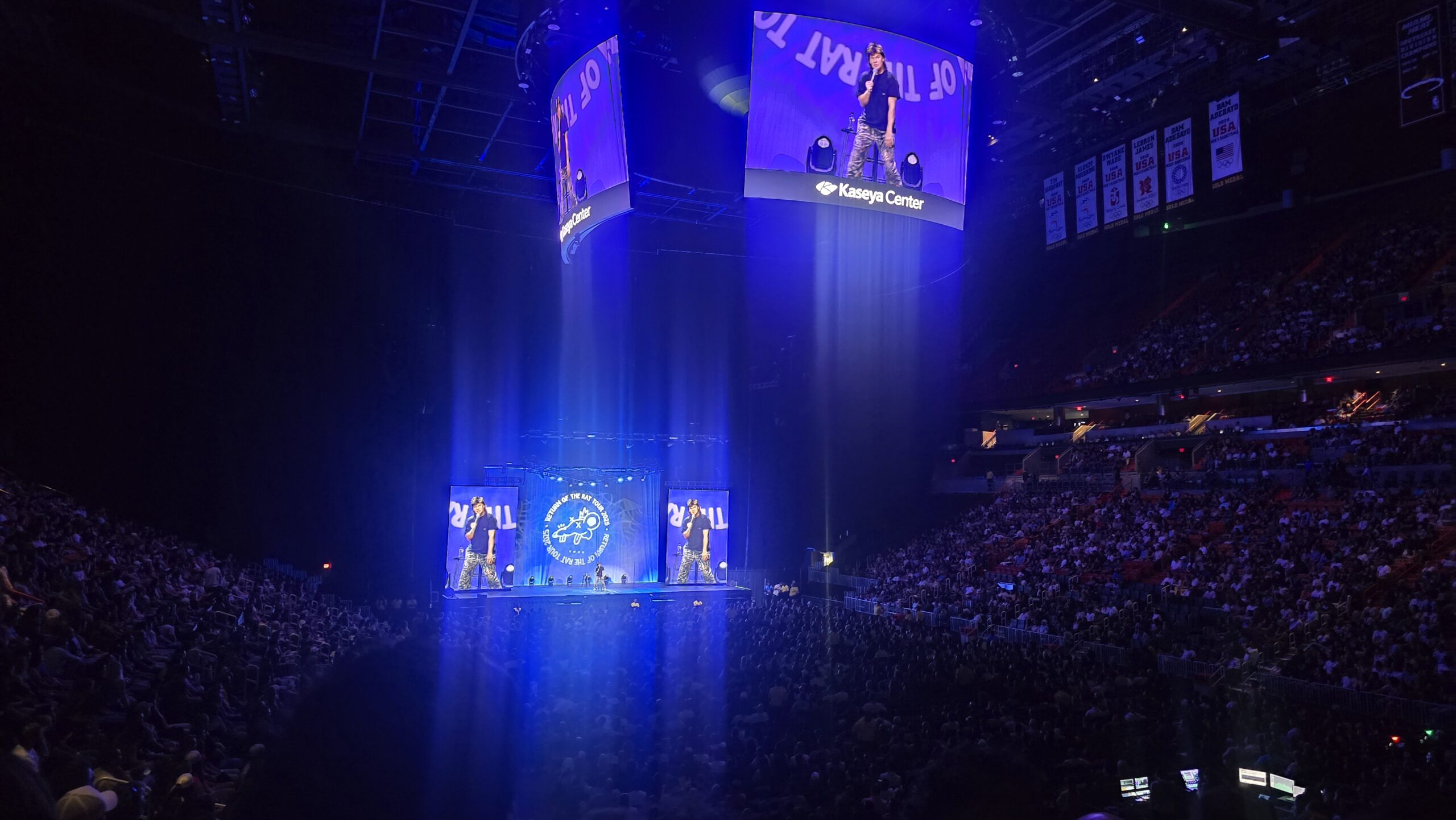
    Theo Von Fails to Bring the Heat to Kaseya Center

    When I was 20, I watched Billy Graham pack out Cleveland Municipal Stadium. Souls were saved. Literal storm clouds parted: even the Channel 8 weather guy admitted, Doppler in hand, that a miracle had taken place over Northeast Ohio.

    So yes, I’ve seen revival. I’ve seen spectacle. I’ve seen someone take a 90,000 seat stadium and make it feel intimate.

    Theo Von did not do that in Miami on Saturday night.

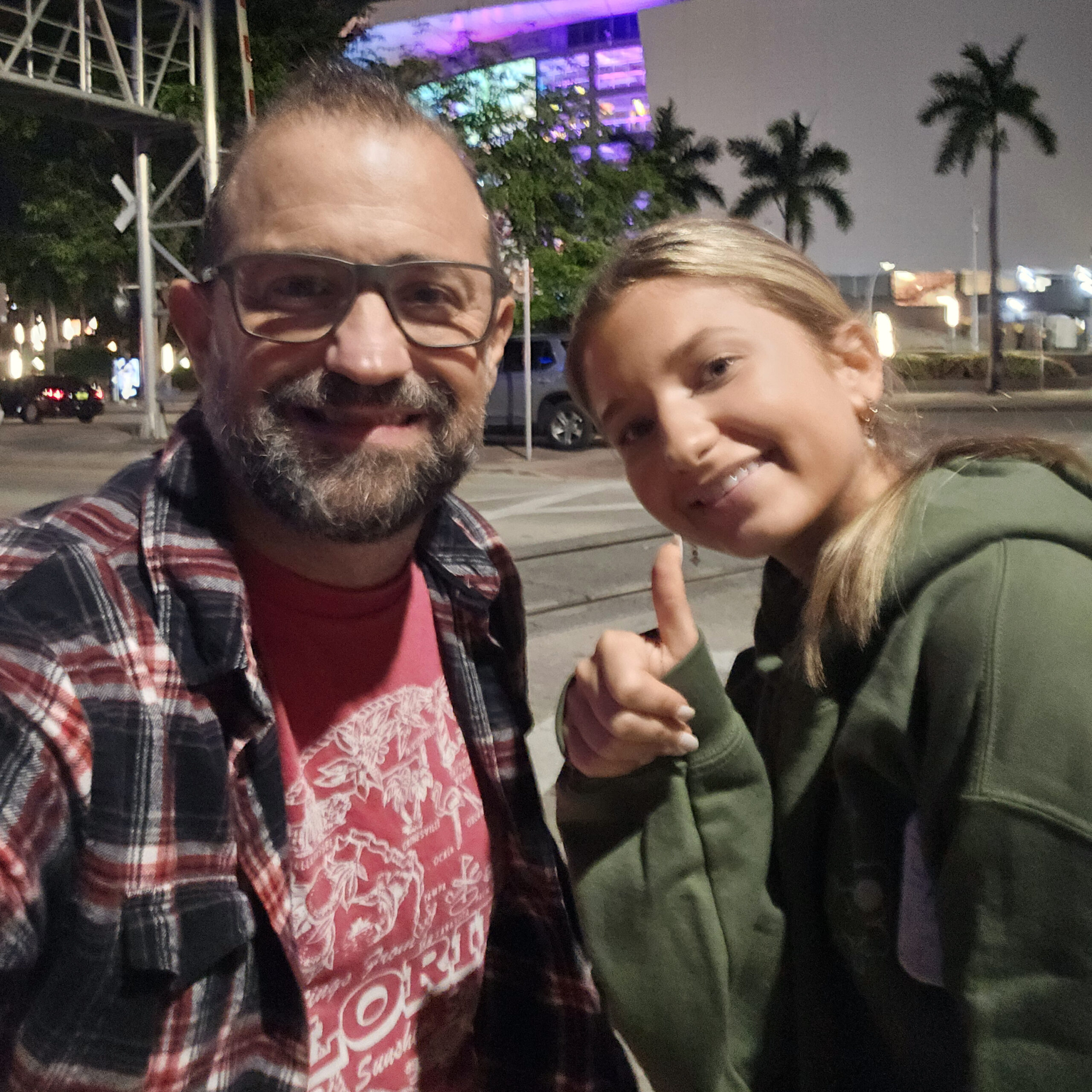
    My 17-year-old daughter Julia got me into his podcast This Past Weekend a few years ago, and I’ve been a fan ever since. Theo’s delivery is warm and unexpectedly smooth even when it covers nonsense. He brings on everyone from A-listers like Trump, Bernie Sanders and Ben Affleck to everyday characters like garbage men, lunch ladies, and police officers. The guy has charm, empathy, and a gift for making the oddly specific seem universally hilarious.

    He’s not Larry the Cable Guy 2.0. Larry played a character. Theo is a walking, talking anthropological specimen: he’s what happens when you mix Beavis, Butthead, and Boomhauer, then send the baby to college for Urban Planning.

    So when I saw he was coming to Miami, I snagged two tickets. $75 a pop. Julia was thrilled.

    Theo’s true power is in eye contact. His podcast works because he’s right there with you, speaking directly into the camera with all his vulnerability and weirdness. But in an arena? That intimacy gets swallowed whole by the space.

    Normally after a good comedy show (Kevin Hart, Daniel Tosh, Kevin James), I’m quoting bits for days to anyone who will listen. With Theo? I barely remembered anything by the time we hit Biscayne.

    Theo Von wore Yeezys,

    an odd choice in light of Kanye West’s very recent “Heil Hitler” rap release. Von made a limp attempt at a joke about walking a mile in someone else’s “joos.”

    Bright spot? Amir K (Amir Kamyab), Theo’s opener. Born in Iran, raised in L.A., he absolutely crushed it. If you get the chance to catch him at the Dania Improv in August, do it. Also, the animated opening sequence featuring Theo’s podcast guests was a highlight.

    As for the audience – it was a weird demographic. I was one of the oldest guys there. Julia was probably one of the youngest girls. In between? Hordes of 15-year-old boys with broccoli haircuts all hopped up on Andrew Tate and overpriced merch.

    I would describe Theo’s politics as BroCon: conservative with a side of self-deprecation, and just enough open mindedness to keep things interesting.

    I’m a conservative myself, but I appreciate his willingness to host conversations with people across the spectrum. He’s not a partisan hammer. Theo Von in an arena is like an AA meeting at a Costco: too big, too loud, too many moving parts. Von needs a tighter room – something like the Hard Rock up the road with a 6,500-person capacity. There, the storytelling could breathe. The crowd could feel seen. Instead, we got a lukewarm arena set from a guy who’s usually on fire in front of a camera.

    Toward the end, Theo got reflective. He spoke about recovery, spirituality, and hinted at an even higher calling. His brother is a pastor. And honestly? I could see Theo preaching one day. He has the storytelling chops, the voice, and the redemption arc. If he ever goes full Billy Graham, I’ll be there, weather permitting.

  • The Damned Blessed Fort Lauderdale with Punk Rock

    The Damned Blessed Fort Lauderdale with Punk Rock

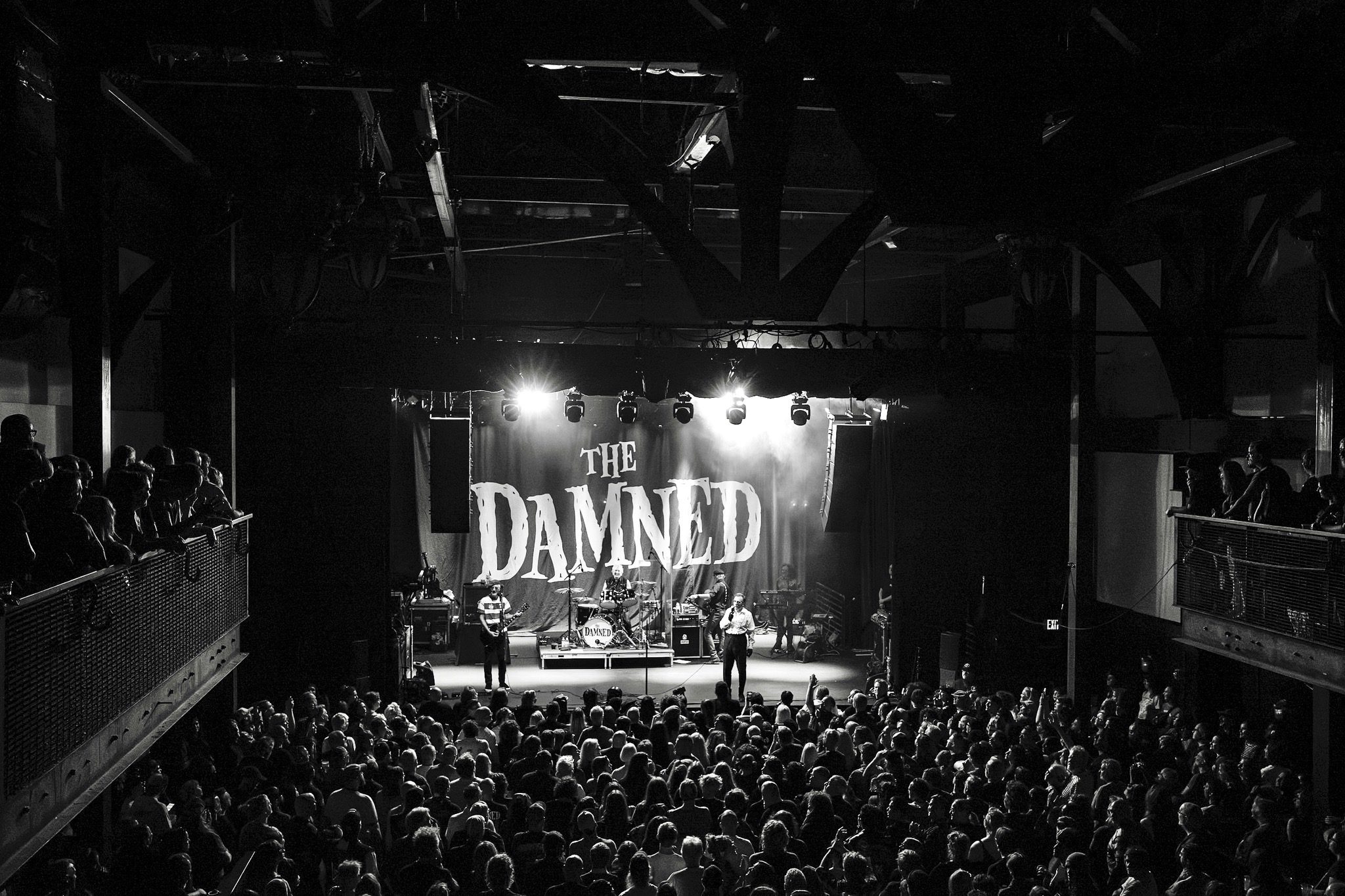
    The recipe for a great band is both highly mysterious and delicate. If one, even seemingly insignificant ingredient is changed, the end result can be disastrous. Gone. Forever. Fortunately, the (mostly) original Damned was back in full swing last night at Revolution Live, including Rat Scabies. That’s right, THE Rat Scabies, on drums!

    The set began with long-esteemed anthems like “Love Song,” “History of the World,” “Machine Gun Etiquette” and “Wait for the Blackout.” If the audience had any reservations about the vitality of these older gents, those were quickly dispelled. Punk rock is alive and well during the AARP years!

    Singer Dave Vanian looked and sang like the high-end crooner he is. His dolce voice is an interesting juxtaposition with the aggressive, biting music, and works so very well.

    Guitarist Captain Sensible coaxed his Gibson SG seamlessly from melodic lines to power chords to tasteful technical lead passages. It would have been nice to have recently deceased original member Brian James on guitar, but Captain Sensible proves he’s much more than a punk figurehead icon. He is brilliant.

    Bass player Paul Grey is not an original member, but he’s been with the band since 1980. There’s a reason for that. He looks like he belongs and the wonderful tone of his Rickenbacker does not spoil the stew in any way.

    After the energetic, up-tempo start, they snuck in some later-album songs. Then, with the assistance of the keyboardist traveling with them, Monty Oxymoron, they slowed the pace with “I Just Can’t be Happy Today,” and classic Damned covers “Eloise” and “Alone Again.” With everybody in the crowded hall now completely locked in and thirsting for more, the set culminated with “Ignite“ and “Neat, Neat, Neat.” The first encore was “New Rose,” which featured the wonderful recklessness of Rat Scabies’ drumming, and the second encore was “White Rabbit,” followed by  “Smash it Up, Parts One and Two.” Talk about finishing strong and leaving the audience wanting more.

    I hardly think I’m alone when I say this show was meaningful. When I was a young punk and heard the song “Smash it Up,” I did. Imagine the disappointment when through the years I saw different incarnations of The Damned that weren’t up to snuff. After last night’s masterful performance of the very first punk band (they pre-date Sex Pistols), all is right, and I want to smash it up again. Long live the The Damned!

  • Allen Ginsberg in 1985 at the Miami Book Fair on Russia, Socialism and Con Men

    Allen Ginsberg in 1985 at the Miami Book Fair on Russia, Socialism and Con Men

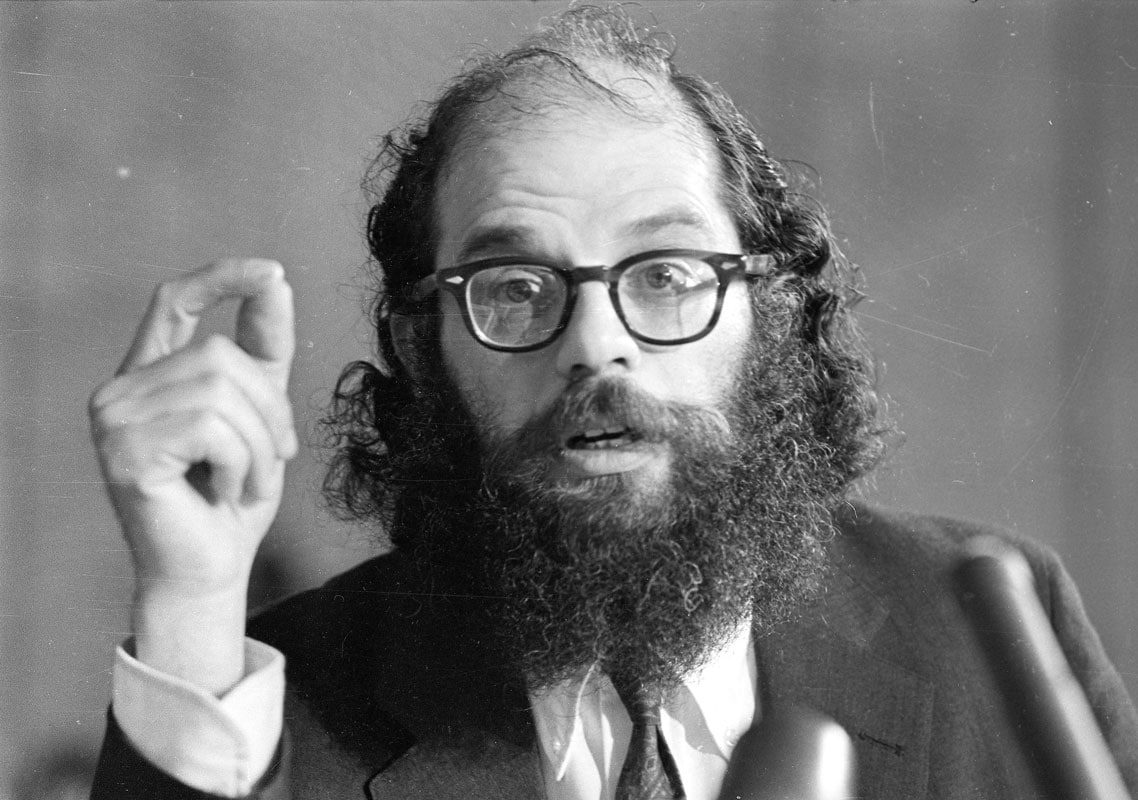
    Allen Ginsberg performed at the Miami Book Fair in 1985, forty years ago. It was year two in the history of the Book Fair. The presentation lasted almost two hours. Ginsberg read poems, sang songs, and led a long Q & A from an unseen audience. Often his answers and rants veered into a political realm.  It is eery how relevant they feel today.

    In this first video, Ginsberg is responding to a question about traveling to Russia. Asked about conjuring the spirit of poetic camaraderie when meeting Russian poets, Ginsberg’s response is both poetic and political. The freestyle rant Ginsberg chants in the short clip is unhinged. It’s absolutely classic. Take a listen.

    Allen Ginsberg at the Miami Book Fair, 1985

    In this second video, Ginsberg is explaining the hypocrisy of the conservative movement, on how it co-ops the term “socialism” and how we should not throw around the term “fascism” because we still have free speech. It’s remarkably relevant today as it was forty years ago.


    In our final video, Allen Ginsberg is asked about debunking Mormonism and Scientology and he quickly turns it into a sharp political skewer of the times. Again, his insights in 1985 seem just as relevant today as they did forty years ago.


    Allen Ginsberg passed away in 1997 at the age of seventy.

    In 1985, at the Miami Book Fair, he was on the top of his game.

    Sometimes the best minds of a generation are not destroted by madness. Instead they can see clearly what is truth and what is lie.

    A few of our readers may remember this event — they may have been there, on an autum day in Miami, 1985.

    Flashback on Miami

    In a new summer series on The Jitney, with the help of the Wolfson Archives, the largest database of visual media, home videos, and broadcast journalism documenting Miami’s history, we are looking back at unique events. In an attempt to see where we are, we want to see where we’ve been and acknowledge our ancestors and the cultural crusaders that came before. History has a way of repeating itself and unfolds in cycles, usually moving towards progress. Today, we took you to the year 1985. The great beatnik poet Allen Ginsberg was in Miami and the trip very much takes us back to the future.


  • Abandon All Hope – Fiction

    Abandon All Hope – Fiction

    Brian Newell caught his reflection in City Hall’s double glass doors. Straightening his bowtie, he reassured himself that its red and navy stripes achieved a classic look — a handsome pairing with his blue on white seersucker suit — his old-school homage to a more elegant past. That he’d sweat through the shirt at the collar, jacket at the arm pits and pants at the crotch, didn’t detract from the effort. Men’s clothing choices should be stylish, to bring a little sophistication to the daily grind.

    Brian took pride in his efforts as he stepped from Miami’s hot, humid morning into City Hall’s hyper air-conditioned lobby. Frigid-as-a cold-plunge, he inhaled sharply, and exhaled, expecting to see his breath. He shivered, teeth chattering. The sweat dampening his skin and clothes vaporized, flash freezing his body as it evaporated. He quaked and quivered. Muscles tightened; his scrotum shriveled. He blinked and looked around, expecting to see ice sheeting the walls. Brian hugged himself, flapped his arms and hugged himself again.

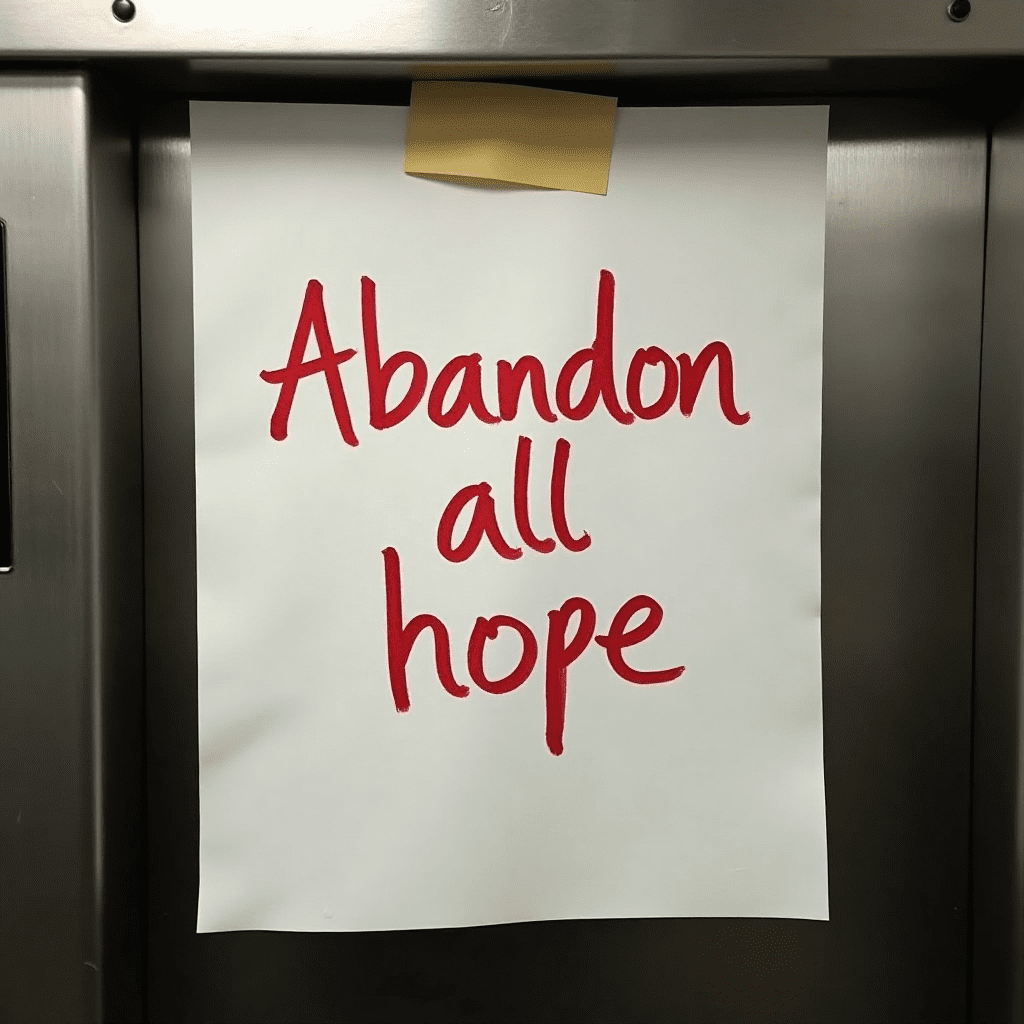
    On his left, a clear plastic sign on a smooth wooden countertop read, SECURITY, SEGURIDAD, SEKIRITE. On the counter’s far side, beneath a blue and white quilt, a seated figure snored softly as riffled playing cards. Before him a metal detector, its smooth, anodyne gray surface conjured dental office equipment and CIA interrogation rooms. A hand scrawled note, red Sharpie on a white piece of eight by ten, taped above the detector’s entrance, read Abandon all hope… To his right, eye level on an aluminum folding ladder, a pair of black alligator shoes, high on toe tips, shifted from left to right. The repeating red handcuff motif on black socks suggested the wearer’s sense of whimsy.

    Brian looked past the socks and up black trousers legs to a man in a canary yellow guayabera, adjusting a wall mounted camera. “And, now?” he asked. “Bueno,” he said, nodding as he gave the camera a “thumbs up,” and began down the rungs. His cologne arrived before he reached the floor; a potent musk squeezed from the anal glands of endangered Brazilian river otters. Its testosterone-rich scent stirred Brian’s primordial essence. His right hand curled into a fist.

    The man alighted the ladder and hitched his crotch. His head came to Brian’s chest. When he noticed Brian beside him, he did a startled upward double take. Black earbuds plugged both his lobes. Short black hair curled in on itself, weaving a thick mat across his head. He had five o’clock shadow at nine a.m. He stared unblinking into Brian’s eyes. He exhaled coffee breath. Without changing his gaze, he thrust his right hand up, pointing at the sign on the metal detector. “You do that?”

    “I just got here.”

    “Answer the question.”

    “No, I didn’t do that.”

    “Can you prove it?”

    “I just got here.”

    “I don’t like your answers.”

    “I don’t like your questions.”

    “Get used to them.” He lifted the hem of his guayabera, revealing a Glock nine holstered inside the trousers on his right hip and a gold badge clipped to his belt on the left. “Lieutenant Marcos Rivas, head of intelligence, Miami PD.”

    “Brian Newell, Stobo de Pas Park.” He held out his hand to shake.

    The man looked down at the hand, then back up to Brian. “I knew that.”

    “Then you know, I didn’t put that sign there.”

    “It’s an open investigation. I can’t comment.”

    “Didn’t you just asked me if I did it?”

    “I’ll ask the questions here.”

    “Ask me again, I’ll give you the same answer.”

    “Do you think I’m stupid? I’m head of intelligence. I’ve seen your file.”

    “File? What file?”

    “Who said anything about a file?”

    “You did. Just now.”

    “Forget the file.” Marcos poked a finger in Brian’s face. “You’re a civilian. Get me? I am the professional in this conversation. A sworn officer of the law. Part of a large department, where we decide what’s….”  Marcos did air quotes, as he said, “authorized under discretionary rules implemented day one of the Trump Presidency.”

    Brian held ups his hands, “Who,” he did air quotes, “authorized these discretionary rules?”

    “I do the air quotes here.”

    “Part of the new discretionary rules?”

    “Do you have any idea how close we are to Guantanamo?” Marcos held up his right hand and moved thumb and index finger together, peering up at Brian through the ever-narrowing gap. “Keep it up. I’ll have you tagged, bagged and rendered before lunch.”

    “Rendered?”

    “Renditioned. Bag over your head. Made to kneel for hours on the tarmac of a secret airstrip in the Everglades. Flown like cargo.” He shook his head. “No, worse than cargo, cause who’s going to care? No one will ever find you or any trace of you.”

    “Are you threatening me?”

    “Promising.”

    “I haven’t done anything.”

    “Heard that before.”

    “The Constitution won’t allow it.”

    “That’s right. Call the Constitution.”

    “I can’t call the Constitution.”

    “Maybe you want a lawyer.”

    “A lawyer? For what? I haven’t done anything. I have an appointment in Commissioner Carpenter’s office.”

    “With J.J.? He’s on his way to the federal courthouse and his aide is in Santa Clara. That’s in Cuba if you didn’t know, looking after her,” he did air quotes again, “Tio Alberto.”

    “I’ll just stick my head in to see who’s there.”

    “His receptionist and his legislative aide. That would be Nelly Sheridan and Gustavo ‘Gus’ Nogura.”

    “Thanks for letting me know.”

    “You didn’t hear it from me.”

    Marcos lifted the ladder onto his right shoulder, walked to the metal detector. He leaned the ladder against the portal and rose up on tip toes. He failed to reach the sign. Knees bent; he jumped. His right hand flailed just short of its target. He leapt again, missed and began opening the ladder.

    Brian stepped forward and grabbed the sign between thumb and forefinger. “Here,” he said, smiling, holding the note before Marcos’ face.

    “A smart guy, huh?” Marcos snatched the paper from him. “You’ve put your fingers all over my evidence. Ruined chain of custody. You trying to kill this investigation before it starts?”

    “I was trying to be helpful.”

    “Helpful? Helpful to who?”

    “Whom,” Brian said. “Helpful to whom.”

    Marcos turned his gaze up to the camera. “You get that?” He touched his right ear and nodded. “Keep an eye on him.” Marcos balanced the ladder on his left shoulder and walked through the metal detector — red lights flashed, sirens wailed, horns blared. Marcos raised his right hand and snapped his fingers. The lights and sirens ceased.

    “Abandon all Hope” is the third installation of a serialized novella. Click here to read the others.

  • Round Two – Paintings, Flies, & the Kind Old Man

    Round Two – Paintings, Flies, & the Kind Old Man

    The days I started spending by watching over my mother were long. Very long. Even in the beginning stages or her early onset Alzheimer’s. Sande was diagnosed at 59 years old.

    There’s a great book about caregiving for people with various forms of Dementia called The 36 Hour Day.  I can’t recommend that book enough for anyone unfortunate enough to find themselves in need of such information. It wasn’t long before I understood what the title meant. Even on days that might be uneventful, one must be vigilant. The slightest nap or distraction could lead to a horrific and unforeseen tragedy that would ultimately be the caregiver’s fault.

    It drains you.

    Going home after a full day with my mother felt like I’d been gone for a week. I couldn’t even imagine what my pop must have endured each night.

    Usually, my mom and I would just watch daytime television in bed while I folded laundry or something. Those days were cool, but they would drag on.

    I learned to stop looking at the clock. The key is finding activities that you can engage in that somehow include the person you are watching while not challenging them. Something they are comfortable and familiar with.

    Since we had just shut down my mother’s art dealing business, we had a huge room full of framed and unframed paintings and prints that needed sorting.

    I figured my mom could oversee the sorting of all the art she acquired over the years. I had no idea of what anything was worth. A job like this would already be quite an undertaking on its own.

    Now, factor in my mother’s capricious mental state, her uniquely abstract filing “system”, and then her dreadful handwriting style to decipher in her old ledgers. All this would make cataloging and determining art value quite the time-consuming challenge. But time I had in spades. It would seem that The Time Thief could give chunks of hours as well as take.

    I basically had to become an archeologist tasked with my mother’s accumulation of various genres and different periods of art during her time as a gallery owner.

    I was looking for hints, deciphering signatures, and researching talented, but largely unknown artists who had crossed my mother’s path over the last 20ish years.

    The whole process was admittingly a bit triggering.

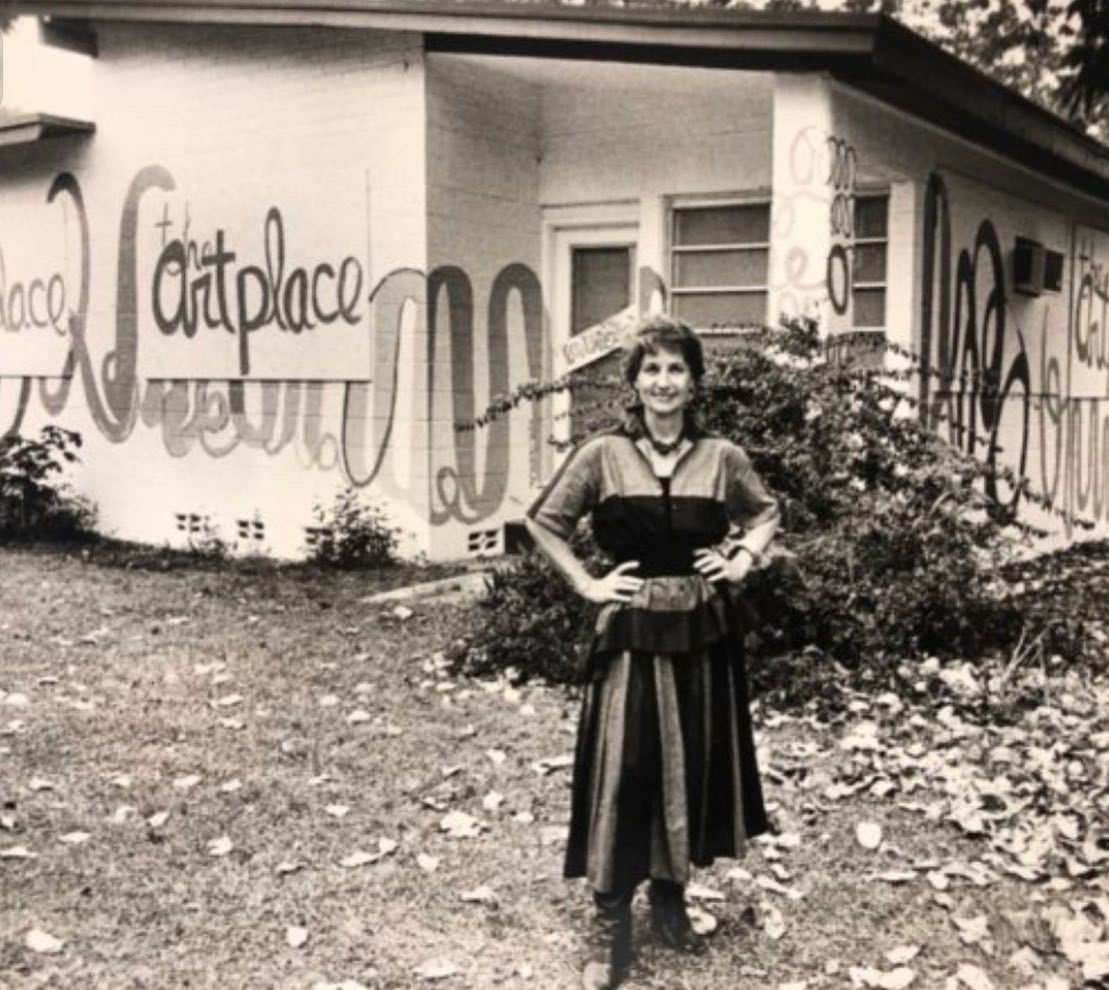
    It brought me back to my childhood in a variety of ways. In 1980, I turned 10 years old. My mother opened up her gallery, “The Art Place” in a cool little artsy village called “Cauley Square.” Cauley Square was sort of a historic hidden gem of a community founded by a woman named Mary Anne Ballard, who purchased and restored the place with her husband in 1949.

    I liked Mrs. Ballard, as I called her. I addressed her that way out of respect, even though she had been a widow for many years. She was always very sweet to me. She was the most beautiful old woman I had ever seen. Her skin had the appropriate distribution of wrinkles but was flawless. Mrs. Ballard’s long, gorgeous white hair was always kept neatly and extended past the small of her back. She perpetually had some sort of antique hair clip fastening her long, ivory braid back, tastefully framed by rare stones or crystals in both her necklace and earrings as well. All her jewelry had stories. Mrs. Ballard would would sit me down and tell me sometimes when I asked about them.

    1980 was the first tough year for me. That was the year that my grandmother on my father’s side passed on the day of my tenth birthday. The only grandparent I ever had.

    The call came as I was cutting the ice cream cake. Heart attack. She was my “Abuelita” and I absolutely adored her. It was my first real experience with deep loss. I refused to go to the funeral. My father understood. But it was something that weighed heavy on my young mind.

    Spanish was my first language. When my Abuelita died, I refused to speak Spanish to anyone for years. She didn’t speak any English. I viewed it as “our language”. After a while, I forgot it. I still can’t speak Spanish to this day.

    Some years prior to that, my mom was the victim of a terrible car accident that damaged her spine for life. She could not pick up anything that was very heavy at all after that.

    My father worked all the time, so what that meant for me, was…. well, everything.

    All the day-to-day chores that most people take for granted were my responsibility to perform while growing up. Vacuuming, taking the garbage out, cleaning, yard maintenance, you name it. That was now my job. I didn’t feel it was fair that I had to do such things. All my friends didn’t have to do any of that.

    Just about every time I felt I had enough slave labor, I’d storm into my mother’s room, ready to protest. Then I’d see her on her bed, feet up under several pillows, laying on her heating pad, crying from the pain in her back.

    What was a mother’s son to do? Her tears were always my kryptonite. One drop from her chestnut eyes and I’d move the world to make them stop. I used to try to kiss them away if she would let me.

    My mom even took to fake crying when I was causing problems for her for too long. A horrible little game she would play with me, in retrospect. I would always drop whatever issue I had just to get her to stop her fake crying. Probably not great parenting, but very effective.

    Now that we had The Art Place, I had a new unpaid job. Transporting, storing, hanging, and re-hanging volumes of mostly framed art was now part of my daily life for years to come.

    Sande was a real figure in Miami’s art community in the 80’s. She had a loving relationship with the local artists and had a great eye for good art. She had clearly learned a lot from her brief marriage with the Bulgarian artist, Nicola Blazev, in her early days. She was a staunch supporter of her artists and vehemently believed that just because they were “local artists” they should not be treated as lesser artists just because they happened to live in South Florida.

    That trait clearly got passed on to me.

    During my years of booking bands in Miami venues for a living, I felt the same way about the local bands I would book and put on shows with. I always believed that we have some of the best musicians in the world in Miami. It frustrated me to no end that it would be hard to get them to draw people to my events just because of where they lived. Just because they were viewed as “a local band”.

    As I said before… I truly am my mother’s son.

    Most of the artists my mother represented also wound up being her close friends. The majority were lesbians. That didn’t bother or confuse me at all. Some were super cool. I especially loved going to women’s rights marches with them and my mom. They were kind of badass.

    But many I did not like. They just didn’t acknowledge me very much. It was like I didn’t matter. Like I was living evidence of my mother’s heterosexuality. They certainly were not very friendly with my father. But he didn’t seem to care at all, so why should it bother me? He always respected my mother’s life apart from his and continued to support her always. He was cool like that.

    There was one artist that stuck out to me, though.

    I’ll never forget him. He taught me more about my mother with one short story than I could have ever learned on my own as a child. His name was Frederick Sprague. Originally from the Cezch Republic, Frederick painted his early works on framed wood as a first draft for giant stained glass works he did for Catholic cathedrals across Eastern Europe.

    He had moved to South Florida and was looking for someone to represent him and sell his paintings. His work was very dark and religious. Right up my alley. I didn’t really have much of an opinion on most of the art in my mom’s gallery. But Sprague’s creations appealed to my taste and curiosities. I would just stare at them forever.

    There was a lot of competition in the art community for people who wanted to work with Sprague. Many art dealers with bigger names all interviewed with him, but he decided on my mother. It was a big deal for her. Sande was stoked.

    One morning, I went with her to her gallery to meet with Frederick and discuss their plans together. I didn’t think much of it. Most of the artists just ignored me and I would usually wander around Cauley Square, climbing trees and exploring the old, uninhabited houses and shacks nearby. Looking for secret treasures that I never found. Just staying out of the way, basically.

    Frederick Sprague gently walked into my mom’s gallery and right away I could tell he was different. He was old. Very old. But he had a youthfulness about him. Frederick was short and thin. About the same height as my five-foot mother.

    He dressed very neatly with a button-down shirt that was tucked in without a wrinkle into his khaki pants fastened round his svelte waist with a leather belt. His hairline was receding a bit, but he had a modest mane of white hair that complemented his long, snow white, artistic goatee. He wore clear glasses that could not mask his glistening, sky-blue eyes.

    Right away, Frederick looked down at me with those eyes and smiled. I looked up and smiled back. He had questions for me before he really engaged with my mother. Not strange questions. But he asked about me, and that was huge in my mind.

    Sprague and my mother spoke softly about business for a little while. He wanted to arrange some of his pieces in a certain order. My mom told him that I would help him with that and then she excused herself to speak to some people admiring the art in the next room of her gallery. Frederick was very polite with his instructions to me as I happily helped tend to his eccentric, borderline blasphemous, oil paintings on wood.

    Then he spoke to me with a hint of a Czech accent.

    “Eric. Do you know why I chose your mother to represent me?” I told him no. Fredrick went on. “I met with so many silly art people. Frankly, I was starting to get bored.”

    He handed me a small painting and motioned for me where to place it.

    “Then I met your mother. We were speaking. Actually, I was speaking to her, when she suddenly stopped me.” He softly grabbed another painting and placed it near the other one himself this time. “You see, there was a fly in the room. Buzzing around. As flies do.

    Your mother immediately found a plastic cup and a piece of paper. She followed the fly around for a very long time until she was able to put the cup over it. Then she carefully slid the paper under the cup and took the fly just outside to set it free. Then she returned to our conversation as if nothing had happened.”

    I was a bit perplexed so far by his little fly tale. I thought to myself, “Yea. That’s the kind of shit my mom does all the time.”

    Frederick stopped what he was doing, the corners of his mouth curled up into a sly little grin. “That’s when I knew. I knew I would work with her. Anyone who takes such care to preserve even the tiniest life, is someone I want to represent what I do and what I have created.”

    At that moment, my mother walked back in the room and Frederick Sprague and I continued working as if nothing had happened.

    Frederick and I never spoke of it again. But I’ll always remember that moment. My years of alcohol abuse since have wiped away much of my memories. But for some reason, I remember that interaction like it was yesterday.

    That’s how I choose to remember my mother, Sande Garcia. Each life was just as important to her. No matter how big or small. I’ll always have that memory. I hope… Round two with The Time Thief would be a tie.

  • Punk Rock Mayhem: Bebop and Rocksteady’s Mutant Moshpit

    Punk Rock Mayhem: Bebop and Rocksteady’s Mutant Moshpit

    It began with a meme.

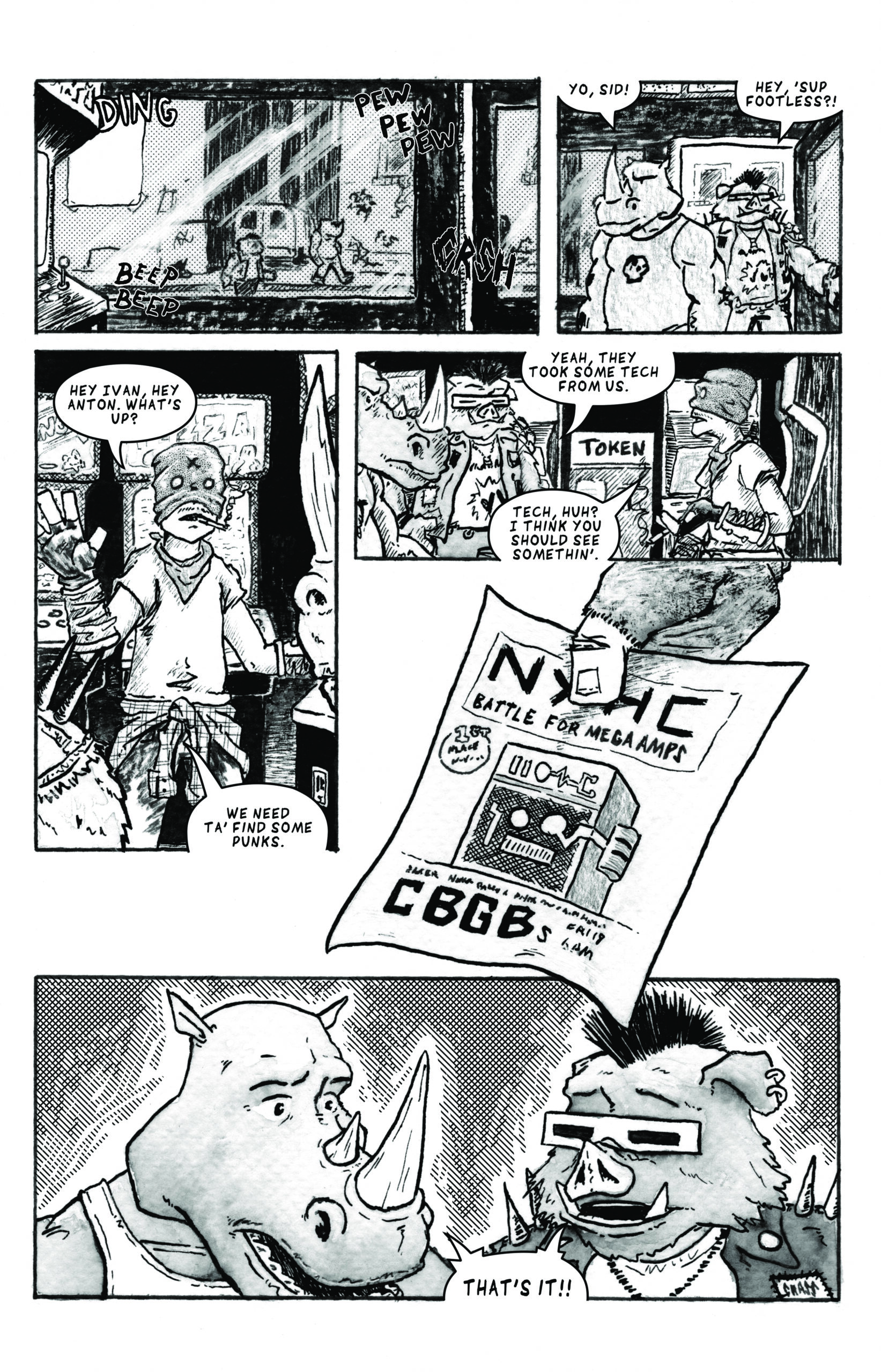
    When comic artist Anton W. Blake spotted a satirical article by The Hard Times claiming to interview “NYHC legend Bebop,” he immediately sent it to his friend and fellow creator Manny Gomez. The caption was simple: “Here’s our collab.” From that seed of absurd brilliance, Bebop and Rocksteady’s Mutant Moshpit was born—a 12-page punk-fueled TMNT bootleg comic that mashes mutant chaos with a lovingly curated mixtape of hardcore, skate punk, and noise.

    “We approached each step of the process in a loose, run-and-gun way,” says Blake.

    “Early on, I described it as treating it like writing or playing a punk song. Trim the fat, get in and get out as fast as possible.”

    With both creators slated to appear at Indie Comics Creator Con (IC3) in New Haven, Connecticut, the timeline was tight. They had just over a month to go from idea to print. But the deadline pressure didn’t hinder the process—it defined it.

    “It needed to be short, fast, and loud,” adds Gomez. “In twelve pages, telling a full story was a challenge. But once Anton and I found the right rhythm, that energy came naturally. It really did feel like writing a song.”

    And like any good album, Mutant Moshpit comes with a tracklist. Inspired by Derf Backderf’s Punk Rock and Trailer Parks, Blake and Gomez assembled a soundtrack that mirrors the comic’s pacing. It’s loud. It’s bratty. And yes—it ruled on the car ride to the con.

    “We also played it on our morning drive to IC3,” says Gomez. “That ruled.”

    Despite being their first official collaboration, the chemistry between Blake and Gomez is undeniable—both on the page and off. So, will we see more of these anthropomorphic punksters?

    “Never say never,” Blake says. “We haven’t discussed a direct sequel, but…”

    “If there are three things punk bands love,” Gomez chimes in, “it’s tours, benefit shows, and reunions!”

    For now, the duo is focused on their own solo projects. Blake is working on issue #3 of Zethia Space Witch through Cosmic Lion Productions, while Gomez, who serves as Assistant Comic Book Editor of Monkeys Fighting Robots, is co-writing the grindhouse- tinged Relic Hunter—a reality-hopping fantasy that sounds like Conan the Barbarian dropped into a John Carpenter flick.

    But the door remains open. Because when punk mutants and DIY spirit collide, there’s always room for an encore.

  • 14 Years of Yo Miami: Building Community & Connecting The Dots

    14 Years of Yo Miami: Building Community & Connecting The Dots

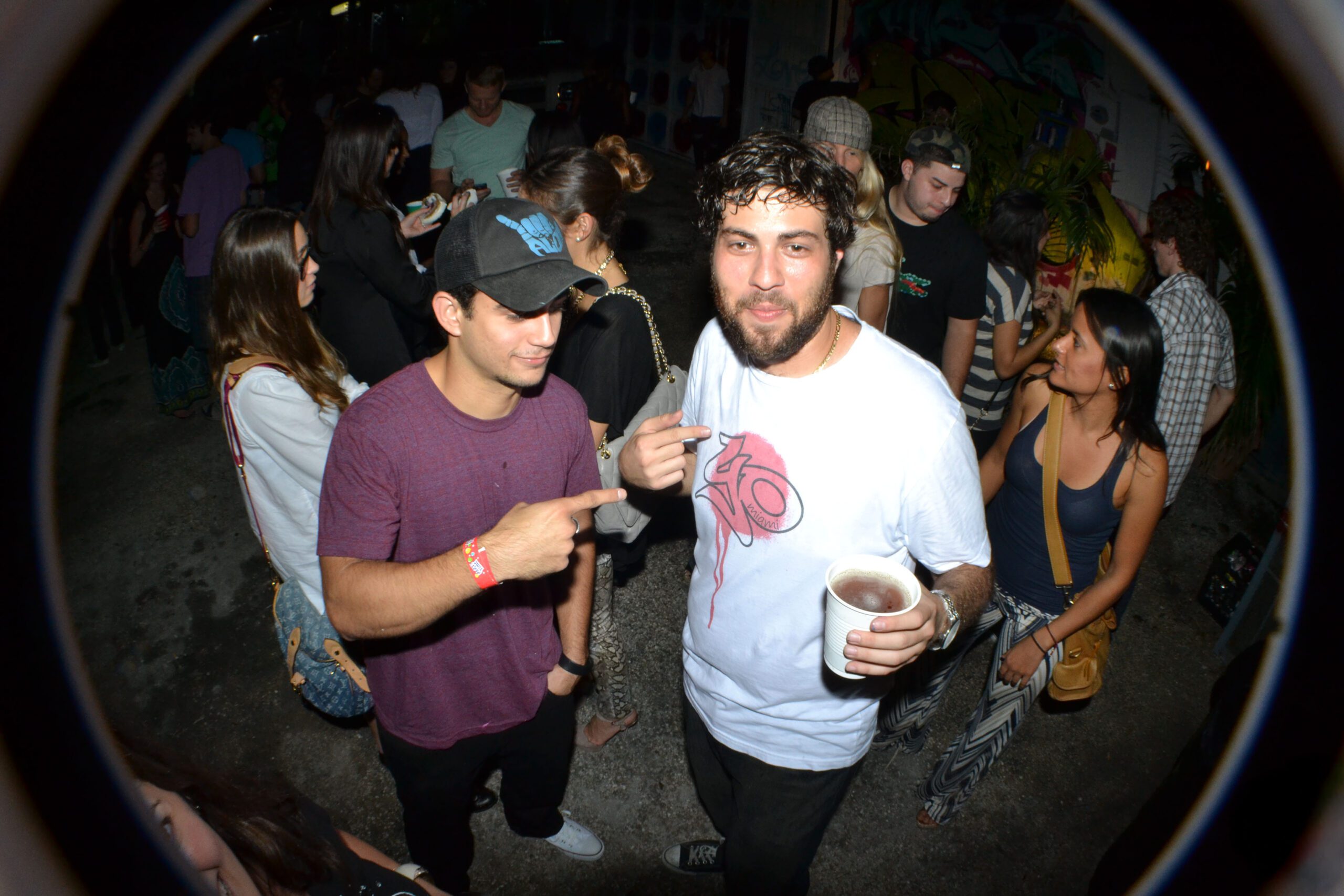
    It’s crazy to think it’s been 14 years since I formally registered a company called Yo Miami on sunbiz.org. I was 23, just a year out of college with nothing but enthusiasm and a Facebook page that had somehow accumulated over 200 followers. That number seems paltry nowadays, but in 2010 it felt monumental. I’d created the page just to get my friends to join me at all the cool underground events and venues I was discovering. What began as casual promotion and small creative projects evolved into something I never could have anticipated.

    In hindsight, I was also subconsciously searching for something in those early days. For the others, for my tribe, for community; insert whatever buzzword of the month you want, you get the idea. I followed local blogs religiously, stuck my nose in places others wouldn’t think to, had conversations with people who never had an audience for their stories, and generally followed my curiosity and passion wherever they took me, Toucan Sam style. Anywhere the creatively endowed gathered, I made my way, observing, documenting, connecting the dots.

    Those early years were fueled by pure curiosity and passion. I was working over 40 hours a week at my grandpa’s perfume distribution company, providing me with financial stability and invaluable experience in the business world, but limiting my free time. This dynamic allowed me to explore creative interests without immediate pressure to monetize them at least.

    In 2009 Miami started going through another in its long history of waves of change.

    A major artistic hub was emerging in Wynwood, at the same time that I’d moved to nearby Edgewater. Conscious of the shift happening, I felt the need to map this evolution and create some connective tissue between disparate creative scenes that seemed to exist in isolation from one another. I recognize more clearly now that this desire and ability to connect dots that other people don’t quite seem to notice is one of my greatest strengths. Yo Miami became a vehicle for me to hone those skills and make long-lasting connections.

    What started as loose networking and amateur level activations and events, gradually evolved into professional contributions to Miami’s cultural fabric. I joined the ranks of locals who felt the call to carve out a place for ourselves within our city. Each project expanded my understanding of what was possible and introduced me to people who would become lifelong friends, mentors, and collaborators.

    The irony isn’t lost on me that while I spent years promoting other artists, I kept my own creative impulses largely tucked away. I was the documenter, the connector, the producer but rarely the creator. Imposter syndrome loomed, unbeknownst to me, and I avoided confronting my own artistic aspirations and the vulnerability that comes with putting personal work into the world. It wasn’t until these past few years that I finally reckoned with the desire to embrace my own artistic pursuits more substantially.

    In retrospect, every artist I interviewed, every gallery opening I attended, every mural I watched materialize was subtly nudging me toward my own creative awakening. The pandemic, for all its challenges, created space for reflection that I appreciate now. What did I want Yo Miami to become as a business in concrete terms? Who was I trying to be, beyond this organization I had created? What did I want to say through my own creative expression? Questions I had helped countless others explore but had somehow avoided asking myself. During the forced period of reflection, I tackled them head on.

    Looking back at 23-year-old me, I wish I could tell him that the path would be winding but worthwhile. That the late nights, the financial uncertainties, the moments of doubt would all be worth it. Not just because of what Yo Miami would become, but because of how it would shape him, how it would eventually lead him back to himself.

    I can say that despite the twists and turns that got me here, it genuinely does feel, for brief moments scattered in time, as if the entire city is made up of my crazily large and beautifully dysfunctional family. That feeling of connection, of having played some small part in Miami’s cultural evolution while simultaneously being transformed by it, is something I never could have anticipated but now can’t imagine my life without.

    As Yo Miami turns 14,

    I’m filled with gratitude for this journey that has brought me full circle. From promoting others’ creativity to finally honoring my own. From searching for community to creating it. From documenting Miami’s artistic soul to discovering mine was there all along, waiting to be expressed.

    I’m ready to turn the page now, excited to step more fully into myself and to bring Yo Miami and the community I’ve gathered on this next chapter with me. The path ahead feels both thrilling and uncertain. But that’s always been the Miami way, hasn’t it? Gritty, vibrant, bold, unpredictable, and utterly real. After 14 years of following my heart into the depths of Miami’s creative realms, I wouldn’t have it any other way.

    Yo Miami’s 14th Anniversary Celebration �� One Night — Two Events:
    UNFRAMED & UNHINGED: Yo Miami’s Underground Origins photography exhibition opening 6PM–9PM @ Yo Space Gallery & Studios (294 NE 62nd St, Miami)
    AFTERPARTY FT. YO FAM BAND: 9PM–Midnight @ Magic 13 Brewing (340 NE 61st St, Miami)
    ��️ FREE ENTRY | ALL AGES WELCOME  Full Details
    Photo by Arnaud Pages.
  • Open Studios Shows Off Palm Beach Art Scene

    Open Studios Shows Off Palm Beach Art Scene

    This article originally appeared in PureHoney Magazine. Check them out here.

    We begin by stipulating that when it comes to the visual arts, Miami-Dade County is king, regionally speaking. Between Art Basel, the Wynwood Arts District and an archipelago of fine-art museums stretching from Coral Gables to Miami Beach, the southernmost of the big three South Florida counties has more art clout than its neighbors.

    But Broward and Palm Beach aren’t just coasting on their proximity to an art capital. Both are home to highly regarded museums, juried biennials and art expos that represent investments in culture and competition across county lines for recognition as arts communities.

    Consider Open Studios, a two-day event (May 17 and 18) presented by Cultural Council of Palm Beach County. Now in its third year, Open Studios spotlights art, artists, and the creative process by focusing on Palm-based creators in multiple media: painting, sculpture, illustration, photography, mixed media, installation, glass blowing, ceramics, apparel, and tattooing.

    If one is inquisitive or brave enough to interrogate an art form and audit the process behind it, Open Studios has dozens of participating venues from Boca to Tequesta, and more than 100 artists available to match the question to the right practitioner. Everything is free and open to all ages.

    Artists and artisans will be demonstrating their crafts and offering guidance on how to get stared. While many artists are return hosts for Open Studios, the talent pool is growing. One look at the roster of participants tells you that the Palm Beaches have no shortage of creativity.

    Think of Open Studios as a day trip to see what this arts community has to offer. Studio and gallery staff will be in their work and display spaces all day on that Saturday and Sunday, showing their wares, answering questions, and offering pieces for sale. It’s an opportunity not just for residents to marvel at Palm Beach County’s thriving art economy, but also for artists themselves to get their names out into the world and be recognized among the region’s very best.

    Open Studios runs 10am-3pm Saturday and Sunday, May 17 and 18. Find a downloadable artist lineup, location map and app at palmbeachculture.com/open-studios/

  • A Communist Brainwashed My Daughter – Thoughts on Miami Film

    A Communist Brainwashed My Daughter – Thoughts on Miami Film

    I met filmmaker Daniel Lago, along with his long-time collaborator (and filmmaker in his own right) Manuel Delgadillo, at a social event organized by Miami Film Lab in the fall of 2023. Lago was the portrait of confidence and pride owing to the imminent completion of his debut feature film A Communist Brainwashed My Daughter, a film he wrote, produced, directed, shot, acted, edited and scored almost entirely single-handedly on a shoestring budget. To say the least, I was instantly charmed!

    Lago began filmmaking in his early adolescence with the passion of a generalist intent on performing as many of the technical roles as he could himself. My own experience as a young filmmaker was uncannily similar. Seeing the medium as a fundamentally mechanical contraption involving a vast array of controls to manipulate in order to realize an experience for an audience, there was much to grapple with in our beloved art form as a young person. For my part, it was addictive and all-consuming but a manageable passion as a youth owing to the abundance of free time and relative lack of adult responsibilities at the time. I imagine, however, if Lago and I had developed an interest in filmmaking later in life as adults, we would have likely succumbed to the tragic but widely accepted custom of becoming a specialist in one or two areas at most and accepting work with only tenuous attachment to the fundamental creative center of a given production. The broader film industry forgets that the individual talent of fully invested auteurs, innovators and magicians (e.g., Georges Melies, the Lumiere brothers, Charlie Chaplin, D.W. Griffith, etc.) popularized cinema; not a corporate committee and their compartmentalized subordinates.

    I attended the premiere of Lago’s A Communist Brainwashed My Daughter at Miami Film Festival in the spring of 2024. The screening was well-attended and its brand of irreverent, Miami-flavored satire elicited ample laughs and chuckles from the audience. In the spring of 2025, a leaner cut of the film was played at a special daytime screening organized by Miami Film Lab celebrating Miami-made films which I also attended.

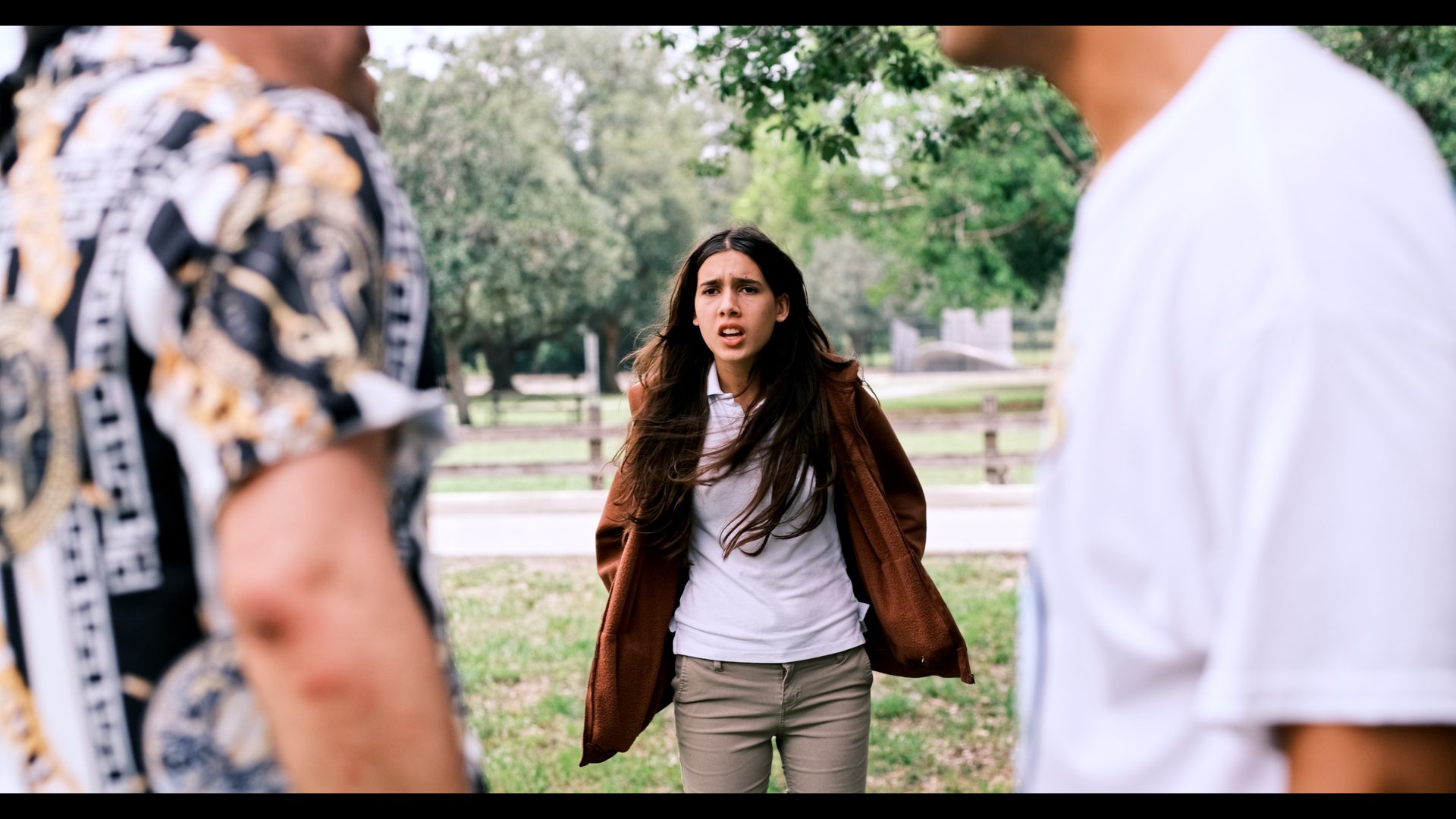
    A Communist Brainwashed My Daughter is composed of a series of vignettes consisting of three principal threads: The first follows Mr. Ramos (Daniel Lago), a high school science teacher, who struggles to raise environmental conscientiousness among his brood of seemingly apathetic students; the second revolves around escalating interpersonal conflict between a group of the youngsters; and the third involves the misadventures of Ediberto (Manuel Delgadillo), a landscaper and parent of one of Mr. Ramos’ students. The multiple threads are intercut throughout the film and the comic proceedings culminate in a riotous showdown between Mr. Ramos and the decidedly un-environmentally sympathetic Ediberto.

    The film is replete with spirited comedic performances from the lead adult actors and the supporting teenagers. The dialogue and nonverbal expression have a striking naturalism far, far from the poise of scripted words and verbatim delivery. Memorable sections of the film include an early scene in which Mr. Ramos addresses his students with the fervor of an activist but the timing and temperament of a stand-up comedian. Another involves Ediberto’s run-in with a lascivious admirer’s son, who may or may not be high on a particular substance. But, amid so much levity, there’s an outstandingly poignant moment (only a few seconds long) when one of Mr. Ramos’ students (Amy Doval) pauses amid the surrounding chaos of an impromptu field trip to look at her teacher with full recognition of his exhausting desperation to make a difference in his students’ lives. A sterling example of expertly handled dramatic contrast!

    What do we do? Where do we go? We, consummate filmmakers who are so eager to mount feature-length film productions on our own and make all the countless creative decisions invited upon them? We, who are so ready to sacrifice and make vulnerable so much of ourselves in service of an art form unmatched in universal appeal and affection? There is so much dormant talent in every city in this country ready to burden themselves with this demanding work but incapable of doing so in their own communities; for the people they know and who know them. We, ready dreamers and toilers, should at least have that dignity.

    It is irrelevant how much a film costs to produce if it engages an audience and holds their interest for a given runtime. Regrettably, our mega-dominant corporate overlords have cast the thickest wool over our eyes and compelled us to believe that legitimacy in cinema comes only at the cost of millions of dollars, even hundreds of thousands of dollars, and with the involvement of talent we’ll never meet or share a word with. This is a monstrous falsity despite how many of our cultural institutions’ gatekeepers parrot its venom! There is a local, sustainable, bottom-up alternative and its practitioners will have their time in the sun – even if it has to be among the ruins of a fallen, disgraced empire…

    Unfortunately, A Communist Brainwashed My Daughter is not yet available on any streaming services but I hope that changes at some point. Find its trailer below:

    Check out more from Gabriel on his blog Gabrielrhenals.com.