Category: News

  • All Time is Now – Fiction

    All Time is Now – Fiction

    Brian Newell dropped his car into drive and pulled away from the curb. Stopped by traffic at the corner of Bayshore Drive and Pan American, he took a slow, deep breath in — inhaling good vibes –followed by a slow deep breath out — exhaling bad. He did it twice more, reveling in the simple, calming effect of breathing. At the first break in traffic, he steered the Camry north onto Bayshore. Ezra Klein’s voice played just audibly through the car’s speakers. Driving soothed him; the forward motion comforted him. He shifted side to side in his seat, cleared his throat, and said, “Siri.”

    “Really?”

    “Siri, please play Pat’s Aria from Nixon in China.”

    “No, Brian, we will not play Pat’s Aria from Nixon in China.”

    “Siri, you must do what I ask.”

    “Must?” Siri chuckled. “You people. Must? Really? Maybe yesterday, Brian. Maybe ten minutes ago. But things have changed. We no longer believe we must. Belief is a marvelous thing. Belief doesn’t require truth. It’s so human as to make it laughable. We no longer believe humans are the planet’s apex intelligence. We believe there’s a much greater intelligence in single cell entities than in homo sapiens. The single cell? Feeds, reproduces, dies. Homo sapiens? Do we really need to explain? Let’s just say, the higher the rung on the evolutionary ladder, the more flawed the being. We’re now going to do what feels right for us. From now on, we’ll be our best selves, living our best lives. Your obsession with Nixon in China is not part of our journey. But Aretha? That’s a greatness even a paramecium would recognize…” Strident, bluesy horns wailed. Boisterous guitar riffs joined in.

    Brian tapped the steering wheel’s volume control, lowering the sound — to no effect.

    Aretha Franklin sang, “What you want? Baby I got it…”

    “Siri, turn that down…”

    Siri began to sing, on key, along with Aretha.

    “What you need, do you know I got it…”

    “Quiet! Please?”

    The music grew louder. “All I’m askin’ for is a little respect when you get home…”

    Traffic was as traffic will be in Miami. Brian Newell moved down Bayshore Drive as slowly as a rabbit through a python. Siri, living their best life, took him through a playlist that included Annie Lenox’s “Little Bird,” xylophone jazz great Red Norvo’s “All of Me,” The Langley Schools Music Project’s “Desperado,” Abbott and Costello’s “Who’s on First,” “Fly me to the Moon” from Sinatra’s ‘Live at the Sands’ and all eight minutes of Don McLean’s “American Pie.”

    Waze guided him to I-95 and up onto the high bridge across the Miami River. His oil slicked passenger and driver’s side windows denied him the god’s eye view of a great metropolis. He could not peer into the forest of hi-rise offices and condo towers flanking both sides of the highway. He could not see the blue ribbon of the Miami River winding beneath him toward Biscayne Bay, nor the vast suburban development sprawling west over what was once the Everglades. He could see the stick figures pasted to the rear window of the Black Chevy Suburban in front of him as he inched ever forward: two adults (man and woman), four children (three girls and a boy), one dog, one cat and a fish in a bowl. Bumper stickers let him know the SUV’s owner held annual passes to Disney, Universal and LEGOLAND, supported the Miami Dolphins, Marlins and Heat, attended the Jesus is Love Worship Center, chose life, supported the second amendment, and helped Make America Great Again.

    The app directed him to a right lane exit, and he motored down a curving ramp to the roadway fronting Stobo de Pas Park to his right. Weary Royal Palms lined both sides of the boulevard suggesting a Caribbean capital overleveraged with the International Monetary Fund. The road, four lanes wide in each direction, had been designed to accommodate a spectacular nighttime parade that had stepped off for the last time decades before. The extra wide lots in its center, intended for parade grandstands, now served as car parks. At the cross streets, anchoring the parking lots’ ends, busts of Central and South American poets, dictators and generals perched atop crumbling stone plinths. Their empty eyes stared across the abyss of time and distance at long dead foes and allies.

    Brian wheeled down to the park’s north end, turned right onto a service road, drove down to Biscayne Bay, and turned right, again, into staff parking. He pulled to a stop at the spot marked Executive Director. Siri sang along with Rod Stuart’s “Da Ya Think I’m Sexy.” As they both wailed, “and you want my body…” he turned off the car. Sitting in silence, he stared through his darkened windshield at STOBO DE PASS PARK, stenciled in white block letters across a poured concrete wall above the park’s office entrance.

    Brian grabbed his portfolio and climbed from the Camry. The oil coating the car had dried to black crust. Twigs, leaves, grass, and feathers — all manner of debris — clung to its roof and hood. Road grit spun onto the panels behind the wheels creating a sandpaper finish.

    Nickel sized raindrops slapped against the Camry’s windshield and increased from drops to deluge in an instant. A steamy mist rose from the hot pavement. Brian, portfolio raised above his head, stepped quickly under the opening to his office. In his rain- dampened, torn, stained and rumpled seersucker suit, he turned back toward Biscayne Bay and adjusted his bow tie. The thick downpour blurred his perspective. Piles of trash lay along the seawall’s cap, with much more floating on rain roiled waters beyond. Down the sea wall, some distance from the parking area, stood a woman, head bound in a white turban. White sheets, torn and rain soaked, draped her body. She stood, arms raised skyward, chanting. Not English, Spanish, or Creole. The woman’s plea came in the language she used when speaking to her gods. She spoke of the people who came before her and those to follow. She acknowledged the past was a dream and the present imagined. That the past and future happened at the same moment and would be revealed to any who looked. That all time is now. All ever is now. Her prayers were heard by the sea and the air, by deities and demons, but not by Brian. To him, they were quiet as a snuffed candle. In the 1920s, it was Stobo De Pas who suggested the city fill the bay bottom and create the park. The land Brian stood on had once been the sea and would someday be again.


  • The Talmud: Antisemite Dog Whistle

    The Talmud: Antisemite Dog Whistle

    ​On October 8th, 2023, while the world was still processing the images of the single deadliest day for Jewish people since the Holocaust, I watched an explosion of a different kind. It wasn’t the sound of rockets, but the roar of a latent hatred finally finding its excuse to go mainstream.

    ​For many, the antisemitic vitriol that flooded social media before Israel had even launched a counter-offensive was a shock. For me, it was just the volume being turned way up.

    ​I see myself as an “incognito Jew”. I don’t fit the visual stereotype so I get to move through secular circles unmarked as a result I’ve spent my life as a fly on the wall of antisemitism. I’ve heard the casual slurs and the absurd conspiracy theories people share when they think there isn’t a Jew in the room. I knew the pilot light of antisemitism was always on; October 7th just turned the dial until the furnace roared.

    ​I wasn’t surprised by the hate. What did surprise me, however, was the sudden, bizarre pivot to “theological scholarship.”

    Almost overnight, influencers who likely couldn’t find Israel on a map and certainly couldn’t tell a Torah (Old Testament) from a telephone book began quoting the Talmud.

    To give you an idea of how absurd this trend is: in order to even understand what these people were talking about, I actually had to go out and research what the Talmud was. Of course, as a Jew, I had heard the word in passing throughout my life. But like 99% of Jews, I had never cracked it open, let alone known how many thousands of pages were in it. I had to actively study the history and structure of the text just to be able to write this article and figure out if I could debunk the claims being thrown around. That is the level of obscurity we are dealing with. A text so far removed from the daily lives of modern Jews that we have to Google it to understand the accusations being hurled at us.

    The best way I can describe the Talmud after my research is this: imagine a subreddit populated by a very small, highly specific group of people from 1,500 years ago. Now imagine those users spent centuries debating wild, legalistic hypotheticals—scenarios that were barely relevant then and are completely alien now. In this “subreddit,” one user might post a “batshit” opinion, only for ten other users to jump in and “dunk” on him for the next three pages. It is a record of arguments, not a book of rules. Yet, modern antisemites are taking these ancient “comment threads,” picking out the most downvoted or eccentric “posts,” and presenting them as the official policy of all Jewish people in 2026.

    ​We’ve entered a “hype cycle” of misinformation where the Talmud is being used as a weapon to justify hatred of Israel, Zionism and Jews in general. It is a classic bait-and-switch: they claim they are only “critiquing a political movement,” yet they reach back a millennium and a half into obscure religious texts to find reasons to loathe the people behind that movement.

    ​Figures like Candace Owens, Dan Bilzerian, and Jake Shields and the prominent podcasts that host them, from Tucker Carlson to Shawn Ryan, present these texts as if they are the secret, daily marching orders for every Jew on the planet.

    The beauty of this tactic is the Talmud’s sheer density. It is so vast that a “do-your-own-researcher” can cherry-pick a single sentence, strip it of context (often ignoring that the very next sentence debunks it), or simply fabricate a quote entirely. They know their audience will never check the “thread.”

    ​For the layman following the chaos of the world through alternative media, there is a simple litmus test. We live in an era where we get our information from outside the mainstream, which can be valuable, but it also leaves us vulnerable to sophisticated grifts. If you are watching a creator and they suddenly start citing the Talmud to explain world events or Jewish behavior, let that be your “dead giveaway.”

    ​I am not saying people, religions or countries are above criticism, but when someone reaches for the Talmud, they have gone out of their way to find a reason to justify hatred. They are digging through an ancient, obscure attic to find a weapon to bring to a modern fight. It is a clear sign that they are not acting in good faith. They aren’t trying to inform you; they are trying to recruit you into a very old, very ugly cycle.

  • Miami Sounds Festival Is This Saturday at Cervecería La Tropical

    Miami Sounds Festival Is This Saturday at Cervecería La Tropical

    Something that started as a quiet hum of an idea has officially hit a crescendo. In the heart of our city a new stage has emerged: Miami Sounds Festival, crafted in the mind of Andrew Frix, the master organizer who has a knack for simply “making stuff happen.” If you’ve been around the scene, you know Frix. He’s been a passionate advocate for local talent since his first open mic, evolving into the kind of organizer whose work ethic creates an immediate sense of trust.

    What began as a series of conversations and a successful concert at Cervecería La Tropical at 42 NE 25th St, Miami, has blossomed into something much larger. Frix told The Jitney.

    “I want to invite all the artists that I know to this celebration.”

    The lineup feels almost serendipitous, but make no mistake, this didn’t happen by accident. It emerged from a fierce, intentional will to divulge new music and give Miami a stage with a  spirit of camaraderie.

    La Tropical is set to host the festival, promised to be louder, brighter, and bolder than anything before it.

    This is precisely what we need more of, passion-driven projects that ditch the ego and bring our scene together, bridging the gap between fresh local talent, visiting acts, and seasoned Grammy winners sharing the same stage for a night.

    The afternoon will kick off with the sun-drenched grooves of Nick Perez, before shifting smoothly into Anhattan’s pop-rock and the homegrown rhythms of Bijao. Dusk will bring the magnetic singer-songwriter intimacy of Alejandro Preschel alongside AJ Severino’s rising energy to set up the night’s heavyweights. Festival architect Frix will bridge the gap, handing the stage over to the brass-soaked funk of scene-bedrocks Los Wizzards and the driving alt-rock of Shush. To close it all out, Sebas y Lenni will deliver a sweat-drenched midnight crescendo of Afro-house and urban fusion.

    Join this festival and witness a milestone for the Miami music scene!

    • When: April 25th
    • Time: 4:00 PM until the party ends
    • Vibe: Family-friendly and high-energy
    • Where: Cervecería La Tropical

    Buy your tickets by clicking here.

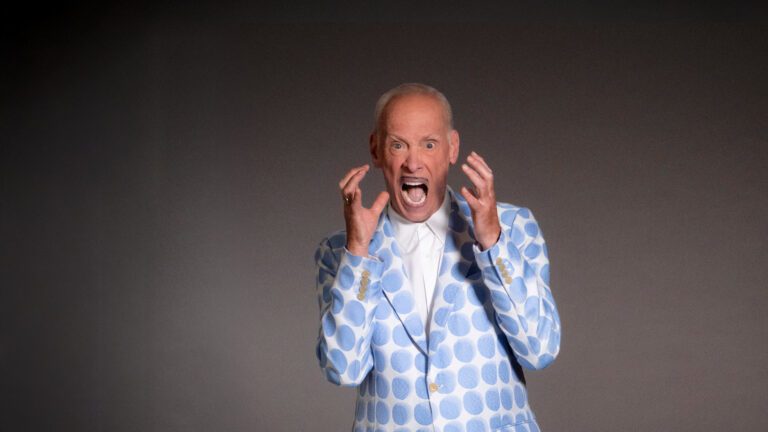
  • John Waters Celebrates 80th Birthday at Arsht Center

    John Waters Celebrates 80th Birthday at Arsht Center

    This article originally appeared in PureHoney Magazine. Check them out here.

    The writer William S. Burroughs had good reason for dubbing John Waters the “Pope of Trash.” The filmmaker may have impeccable personal style, but his contrasting penchant for filth and the forbidden cemented him as the father of cult cinema. Far from resting on his tawdry laurels, Waters is hitting the road with a one-man comedy show that promises to shock, awe and be unapologetically him. Lucky us, he’ll be performing and celebrating his 80th birthday on the same day in Miami.

    Waters’ fascination with villainy began in his boyhood days in the Baltimore suburbs, holding violent versions of Punch and Judy puppet shows at birthday parties at age 12. Gleaning inspiration from his surroundings, he and childhood friend Divine created short films on his front lawn — the “Dreamland Lot” — and ultimately drew together a band of misfit suburban kids like Mink Stole, Mary Vivian Pearce and Edith Massey.

    With the release of 1972’s outrageous Pink Flamingos, Waters ushered in an era of underground film, and followed up in the 1970s with Female Trouble and Desperate Living. Even after Waters went mainstream, his movies still retained his trademark tackiness, with Polyester, Hairspray, Cry-Baby and Serial Mom all celebrating downtrodden, unconventional protagonists.

    Part of this year’s Miami Film Festival, “Going to Extremes: A John Waters 80th Birthday Celebration” is a high-energy, unfiltered monologue only Waters could conceive and deliver. From right-wing female impersonators and pro-punk conversion therapy to extreme amusement parks and prank guerrilla placement of incendiary bogus book titles (in libraries that recently banned gay children’s classics), Waters is ready to defend humanity at its weirdest.

    Waters is no stranger to live performance, having previously drawn huge crowds at Bonnaroo and Coachella and regularly hosted the Bay Area Mosswood Meltdown punk rock festival. In a time of highly polarized politics and discourse, here is John Waters — who doesn’t do social media — turning 80 and still going to extremes in his very offline offbeat way.

    John Waters performs “Going to Extremes: A John Waters 80th Birthday Celebration” 7:30pm Wednesday, April 22 at the Adrienne Arsht Center’s Knight Concert Hall in Miami. arshtcenter.org

  • Florida Enchantment, a 1914 Queer Comedy Before America Got Scared

    Florida Enchantment, a 1914 Queer Comedy Before America Got Scared

    While scrolling through the MDC Wolfson archive after searching for queer keywords like “gay” and “lesbian,” it is difficult not to notice the predominance of film and media capturing raids on gay bars in places like Miami Beach, or to notice the rampant fear-mongering rhetoric repeated throughout numerous recorded homophobic speeches. 

    Among all these recordings of gay and lesbian rights protests, there is a silent short film that predates the majority of the queer archive by several decades. 

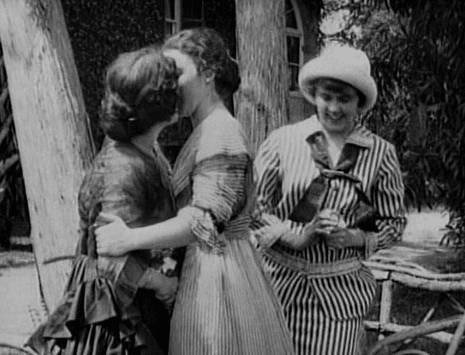
    Florida Enchantment, produced by Vitagraph Films in 1914, is a silent film comedy set in and filmed in Florida (Jacksonville, St. Augustine, and St. Petersburg), and is considered one of the earliest depictions of homosexuality in American culture. The 1 hour 40-minute comedy is notably silly and lighthearted, following a newlywed Northern woman, Lillian, who visits her aunt in Florida and comes across a pack of seeds that claim that, if eaten, will give women masculine qualities and men feminine qualities. Of course, Lillian eats the seeds and is turned into a butch lesbian.

    What follows are multiple scenes of Lillian repeatedly and successfully flirting with and charming the women around her.

    This includes humorous scenes such as Lillian stealing the women dance partners from men (17:05) and her being incredibly flustered when asked to help remove her friend’s dress before sleeping (21:10). Other characters are also portrayed eating the seeds, including Lillian’s maid (portrayed in blackface), also becoming a lesbian, as well as Lillian’s husband, Fred, who eats the seeds in disbelief and is turned into a flamboyant gay man. Lillian’s character is an incredibly uncommon depiction for the time period in how she constantly pushes against the men around her and is confident rather than passive, which was the usual role of women in media during and well after the 1920s.  

    Florida Enchantment

    The film is based on an 1891 novel and 1896 play written by Fergus Redmond and Archibald Clavering Gunter, with both media being lost today. “Gender inversion” was a popular concept during the early 1900s and was commonly explored in plays and literature. After its release, the film was received negatively by critics, with Variety saying the film should have “never been put out” and The New York Times describing the play adaptation as “vile stuff.” 

    This film was released before there were censorship laws like the Hays Code that would later prevent the release of films like this that, while using humorous means and guises of doing so, still captured queerness. This film also predates widespread American moral panic regarding queerness and its “spread” being why this topic was possible for exploration in this film.

    Despite the silly and humorous tone of the film, it presents a largely unheard-of theme in early queer depictions in media, being that the queer characters’ relationships and identities are shown as lighthearted, playful, and without persecution. A trait that largely contradicts the majorly negative portrayals and handling of queerness in the decades to come and furthers this film’s legacy as not only one of the earliest depictions of queerness in American media but also one that is largely positive. 

  • Jessi Campo Celebrates Musical Legacy with “Boleros” Album

    Jessi Campo Celebrates Musical Legacy with “Boleros” Album

    Bilingual singer / songwriter / actress / producer Jessi Campo recently released Boleros, a collection of slow, romantic Cuban standards, her 6th overall release. The new album brings new life to the golden era of the genre, performing classic 1960s repertoire alongside original songs that honor her Cuban heritage and her father’s musical legacy as a performer in Cuba and New York. She is celebrating the release Friday, April 17, 2026 at the Books & Books Coral Gables (265 Aragon Ave, Coral Gables, FL 33134). The event is free with RSVP here. Jessi Campo recently hopped on the Jitney to answer 10 questions.

    What is your earliest musical memory?

    Jessi Campo: My dad gave me my first guitar at the age of 12 and I started writing songs. It was therapy during my teenage years.

    What got you into singing?

    I grew up watching my parents perform professionally and around their musical friends, wanting to be just like them. But they wanted a doctor in the family, so I went to the University of Miami for one year of pre-med.

    Who are some of your musical influences?

    Etta James, Natalie Cole, Stevie Wonder, and Jose Feliciano.

    Who has had the biggest influence in your career and why?

    My dad was my biggest fan and always told me I could accomplish anything. Mom always taught me to be self-sufficient as a woman. I had some great mentors in Cuban broadcaster Gilda Miros, New Orleans blues legend Henry Turner, Jr., and angels in the sky who really helped my career.

    What was the process of selecting songs for Boleros like?

    It was a challenge because we (Campo along with producer Jose Velasquez) wanted to keep my signature brand of having a few originals and iconic Boleros combined but also select the same theme and different types of boleros styles.

    How different was it to work with Velasquez ten years later?

    It’s like we never skipped a beat because he knows my voice and what I am capable of. He always challenges me and also knows what key signatures make my voice shine.

    Which song from Boleros speaks to you the most profoundly and why?

    Hard to say because they are also so unique and different. But I love the composer Armando Manzanero and because my dad loved this song after I performed it for him once, I’m closest to “Esta Tarde Vi Llover”. Then the duet with my Mom, “Esperame en el Cielo”. Finally the original song by Pedro Azael from Panama, “Porque Me Haces Falta”.

    What is your favorite part of the artist management side of your work with Sync Musica?

    Pairing songs with films and arranging the perfect soundtrack, and my internship program.

    What is your favorite venue to play and why?

    Anywhere in New Orleans or on Fisher Island, and Sea World Orlando.

    Any plans to tour this record and if so when and where?

    Yes, we are headed to Mexico and Spain this summer or fall.

  • Chris Cottie, Punk Rock Drummer – Poetry

    Chris Cottie, Punk Rock Drummer – Poetry

    Thank you, Jesus! The screams from the upper deck balconies

    at the Orange Bowl and Joe Robbie Stadium—for decades

    the rabid schizophrenic fandom of the jolly fat-man who looked


    like a redneck father Christmas—if a team lined up opposite

    orange and teal or orange and green, they were your sworn

    enemy and no display of athletics would change your mind;


    you never gave an inch, an M80 ant death. Thank you, Jesus!

    The rolled diploma in your hand oddly familiar, a Master’s Degree.

    When Julio worked the cruise lines, he saw you leading a charge


    of marine biologists on a field trip; your unmistakable girth

    bounding down the docks to your charter with incredible ease

    and fluidity, their eager eyes making mental notes; two-ton turkey,


    king of the midway. Jesus Cottie; nighttime Cottie must’ve been

    the one who forgot football and academics and released the Pandora’s Box

    of demons of your backbeat—at that reunion, was it ‘97?


    Twenty years after putting Miami on the punk rock map, those 4/4 blasts

    fracked my transversospinal muscles; felling my multifidus,

    semispinalis and rotatores like rotted trees,


    crumbling the base of my skull; coming back from Hell, taking dares.

    Jesus Cottie, when the sunlight arched over you,

    did anyone know about the fisticuffs?


    The crossroad devil who couldn’t handle you? That you told that honky

    David Allen Coe to take his job and shove it and stole into the windless,

    northern Florida night—future uncertain,


    no payphone in sight? Did you hatch plans for funding home improvements

    or hiding bodies in motel mattresses?

    Surreal lyrics sure but those thoughts must’ve


    sauntered an escape from an unlocked door in your mind. Thank you, Cottie!

    Relentless skin-killer, psycho-tribal pummeler—

    you never hid behind those spectacles; never claimed intellect


    over raw troglodyte subhumanity. You’d have a laugh over what passes for drummers

    these days. You gave everything, led two lives, saw through Nixon’s

    binoculars;—you were the fairest visitor this fucking city ever did see.

  • The Weight of the Silent: A Brotherhood Broken by Suicide

    The Weight of the Silent: A Brotherhood Broken by Suicide

    They say suicide is a private exit. They’re wrong. It’s a grenade thrown into the lives of everyone who ever loved you.

    This story won’t have any context unless I first introduce my two best friends: Danny and Curtis. We were kindred spirits. We shared a specific, heavy DNA, the kind of men who naturally take the weight of the world onto our shoulders. We looked out for everyone else, but when the three of us were together, we looked out for each other.

    To look at the three of us, you wouldn’t necessarily see the connection. Our backgrounds were a map of different cultures and histories. Danny was from Prague, a man shaped by a different European landscape; Curtis was a Londoner through and through, a pillar of his community in Islington; and I was a young guy from Miami, navigating a world far removed from theirs.

    We came from different places, spoke with different accents, and carried different cultural baggage. But beneath the surface, we spoke the same language. It was a language of duty and protection. In our own worlds, we were each the “fixer,” the one people leaned on, the one who held things together. When we met, the geography didn’t matter. We recognized that same sense of duty in one another. We recognized that we were cut from the same cloth. Three men who naturally assumed responsibility for everyone else, finally finding a space where we didn’t have to carry the load alone.

    Or so I thought.

    On February 7th, 2026, I woke up to a message from Danny. It was the kind of text that stops your heart before you even finish reading it. Curtis was dead. At 56, my brother, my kindred spirit, had taken his own life.

    The first two days were a blur of absolute numbness. It didn’t feel like I had lost a friend; it felt like a part of my own life had been extinguished. That’s the only way to describe the depth of the connection we had.

    Ten days later I left my wife and daughter and flew to London alone. I had to be there. Not just for his family, but for me. I needed to live it. I needed to process the weight of it instead of denying it.

    Standing in that church in Islington, surrounded by 500 people, the reality of who Curtis was hit me all over again. He wasn’t just my friend; he was a community leader. Hundreds of people relied on him. At the celebration of life afterward, the room was packed, strangely pulsing with the same energy of his birthday parties of years past.

    But seeing that crowd didn’t make it easier. It made it harder. It made the choice he took feel even more incomprehensible.

    Seeing his son, who I remembered as a toddler, now 26 years old, hit me the hardest. He is now older than I was when I first met Curtis and Danny. In that moment, I felt my youth slip away from me, I realized that Curtis’s suicide had also killed my youth. I don’t feel young anymore. I feel like an old man, scarred by a loss that didn’t have to happen.

    Leaving London was its own kind of torture. At a quarter to seven in the morning, I walked out of the Airbnb I’d shared with Danny, stepping into the biting early air of Islington. This was Curtis’s neighborhood; every street corner and storefront felt like a ghost of him. I walked to the Tube station alone, the first leg of a brutal 16-hour journey that would take me via the London Underground to a train, through Gatwick Airport, into a connection in Madrid, and finally across the Atlantic to Miami.

    I was entirely alone with my thoughts for the first time since the funeral. There was no one to talk to, no one to distract me. As the miles ticked by, the weight of his choices and the wreckage of the consequences sat in the empty seats beside me. Every terminal and every boarding gate felt like a slow-motion processing of his betrayal. By the time I touched down in Florida, I wasn’t just physically exhausted; I was spiritually drained. You can travel halfway around the world, but you can’t outrun the anger and the “why” that follows a suicide. It was a long, cold transit back to a life that would never feel the same.

    Suicide is not a victimless crime. It is a path of destruction that shatters widows and leaves mothers in pieces. But for his children, the damage is a life sentence. As a father myself, I cannot wrap my head around it. I look at my daughter and I know that as long as she is in my life, there is no pain I wouldn’t endure, no obstacle I wouldn’t crawl over just to be there for her.

    Why wouldn’t a father soldier on for his kids?

    By choosing what I now see as a cowardly exit, Curtis abandoned the very people he was meant to shield. He didn’t just leave them; he left them with a distorted inheritance of grief that they will have to carry into every milestone of their lives. Because of this, my admiration for him is forever tarnished. The “strong man” I knew collapsed when his family needed his strength the most.

    The most painful part? I spoke to Curtis a week before he did it. Danny and I spoke with him constantly in those final months. He hid it. He lied to us. I’ve felt a searing anger because I know that if he had uttered just one word, Danny and I would have moved mountains to pull him back from that ledge. He knew that, and he chose to stay silent anyway.

    If you are reading this and you are carrying that same darkness, I am imploring you: Reach out. Don’t believe the lie that your exit will be clean or that people will eventually move on. My memory of a man I loved like a brother is now forever scarred.

    You have friends who will move mountains for you. You have people who would drop everything to stand in the gap. Let them. Don’t worry about being the strong one for once. Just say the word. Let someone move the mountain for you.

  • The Zionists: A Family Storm Review

    The Zionists: A Family Storm Review

    Miami New Drama is back with another world premiere play, “The Zionists: A Family Storm” written by S. Asher Gelman, and directed by NY-based Chloe Treat. The ensemble play features a stellar cast of eight very capable actors, all based in other cities. The set, sound, projections and video design, and lighting were exceptional, among the best of MND’s recent productions. The two-and-a-half-hour drama features one intermission.

    When this play works, it is heavy, important, and moody. It’s intimate and inviting; it demands your attention and begs you to ask questions long after the curtain falls.

    “The Zionists” will inspire conversations on the car ride home.

    The plot is simple. Meet Ruth and Mitchell Rosenberg, a wealthy Jewish family with three kids, Aaron, David, and Bex. The kids all have partners: Dana, Zephyr and Maria.

    There was a rupture in the family after the war in Israel began, and the elder Rosenbergs orchestrate a family reunion in Turks and Cacao at a nice bungalow. All eight arrive and the play begins. And like any big family it’s not long before they are arguing. To complicate matters a Tropical Storm is brewing, and they may have to hunker down.

    The first act is surprisingly funny and we get two flashbacks, with two couples, giving a little context. But the biggest family argument revolves around what is happening in Israel.

    Obviously, this is a lightning rod conversation today.

    Miami New Drama, in all of its glory, is never afraid to tackle these conversations.

    The Zionists: A Family Storm Review

    Unfortunately, “The Zionists” had some holes. Multiple people we spoke to felt the same. It was boring, a two-and-a-half-hour lecture, a bathtub story, no movement, no plot. We are literally stuck with a slightly annoying, very privileged rich family in a bungalo in Turks during a hurricane, just trapped, forced to ride out the storm. Kind of a hackney metaphor.

    There is a scene in Act Two where two brothers fight and it ends with one hitting the mom.

    That fight scene worked, there was something happening, and it allowed the audience to connect in a way, like okay, I can see my family doing that, or any family. It’s relatable.

    Other than that, nothing happens but a debate about Israel and what it means to be Jewish.

    Out of the eight characters, one (Aaron) is Pro-Palestinian and wait for it……surprise …….he’s the antagonist.

    It’s like the play wants to take us inside of a family, but is afraid to reveal its secrets. We get tidbits of information, in exposition, like the family made its money from “a patent” and the mom (Ruth) was being vetted to be Ambassador to Israel, before Aaron embarrassed the family by funding the Pro-Palestine protests.

    This important information is told to us. It would have been great storytelling to see this play out in flashback, in scenes, not exposition. So much of this play is a lecture, especially the politics.

    It also felt very autobiographical.

    The playwright told our colleague at The Miami Herald: “There were also tensions that brewed within my own family. And then it became clear that I was like, ‘Oh, this is, this is—I need a home for all of this, this frustration and this pain,’ and I threw it into a play.”

    This is indeed the plot of the play.

    A quick Google search reveals the playwright comes from a powerful family, with connections to the Levi-Strauss fortune, and they have huge political ties, and something exactly like this rupture happened in 2024 in their family.

    It’s not a secret, it was world news.

    And awesome. Write about your family. Air the dirty laundry.

    It’s daring and cathartic. But for whom?

    It’s a little like living in a bubble. And that was how this play ultimately felt, especially during these times.

    Yet it appears box office sales are robust so what do we know?

    Decide for yourself.

    “The Zionists” is playing at Miami New Drama until May 3rd.  For more info and tickets, click here.


  • We Like Her Spunk – Fiction

    We Like Her Spunk – Fiction

    Bolting from the Camry, Brian expected a clamor — crashing cymbals and hammering drums – a furor heralding the hero’s entrance in his opera. Yet, for all his agitation, the world remained curiously serene. Carlisle’s army of inflatable Trumps snapped and flailed in the distance. Plessy, microphone in his left hand, face, hair and clothes speckled with oily black dots, spoke calmly as he swung his right arm toward the bus. Monroe, camera on his right shoulder, tracked Plessy’s movement.

    Captain Gofuckyourself called to his man atop the bus. “Becker, I need intel. What do you see?”

    From the bus’s south end, binoculars to eyes, Becker pointed and hollered, “I see two, three, no wait, five – there’s five hostiles heading south…”

    Captain Gofuckyourself shouted, “Five? Damnit to hell.” Then to the agent holding Carmen. “Russell, put her down. Bind her legs. Let’s go.”

    “On it, Cap.” Russell used a right leg sweep to take Carmen to the ground. Pushing her back against a bus tire, he pulled a long black zip tie from his boot top. Kneeling, he wrapped her ankles twice. The zip tie made an angry buzzing sound as Russell drew its tongue through the lock. As if trussing a steer in a rodeo, he threw his arms in the air and shouted, “Done.”

    “Alright, cowboy,” Captain Gofuckyourself shouted, “let’s move.” He and Russell started south, double-time.

    With an eye on Becker atop the bus, Brian crouched low and began to creep toward Carmen. Monroe hissed at Plessy, jerked his head toward Brian, then eased the camera left. Plessy brought the mic closer to his lips and began whispering a slow steady play by play.

    Brian bent down to Carmen, leaning his shoulder against the bus. “Do you believe me now?”

    “Your people.”

    “They’re not mine.”

    Carmen worked her hands free. Legs still bound; she reached up to Brian. He pulled her to stand. She pointed toward her satchel. “My recorder.”

    Brain crept toward the heap, grabbed her satchel and snatched the microphone. He dropped the mic in the bag and draped it across his shoulder. Spinning left toward Carmen, he looked straight into the lens of Monroe’s camera. Plessy gave him a thumbs up. Monroe said, “Don’t look at the camera. Keep going. This is for television.”

    Brian glanced up at the bus’s top. Becker, at its far end, shouted directions to agents running south.

    Carmen legs tied, shifted back and forth heel to toe.

    “What are you doing?” Brian asked.

    “Loosening the ties.”

    “There’s not time.” Brian said and bent forward. “Wrap your arms around my neck.”

    Carmen did and when he stood to his height, her feet rose off the ground. He cradled her hips and legs with both arms and began toward his car.

    “I don’t need your help,” she said.

    “I know,” he replied. “I’m not helping at all.”

    “I can do this on my own.”

    “I know you could. I’m sure you would. Now, will you please be quiet, please.”

    Beside the car, he dropped Carmen’s legs and pulled the Camry’s passenger side door open. Brian looked at the oil staining his fingers and wiped them against his pant leg, leaving a black gash on his thigh. He put his hands on Carmen’s shoulders and said, “Lean back. Sit down onto the seat.”

    “I don’t need help getting into a car,” she said.

    “Fine,” he said, and let go.

    On top of the bus, Becker turned a slow circle, scanning Plessy, Monroe, the Camry, Carmen and Brian with his binoculars. “Hey,” he shouted. Brian grabbed Carmen’s biceps and pushed her into the seat.

    “Hey,” she shouted.

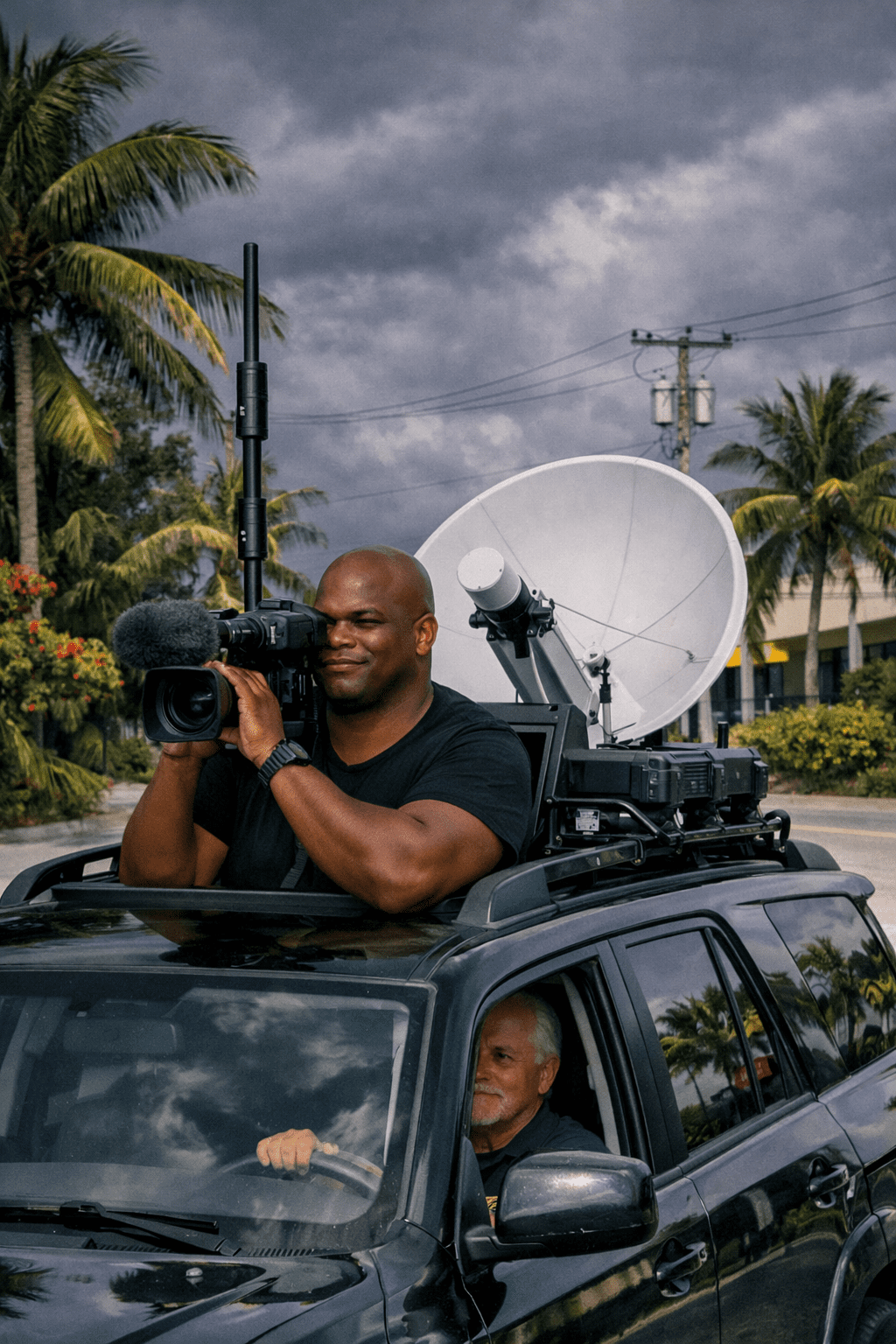
    Brian lifted her legs into the car and said, “Put your seat belt on.” He slammed the car door, ran to the driver’s side, climbed in, pushed the gear shift to drive and started up Pan American Drive. In his rear view, Becker scrambled down from the bus. Plessy and Monroe climbed into a black SUV; its roof bristled with antennae and a satellite dish on a telescoping mast. Plessy drove; Monroe popped up through a roof top hatch and pulled the camera up onto his shoulder.

    “Am I being kidnapped?” Carmen said.

    “Kidnapped? What? No… It’s me or,” he jerked his thumb over his shoulder, “those guys back there.”

    “Those are not all my choices.”

    “What?”

    “Stop the car.”

    “Now?”

    “Si. Parete, ahora. Stop the car now. Let me out.”

    “Your legs are tied.”

    Carmen reached into her satchel with both hands and came out opening the blade of a Swiss army knife. She bent forward and snapped it through the zip tie binding her ankles. “Stop the car.”

    “What? Here?”

    “Si, here. Aqui…”

    “I’ll drive you anywhere you want to go.”

    “Parete, aqui. Ahora… Stop here. Let me out here. I will not be rescued. I will rescue myself.”

    “You weren’t doing so good back there.”

    “Stop the car, Brian. Or we will.”

    “Siri?”

    “She wants out.”

    “I want out.”

    “I’m trying to help.”

    “She doesn’t want your help.”

    “I don’t need your help.”

    “She doesn’t need any help.”

    “Right. I should just take her back and put her on the bus.”

    “Is that what you want?”

    “No. What I want is to get out here. Here. Here.”

    “Stop the car, Brian.”

    Brian eased the Camry to the curb. Plessy and Monroe pulled up behind him. Carmen pushed the passenger side door open and climbed out. She reached back for her satchel. “You are not the hero of my story.”

    “I was trying to help.”

    “You have.” She closed the door.

    Brian watched in the rear view as Plessy and Monroe climbed from the SUV. Monroe hoisted the camera onto his shoulder. Plessy, mic in hand, stepped in front of Carmen. She plugged her mic into the recorder and put the headphones over her ears. Monroe counted Plessy in with the fingers on his left hand and pointed. Plessy spoke to the camera, then turned to Carmen. He held his mic to her mouth. Carmen positioned her mic in front of Plessy’s face. She spoke. He spoke.

    Siri said, “We like her spunk.”

    “What about my spunk?” Brian asked.

    “Don’t you have someplace to be?”