Category: News

  • Ignite Broward Takes Off This Week

    Ignite Broward Takes Off This Week

    This article originally appeared in PureHoney Magazine. Check them out here.

    A novelist from another era once wrote that “art is the stored honey of the human soul” — both product and repository of our imagination, industry, and curiosity about what it means to be human. An analogy that we at PureHoney appreciate also makes sense as a way to think about an event in our backyard: the IGNITE Broward festival.

    Broward County’s tech-forward, spatially ambitious happening, which turns five this year, unites multimedia works, people and environments in a kind of honeycomb of creative synthesis.“Festivals like IGNITE allow us to broaden the reach of the arts and give both locals and visitors a deeper appreciation for the role technology plays in creative innovation,” says Phil Dunlap, director of Broward Cultural Division, the festival’s sponsor and organizer.

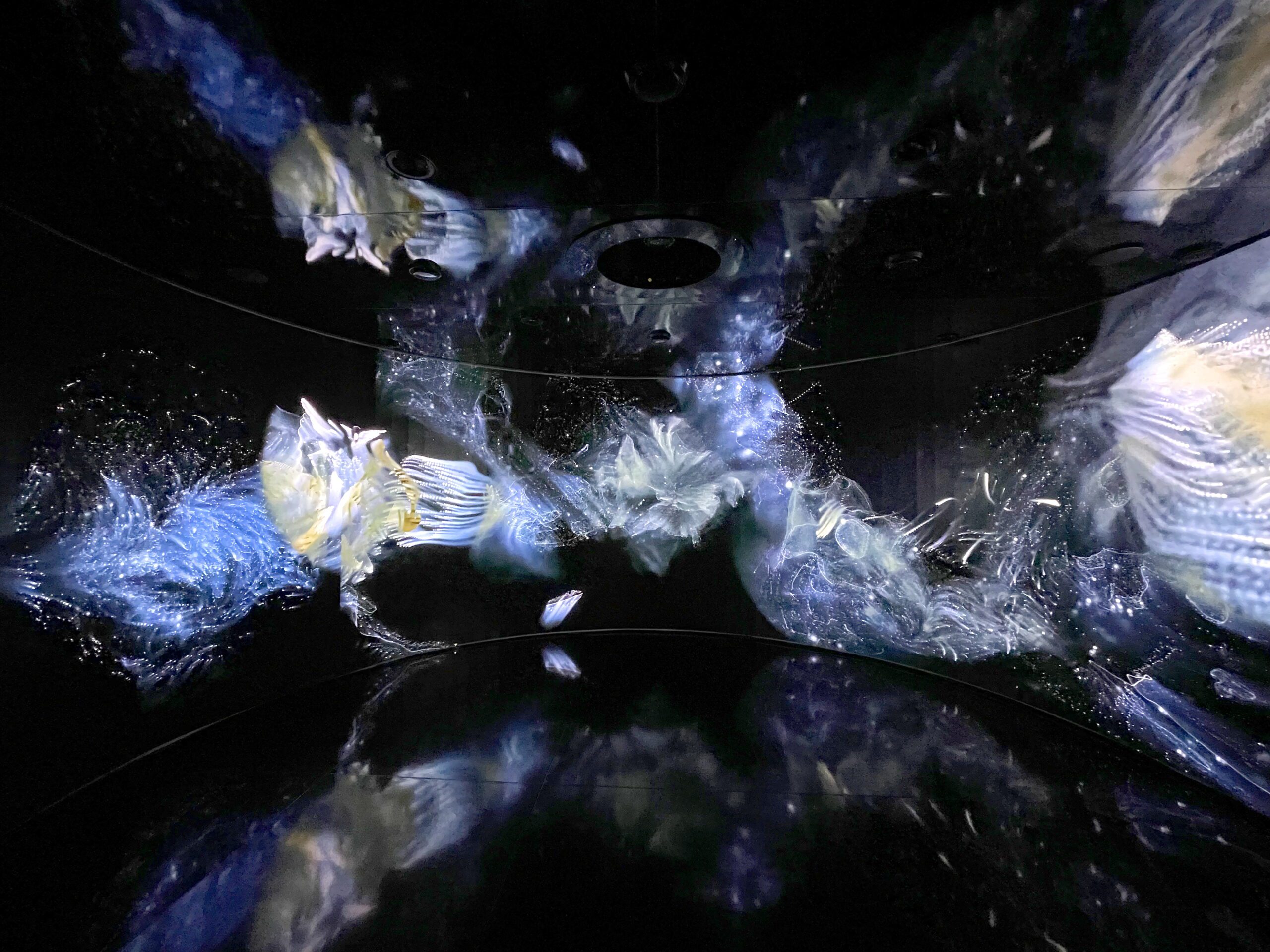
    IGNITE Broward expands to four locations for 2026, including Fort Lauderdale-Hollywood International Airport, auguring an even bigger sense of scale and greater accessibility to its many exhibitions and immersive installations. At IGNITE Broward mainstay MAD Arts in Dania Beach, Guillaume Marmin’s cosmic, data-driven work will pull celestial rhythms down to earth, and Weidi Zhang’s AI-infused environments morph through human interaction.

    During the festival’s ten days in February, also keep your antennae up at MAD Arts for poetic digital narratives by Darius Daughtry or sound-reactive collaborations of Homegrown Visuals + Akomi. At new IGNITE Broward locations — Reverend Samuel Delevoe Memorial Park in Fort Lauderdale and ArtsPark at Young Circle in Hollywood — look for expansive outdoor works by the likes of Daniel Popper, Pneuhaus, Studio McGuire, and ITHACA Studio as they transform shared public spaces into luminous ecosystems.

    The festival’s array of projection mappings, light sculptures, audiovisuals and less easily categorized creations really have to be experienced in person. In past years, you could have found yourself becoming part of the work as waves of shifting color danced around you, or as sound ricocheted through open air, with some installations seeming to speak directly to you in moments of solitude. Everywhere you go at IGNITE Broward, participation reshapes perception.

    IGNITE Broward takes place February 13–22, 2026 in Dania Beach, Fort Lauderdale, and Hollywood, with daily public hours varying by location. ignitebroward.com

  • The Narco Kings of Miami

    The Narco Kings of Miami

    In 2017, Netflix released Narcos, one of its most successful series. Audience demand pushed it to extend for two additional seasons. Colombia and Mexico were portrayed as the epicenter of drug trafficking during the 1970s and ’80s. For years, countless productions on other networks did something similar, exploiting the narco theme on screen. The United States appeared only in the background of these series, but none focused exclusively on exposing the country’s relationship with the drug trade. And yet Miami was as much, if not more, of an epicenter than Mexico or Colombia, thanks to the Los Muchachos cartel, founded by Willy Falcón and led at the top by his brother Gustavo “Tavy” Falcón and Salvador “Sal” Magluta.

    Willy Falcón was born in Alquízar, Cuba, a town an hour from Havana. In 1967, at just twelve years old, he emigrated to Miami as part of the Freedom Flights family reunification program, which ran from 1965 to 1973. His father Arsenio, his mother Marta, and his brother Gustavo came with him. The family settled in a middle-class neighborhood that most closely resembled what they had left behind, in a city that was still largely Anglo: Little Havana.

    Willy Falcón’s childhood and adolescence mirrored that of many first-generation immigrants: a small house, public school, and early work in construction to help support the household. As the Cuban community took root in its new home, the dream of reclaiming the homeland remained fiercely alive. From Miami, conspiracies and covert operations to overthrow the dictator Fidel Castro were openly discussed. Willy was not immune to those dreams. Despite his young age, the dictatorship had left a deep scar on him: he had witnessed human rights abuses, executions, and the imprisonment of family members and friends.

    As a teenager, after dropping out of high school, Willy Falcón was introduced to older Cuban exiles—many of them veterans of the Bay of Pigs—who proposed that he receive a shipment of cocaine, sell it, and use the proceeds to purchase weapons for clandestine armies training in Central America with the aim of invading Cuba. Cocaine was illegal, but it was not yet perceived as the poison it is today. All of this, moreover, was carried out with the tacit approval of the CIA. Then came another shipment. And another. Demand was enormous, and sales were easy. Falcón saw a business opportunity.

    That was when he established direct contact with Manuel Garcés, a Colombian twenty-seven years his senior, a smuggler and drug trafficker who opened the necessary channels in Medellín and Cali for him to consolidate himself as a direct distributor. Willy did not manage these operations alone: he surrounded himself with childhood friends from exile, among them Salvador “Sal” Magluta, who became his accountant and indispensable right hand; later, his brother Gustavo “Tavy” Falcón joined them. Thus, the Los Muchachos Corp cartel was born.

    Los Muchachos grew exponentially. By 1979, they were bringing in an average of one thousand kilos of cocaine per month. This was no longer a street-level operation but an organization that functioned like a corporation. They moved from counting stacks of cash in their homes to purchasing bank-grade money-counting machines. They later financed a businessman with five million dollars to acquire a controlling stake in Sunshine State Bank, facilitating money laundering. Shell companies soon appeared in tax havens in the Bahamas and Panama, with collusion from government officials—among them Guillermo Endara, who would later assume the presidency of Panama after the fall of Manuel Antonio “Pineapple Face” Noriega.

    They also acquired a ranch in Clewiston, in central Florida, complete with airstrips for their planes. The son of the town sheriff cooperated in exchange for money and cocaine, which he also sold on his own. Headquarters were established in Miami, at 1200 SW 49th Street, on a two-acre ranch in what is now known as Horse Country.

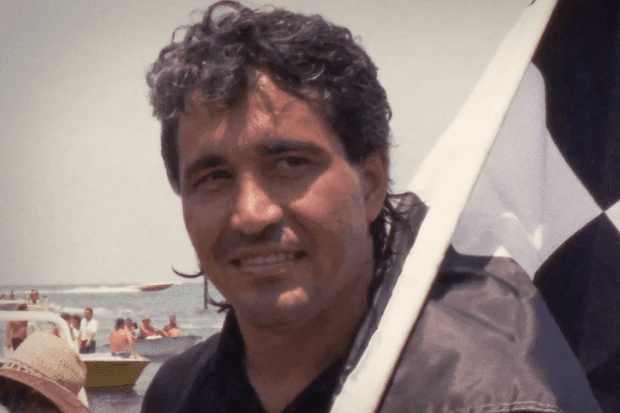
    Luxury and excess arrived hand in hand with money. Willy Falcón and his circle were regular figures at the parties and orgies of the Mutiny Hotel—they invested a million dollars in the property, money they never recovered. They owned properties, luxury cars, and women. Their greatest guilty pleasure, however, was offshore powerboat racing. The competition was fierce in Miami and across the country, and Willy, Tavy, and Sal raced in every event. Their team, Seahawk, even had a company dedicated to preparing boats with the best engines and finishes.

    During those years, Los Muchachos did business with the major cartels: Medellín, Cali, Sinaloa, and Juárez. But it was only with Pablo Escobar, boss of the Medellín cartel, that Willy Falcón formed a true friendship. He considered him a brother. They spent New Year’s together in suites at Caesars Palace in Las Vegas, vacationed at Disney, and traveled aboard the Los Muchachos jet.

    By the mid-1980s, more than eight thousand kilos of cocaine were entering the United States every six weeks. There seemed to be no limits. But behind the scenes, the government was advancing an operation to dismantle the organization. In 1982, President Ronald Reagan, after declaring the War on Drugs, announced the creation of the South Florida Task Force, led by Vice President George H. W. Bush.

    At first, Falcón and Magluta underestimated the authorities. They took minimal precautions: transferring some properties, traveling with false documents—but business continued uninterrupted. Over time, the net tightened. Properties were seized, mid- and lower-level operatives began to fall. In the early 1990s, Willy Falcón, his brother Gustavo, and Sal Magluta went underground.

    In October 1991, authorities raided Sal Magluta’s residence at the La Gorce condominium in Miami Beach and Willy Falcón’s home in Fort Lauderdale. Both attempted to escape, but the scale of the operation made it impossible. Gustavo Falcón, however, managed to flee.

    More than five years passed before sentences were handed down. During the trial, jurors and witnesses were bribed; others were murdered; some simply refused to testify. On the streets, Falcón and Magluta were seen as benefactors. Many argued that Miami had grown and evolved thanks to them and their money.

    Willy Falcón was sentenced to twenty years in prison. In 2017, after serving his sentence, he was deported and managed to avoid returning to Cuba. He currently resides somewhere in Latin America, the name of the country kept undisclosed. Sal Magluta was not as fortunate: he was sentenced to 195 years in prison.

    In 2021, Netflix released the documentary Cocaine Cowboys: The Kings of Miami, which examines the Los Muchachos case. By then, Gustavo Falcón had already been arrested after spending twenty-six years on the run. Journalist T. J. English recounts in his book The Last Kilo that when Tavy watched the documentary in prison, a guard said to him, “Oh, so you wanted to be like Scarface.” Tavy replied no—that Scarface wanted to be like him.

  • English Only Is an Entertaining Reckoning With Language and Belonging

    English Only Is an Entertaining Reckoning With Language and Belonging

    Miami New Drama’s latest world premiere play English Only is remarkable from the first line of dialogue until the final moment. The one-act play chronicles a pivotal piece of Miami history from 1980 that is very relevant today. Only this week it was announced that Florida will be conducting its driving exams “exclusively” in English.

    Back in 1980, in the wake of the Mariel Boatlift, a movement emerged in Miami-Dade County to make English the official language on all county documents, signage, and public communications. This play brings that initiative vividly to life, examining the cultural, political, and emotional fault lines it created. And oh, boy, does this play erupt!

    English Only dramatizes very important questions. Who gets to define American? What’s more important? Nationalism or humanity? Its themes of cultural fear, immigration and belonging, media influence and misinformation, are so important today.

    English Only takes its themes and knocks them out of the park. It’s a grand slam of cultural storytelling, superb acting and timely relevance. The play is highly entertaining!

    English Only Review   

    The first six months of 1980 in Miami are among the most significant periods in American history. Need proof? Read Nicholas Griffin’s nonfiction book The Year of Dangerous Days, arguably the best book ever written about Miami. Griffin, previously adapted a slice of this material for the MND stage, in 2024’s Dangerous Days.

    With English Only, he wisely narrows his focus to a single moment and expands it into a fully realized, compelling drama, yet the rest of the year is not lost, its context is very much there.

    Under the direction of Margot Bordelon, the staging works beautifully.

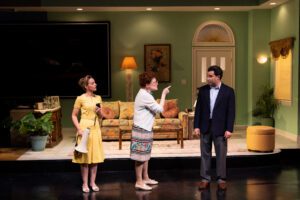
    On one side of the stage, Manny Diaz and his assistant Lucy Alvarez fight for Cuban refugees at the offices of the civil rights organization SALAD. On the other, Emmy Shafer and Barbara Simmons, in Shafer’s living room, lead the English-only initiative that places the issue on the ballot and passes it, making English the official language of Miami-Dade County for 13 years.

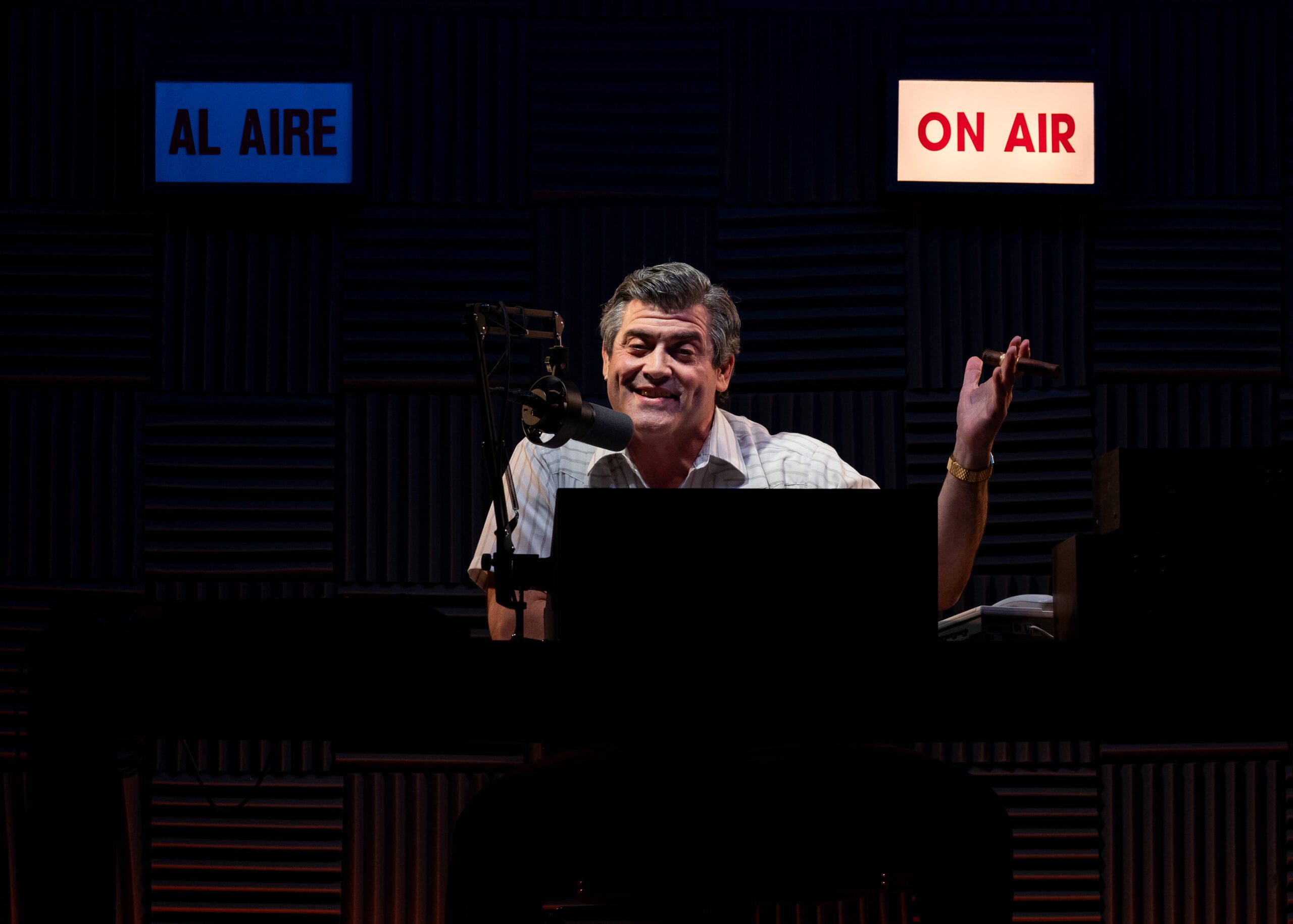
    At the center of the stage is shock-jock radio host Stan Rogers, whose blaring, fear-driven broadcasts frame the debate and give voice to both sides of the argument. The result is a production that feels balanced, thoughtful, and alive.

    English Only Performances

    The performances are exceptional. Laura Faye Smith brings a steady, sharp intensity to Emmy Shafer. Andy Mendez is impassioned and versatile as Manny Diaz. Linda Mugleston delivers a compelling antagonist in Barbara Simmons, adding eccentric charm to the role. Carmen Peláez provides grounding warmth and sincerity as Lucy Alvarez.

    This was one of the best assembled casts in recent regional memory.

    And the standout among standouts is René Granado. He commands the stage as shock jock Stan Rogers and also plays five additional characters. His vocal power, presence, and range elevate the entire production. What a talent! We spoke to Granado who admitted that he had quit acting for about a year, taking on a sales job in pest extermination. Thank goodness MND called and brought him back to the arts. We are all better for it.

    Final Thoughts

    Political debates around language, identity, and immigration continue today. This play enters the conversation with intelligence rather than spectacle and presents both sides with fairness and invites genuine reflection instead of easy judgment.

    English Only is entertaining, provocative, and meaningful. It is exactly what a world premiere should be, a piece of theatre that speaks to its city and the moment.

    For more info and tickets click here.


    By Morgan Sophia Photography
    Laura Faye Smith, Linda Mugleston and Andhy Mendez – By Morgan Sophia Photography
    Laura Faye Smith, Linda Mugleston and Andhy Mendez By Morgan Sophia Photography
  • Is Black History Month Effective?

    Is Black History Month Effective?

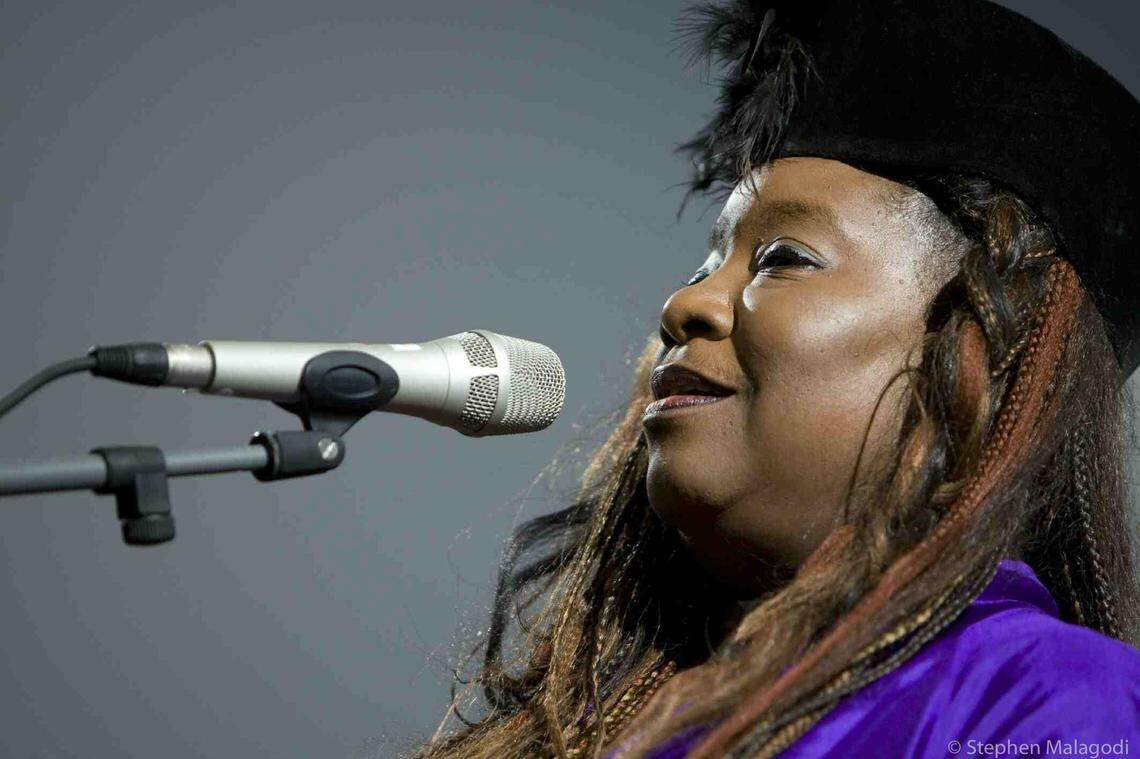
    For February 2026, I am sharing a story excerpted from my new book Miami’s Art Boom: From Local Vision to International Presence, published in late 2025 by University Press of Florida. The book gathers over 100 examples of my Miami Herald writings about art, spanning the years 1987 to 2007. It provides new essays to place this historical material in a current context. With the onslaught of anti-Black rhetoric blaring from this administration, as well as the prevalence of banned books by Black authors, the following 1989 Miami Herald story may continue to pose uncomfortable questions. Does Black History Month truly make a difference? Despite other events presented during the year, does limiting the majority of annual attention to Black History in one month amount to a subtle form of segregation? Does it in effect marginalize Black accomplishments? For my story, a dancer, musician, art dealer, curator, and two museum directors offered their divergent opinions. Pictured above is the jazz singer Alice Day.

    January 29, 1989

    It’s like you have a little box of Black History Month things to do. And you open it up and there’s art exhibits, and dance recitals, and films, and you kind of spread things around, and when the month is over you kind of gather it together and put it back in its box until next year.

    — Gary Moore, Miami-based artist

    Wednesday, it’ll be February again, which means Black History Month. Around South Florida, the special events will include exhibitions of the work of Black artists throughout the Miami-Dade Public Library System, shows in college galleries, a Black film festival in Fort Lauderdale, plays about the Black experience, concerts and lectures.
    But does Black History Month also mean that, when it’s March, it’s time to forget all about Black history until next year?
    A number of Black artists in our community, while appreciative of the flurry of exposure they receive in February, resent the implications inherent in the attention that may come just once a year. Some believe that while Black History Month was intended to foster an awareness of African American contributions to the national culture, it has become a subtle form of segregation.

    “It’s disturbing,” says Ed Love, visual arts dean of the New World School of the Arts. “You either show then, or you don’t show at all . . . If you either have February or nothing, then that’s an awful choice.”

    But others find that the month’s educational value is very much needed in an age when, as musician Nicole Yarling notes, some young people think that Louis Armstrong was the first man to walk on the moon.

    Or, as art dealer Caleb Davis, owner of Gallery Antigua on Biscayne Boulevard, laments: “You have young kids out here throwing rocks and bottles, and they don’t even know that there are important people in their history, their culture, that have made contributions. You ought to be able to roll off your tongue the major artists, performers and prominent people of your ethnic background that you take pride in.”

    A sampling of the artists’ comments reveals a story, perhaps, of what can happen when good intentions do not necessarily evolve with the changing times.

    “The thing that bothers me about Black History Month is that we have to have a Black History Month, ” says jazz singer Alice Day, who hosts a radio show on WLRN and recently opened her own jazz club, Alice’s Place, in Fort Lauderdale. “Why is Black history not part of American history? Why is it not part of everyday curriculum (in the schools)? I don’t understand why this is so . . .”

    Choreographer and dancer Freddick Bratcher, who studied ballet and has danced with both the Martha Graham and the Alvin Ailey companies, worries about the type of pigeonholing that could result from focusing attention on African American artists only once a year. It’s “like being labeled ‘the best Black newscaster’ instead of ‘one of the top newscasters, ‘ ” he says.

    “It’s sort of like a double-edged sword, ” comments art dealer Davis.

    “If there were no exhibits put on during Black History Month, there would be even fewer shows for African American artists. I think Black History Month is a good thing, but I think we shouldn’t show the works of African American artists only in February.”

    Davis would like to see more exhibits throughout the year in such public spaces as the libraries and the Center for the Fine Arts, in downtown Miami. Comparing Miami to other cities with a diverse ethnic population, such as Los Angeles, Philadelphia, Atlanta and New York, he says: “I think Miami is anywhere between two to five years behind these other cities in terms of showing and exhibiting the work of African American and Caribbean artists.”

    The New World School’s Ed Love, a nationally honored sculptor, is showing his work in February at the Coral Gables Branch Library. But Love is so opposed to the way Black History Month is observed, he usually denies requests to exhibit in February, except at institutions that showcase the work of African American artists year round.

    If Black History Month “leads to the next step, where people are exhibited year round because of the quality of their work, then I think it’s fine, ” he says. “But if we’ve become satisfied, which I suspect we have, with having these monthly activities so we don’t have to do anything the rest of the year, then it’s better to not have it. Because then we are settling for too little and assuaging our consciousness and not really expanding it.”

    Love says he would like to curate a show with his partner, Monifa Atungaye, that would feature African American artists using certain conventions that “would not be considered traditional African American modes, but which we think are.” He would include works related to performances based on African mythologies and Eastern rituals and invite nationally known artists such as Martin Puryear, Yvonne Pickering-Carter and Jerome Meadows. Love says he has proposed the show to several museums, including the Center for the Fine Arts, but has had no response.

    Heads of some of the major local art institutions say they recognize that Black artists need more exposure throughout the year.

    Dahlia Morgan, director of the Art Museum at Florida International University, who says she doesn’t curate shows “on the basis of gender and race,” points out that FIU has exhibited the work of a number of major contemporary Black artists, including Robert Colescott, Romare Bearden, Lester Johnson and Richard Hunt.

    “It’s a dilemma, ” she says. “Specific exhibitions can raise the consciousness of the community, but many African American artists wouldn’t want to be exhibited in ethnic shows.”

    Ira Licht, director of the Lowe Art Museum, agrees that there are problems with the concept of Black History Month.

    “I hate to do Black shows for Black History Month and Latin shows for Hispanic Heritage Month, ” he says. “I’ve always tried to break through that kind of grouping so that people could be appreciated on their own.”

    As to whether Black artists deserve more attention in the community, he says: “I have no idea because I haven’t been keeping tabs. I would like to see more attention paid to good artists, from whatever group.”

    Asked what kind of attention the Lowe has given to Black artists, he points to the 1986 exhibition, Sharing Traditions, featuring five Black American artists of the 19th Century. He says next season, most likely in December or January, the Lowe will offer a show on African art titled Wild Spirits — Strong Medicine, which will include artifacts dealing with magic and ritual. He’s also planning a show devoted to the works of Black artist Adrian Piper, titled Reflections, 1967-87.

    Neither the Lowe nor FIU staged art shows for Black History Month. But the Miami-Dade public library system did, and Barbara Young, the library’s art services coordinator, says she was well aware of the issues the exhibitions could raise.

    “We’ve tried to be sensitive to the possibilities of exclusion, ” she says, emphasizing that the library has “incorporated Black artists in group shows we have throughout the year.”

    “The library’s collection, which numbers about 1,500 pieces, ” she adds, “is very strong in works by Black artists.” Pieces from that collection are exhibited year-round throughout the system.

    One of the Black artists being showcased at the library in February is Purvis Young, a painter who has had museum, gallery and library exhibitions year round. His work is in the library’s permanent collection. Young, who considers himself a historian of Overtown, his home for many years, says he isn’t interested in talking about Black History Month.

    “I’m just an artist . . . I paint what I see, ” he says. “I paint pictures of people just reaching out, reaching for better things. It’s a lot of angry people.”

    Ed (Edward) Love 1936-1999

    Purvis Young 1943-2010

    Alice Day 1946-2020

    Ira Licht 1938-2023

  • It’s Time We Listen to OIGO… and His Friends

    It’s Time We Listen to OIGO… and His Friends

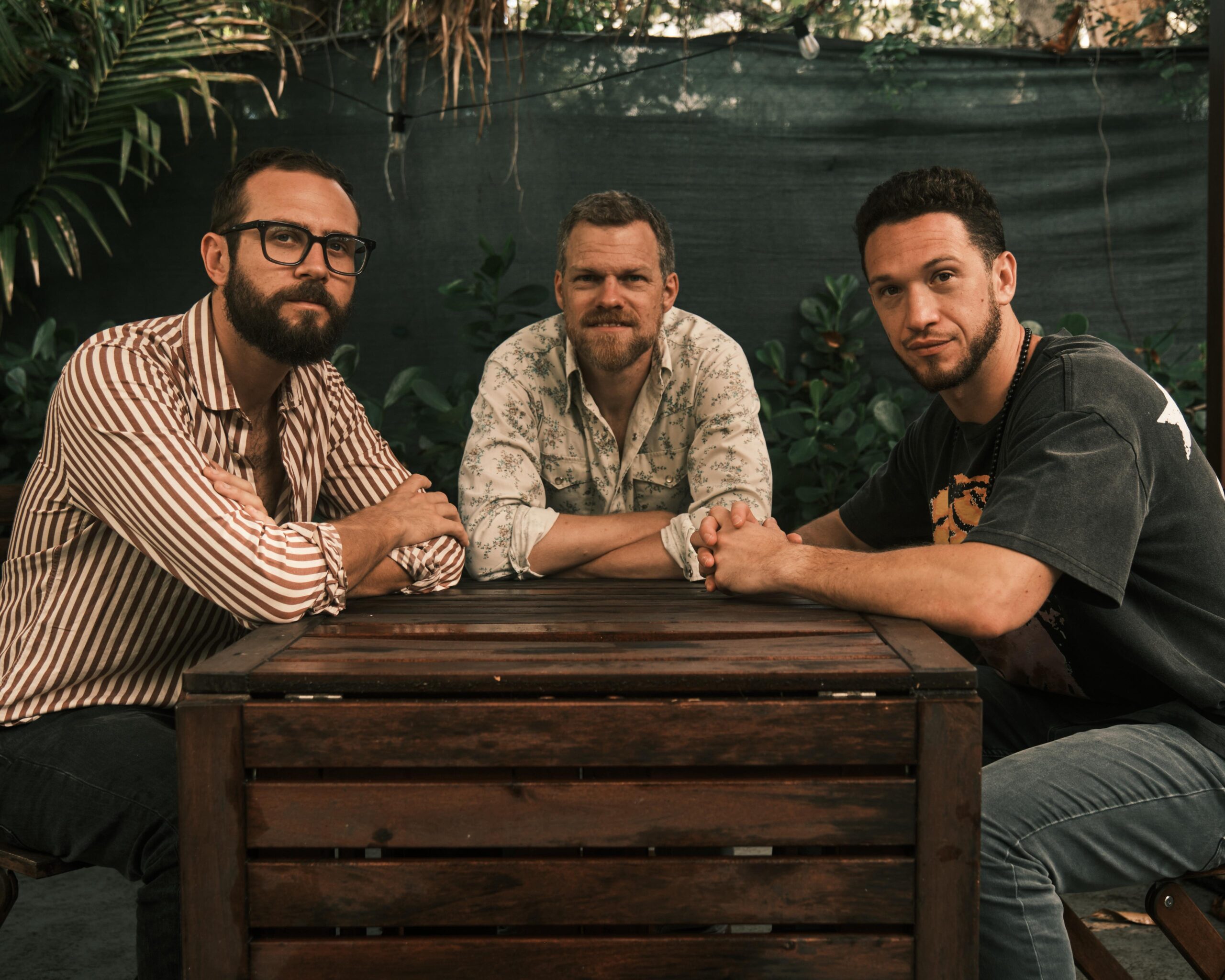
    Adrian Gonzalez, (aka. “OIGO”) has been around us here in Miami for decades. You may have seen him, but didn’t know. You most likely have heard him, but didn’t know.

    The soft spoken, Venezuelan born songwriter, multi-instrumentalist, and videographer has been driving force behind one of Miami’s most celebrated live music acts, Suenaló. He also makes a living by playing music in the background for people in public setting. In hotels and restaurants from South Beach to Boca, OIGO single handedly creates songs using loopers and organic instruments to set the mood. They are frequently cover songs, but you can’t really tell unless you listen really well. He may be playing “Every Breath You Take” by The Police, but you probably won’t figure it out till the end. He does them in his unique way. Very OIGO Music.

    Adrian’s original songs are also terribly good, cerebral, melodic, heartfelt, and….generally unknown. He’s the most underrated songwriter in town for my money. A couple of years ago, I won the “Best Songwriter” award from the Miami New Times. I’m not sure too much thought or deliberation went into that honor. To be honest, it would be a much more legitimate prize if someone like Adrian got it.

    Since the pandemic, OIGO’s video prowess and unique eye have emerged as well. He now does much of the video work for the North Beach Bandshell, and is one of the most sought-after videographers for musicians and bands in town.

    On Thursday, February 19th, Adrian is putting on a big show:

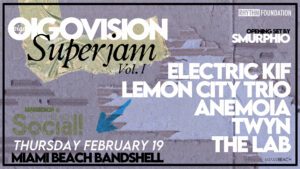
    OIGOVISION SUPERJAM VOL. 1 – A Night of Fusion and GrooveOn February 19, 2026, the Miami Beach Bandshell will host an unprecedented meeting of South Florida’s most inventive musicians — a celebration of rhythm, improvisation, and cross-genre collaboration. The night brings together members of Electric Kif, Anemoia, Lemon City Trio, Twyn, and The Lab — a powerhouse collective that has defined Miami’s modern sound. Expect blistering fusion from Electric Kif’s virtuosic quartet, Anemoia’s hypnotic song-based grooves, Lemon City Trio’s soulful organ-driven jams, and Twyn’s futuristic“jazztronica.” The Lab adds a dose of rock energy to round out the ensemble.

    Special performances will feature Anthony “Smurphio” Laurencio — the keyboardist, producer, and co-founder of Suenalo and Afrobeta — whose mastery of synthesis bridges electronic and organic worlds.

    There will be some other surprise guest performers as well.

    Adrian (OIGO) will be hosting and performing through the night.

    I got to catch up with my old friend who I have watched grow and develop for over 20 years since the old Monkey Village days at Transit Lounge.

    I have always enjoyed connecting with and discussing the Miami music scene, musicians, and venues with him. It has not been an easy journey, and both Adrian and I have been front row for the good and the bad of it.

    When I asked OIGO why guys like us are still at it, he put it perfectly.

    “You have to have the right amount of bitterness and still a joy for what we do, you know? We have that balance.”

    That is indeed true, and a cute answer. But upon reviewing OIGOs creative pathway, the evolution is filled with love and friendship.

    After helping to bring structure to the Monkey Village jams (that logistically share a lot of same stage footprint as his upcoming Superjam), OIGO started playing weekly at Vino’s in The Grove. After three years of that gig, he put together and anniversary show with other bands and musicians from the scene.

    “I like collaboration. People like to celebrate with you. So, I’m lucky to know a lot of talented people I can celebrate with.”

    In 2020, with the pandemic, a lot of musical creatives had to shift gears. That is essentially how “OIGO Vision” was born.

    “Before the global event happened, I was gigging like 5-7 times a week. Which is great, but I was depressed because I was only playing background music at hotels and restaurants. So, I’m like ‘This can’t be it.’ So, I figure everybody’s got to do videos now, right? At the same time, I luckily just got a used computer on eBay that I could edit videos with.”

    OIGO started reaching out to his friends starting with drummer, Brian Lange from The Lab and Faze One Studio. He started editing Lange’s video content. Then he reached out to his spiderweb network of high-level musicians of various genres all over Miami. He would drop by their houses and film them to edit and create short OIGO Vision videos.

    Adrian was honing his camera-craft with the eye of a musician.

    Later on, during one of Suenaló’s sold out reunion shows at the North Beach Bandshell, James Quinlan (Senior Advisor at The Rhythm Foundation), noticed the video content that OIGO was creating to promote the show.

    “James was like, ‘Wait. Are you doing video too? Do you want to work with us?’ They loved what I did and asked me to be a part of things.”

    The catalyst that really connected the dots for OIGO was working The North Beach Social.

    “What an amazing opportunity for local acts to play at a national venue. You know, a free show with production? That’s insane, bro.”

    Oigovision Superjam Vol.1 is going to reflect the creative career of a true unsung hero of the Miami music scene.

    Just like in the Transit Lounge days back in the early 2000’s, the stage will be filled with 2 drum sets, 2 keyboards, 5 guitars, and 2 basses.

    Bands will essentially be doing mini-sets and then mixing it up by swapping musicians in a carefully curated way, along with guest performers like Alejandro Elizondo.

    OIGO knows everyone’s music really well, so he’s creating an atmosphere with the stage as his canvas and the most talented musicians in town as his paint.

    “The idea is that when a band is playing and they’re finishing a song, the other band is already getting on and going to play right after. Everybody is going to get up.

    We’re inviting you to our living room. The Bandshell is going to become our living room and you get to see us jam out with each other.”

    Miami is an event town…..

    With myself being a Miami native and “local musician”, I have seen far too many silly events do well and not enough shows born out of love succeed.

    We are lucky to have The North Beach Bandshell, and we are lucky to have Adrian Gonzalez/OIGO in our music scene.

    Coming to see a unique event with world class musicians at a beautiful venue is “an event”.

    If it isn’t, then you’re missing out on what the real Miami has to offer the world.

    Enjoy the show.

  • Jeff Hafley Is Another Half@$$ Miami Dolphins Coaching Hire

    Jeff Hafley Is Another Half@$$ Miami Dolphins Coaching Hire

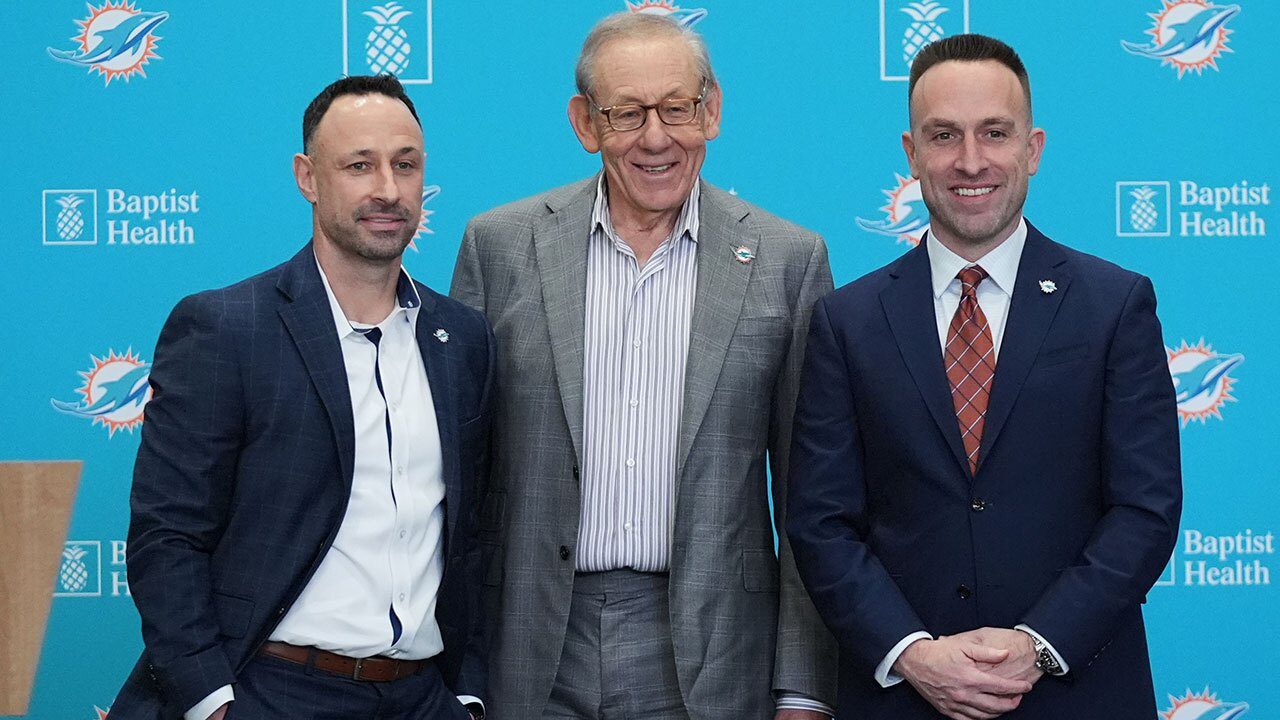
    The abusive relationship that is being a Miami Dolphins fan took another punch in the nose this January. Owner Stephen Ross  finally, if a season too late, decided to fire Mike McDaniel who barely had the managerial skills to run a Best Buy much less a professional football team. Dolphin fans’ joy could only last for a couple weeks, as Ross chose another inexperienced stooge in Jeff Halfley to replace him.

    What makes this crime even worse is there were so many coaches with NFL experience to interview. There were Super Bowl winners in John Harbaugh or Mike Tomlin. There was a two time NFL coach of the year winner in Kevin Stefanski or even a dude who had a 16-3 record against the Dolphins in Sean McDermott. Instead Ross went the cheap route as he always does, hiring a neophyte in Jeff Hafley who will learn on the job as the Dolphins stumble through another wasted season.

    Since Ross bought the team in 2009, he’s hired five coaches following a shamefully predictable pattern. He picks a coordinator with no NFL head coaching experience. Lets them mess around to mediocre results for somewhere between three and four seasons, then fires them and does the same thing all over again.

    To Hafley’s credit, unlike Joe Philbin, Adam Gase, Brian Flores or McDaniel, he does have some head coaching experience as he led Boston College for four years. To his discredit Hafley led the Boston College Eagles to a depressing 22-26 record. If you’re going to the minor leagues to find your NFL coach at least get yourself a winner.

    What makes this even more infuriating is watching our hated rival New England Patriots rebuild so quickly after Tom Brady left them in 2019. The Patriots had five meandering years between Brady leaving New England and making the Super Bowl this year, but their owner was decisive. He saw former quarterback Mac Jones was serviceable, but not dominant. So they cut ties after three years and found a hero in Drake Maye. Meanwhile Ross gave Ryan Tannehill seven seasons and Tua Tagovailoa six years and counting to prove they weren’t elite.

    After The Patriots canned their legendary coach Bill Belichick, they gave a rookie coach a shot in Jerod Mayo. Mayo floundered. Instead of giving him a few seasons to learn on the job, the Patriots saw an experienced coach on the market in Mike Vrabel and pounced. A year later they went from 4-13 to 14-3. Coaches matter in the NFL.

    I assume Ross hired Hafley to tank in the hope of better draft picks. Ross famously, if allegedly, offered Brian Flores lots of money to throw games in 2019. But if Hafley looks like a halfwit during this upcoming lost 2026 season, Ross should learn from his good friend Donald Trump and say “You’re fired”. Then for once he should pony up some of his billions of dollars on a coach with a resume to give long suffering Dolphin fans the slightest bit of hope.

  • Carl Fisher – The Man who Invented Miami Beach

    Carl Fisher – The Man who Invented Miami Beach

    The country’s third-largest skyline belongs to Miami: an aquamarine forest of glass towers, among which the Conrad Hotel stands out with its concave silhouette. From its terrace, sunsets offer an imposing view of Biscayne Bay—the same bay that, in 1910, dazzled Carl Fisher and his wife Jane and led them to build their residence there, The Shadows. Long before Miami became a spectacle of skyscrapers, that bay was the spark that ignited a vision that would forever shape the city’s future.

    Carl Fisher was born in Indiana in 1874. His childhood and adolescence can be summed up in a familiar statistic: his father abandoned the family, and he left school to support them. His first jobs, in small shops and in railway service, allowed him to save enough to open a bicycle repair shop at seventeen, at a time when bicycles were the primary means of transportation. The business prospered immediately. His natural instinct for generating wealth led him to contact the country’s largest bicycle manufacturer, request 150 units on consignment, and launch his own dealership. Convinced that advertising had to be as bold as the product itself, he promoted his bicycles by throwing them off a building and offering special prices to those who retrieved them and brought them to his shop.

    His greatest passion, however, was automobiles and racing. He was among the first in Indianapolis to own a car and the proprietor of the nation’s first auto dealership. His advertising stunts were as extravagant as they were effective; on one occasion, he flew over the city in a hot-air balloon, seated behind the wheel of an automobile, keeping all eyes fixed on the sky. His involvement in the automotive world led to innovations such as Prest-O-Lite, a factory that produced gas lamps for cars, solving the limitation of driving only by day and earning him millions. He also conceived the 500-mile Indianapolis Motor Speedway—the present-day Indy 500—and promoted the Lincoln Federal Highway, the roadway that would connect New York to San Francisco. Fisher had been living by speed for years when he discovered Miami.

    He was not yet forty when he had already amassed a fortune that allowed him to devote himself to racing and to cruising on his yacht. On one of those voyages, he arrived in Miami in 1910. Enchanted by the tropical climate and the paradisiacal landscape, he purchased land overlooking Biscayne Bay and built The Shadows. At the time, aside from Jacksonville and St. Augustine, Florida was largely a territory of vegetation, sea, and swamps. Henry Flagler had begun to change that panorama with his hotel empire, centered in Palm Beach, and with the East Coast Railway, the railroad that ran the length of the state.

    From his yacht, Fisher explored Miami and became intrigued by a small island near Biscayne. Living there was a short, white-haired man, always impeccably dressed, devoted to farming. That man, John Collins, had attempted to connect the island to the city with a wooden bridge at the site of today’s Venetian Causeway, but he ran out of funds. Chance brought them together. Fisher shook his hand and agreed to finance the project in exchange for land.

    The new island opened up a world of possibilities. As Flagler had done in St. Augustine and Palm Beach, Fisher saw in Miami Beach a tourist potential for wealthy northerners seeking to spend the winter far from the cold. He built his home on what is now Lincoln Road, abandoned The Shadows, bought more land, and founded the Alton Real Estate Company to market it. But he knew that to attract people he would have to transform the beach: a nearly untouched territory, choked with brush and mosquitoes, without electricity or shops, accessible only by Flagler’s railroad.

    His projects were ambitious. He remodeled the Roman Pools, an earlier work by Collins, adding windmills and completely refurbishing them. He promoted the construction of the Dixie Highway, a roadway that would allow travel from Chicago to Miami. In 1921 he inaugurated the glamorous Flamingo Hotel, complete with polo and golf courses, an eleven-story building crowned by a luminous dome that lit up the sea at night, Venetian gondolas, and docks.

    For Fisher, the Flamingo was the gateway for future buyers. He organized polo tournaments, golf competitions, and regattas; entertained his guests aboard his yacht; and although sales were initially slower than expected, his tireless campaigns and the outbreak of World War I—which diverted tourists away from the French Riviera—ultimately led him to success. In less than a decade, Miami had consolidated itself as a coveted destination to live in and invest. Fundamental urban projects such as Coral Gables and Hialeah emerged, and the real estate market reached unimaginable figures. A plot of land without an ocean view that cost $800 in 1915 was worth $150,000 by 1924.

    Unchecked growth fed the real estate crisis that soon struck Florida—a phenomenon Fisher had already anticipated. For that reason, he closed the Alton Real Estate Company in time, left the state, and took with him a profit of $23 million. Miami Beach had ceased to be a land of mangroves and had become an irresistible stage for wealthy northerners. Fisher, who had always lived in pursuit of vertigo, ended up inventing a city where others saw only sand, mosquitoes, and sea.

  • FGO’s Die Fledermaus Peak Storytelling and Entertainment

    FGO’s Die Fledermaus Peak Storytelling and Entertainment

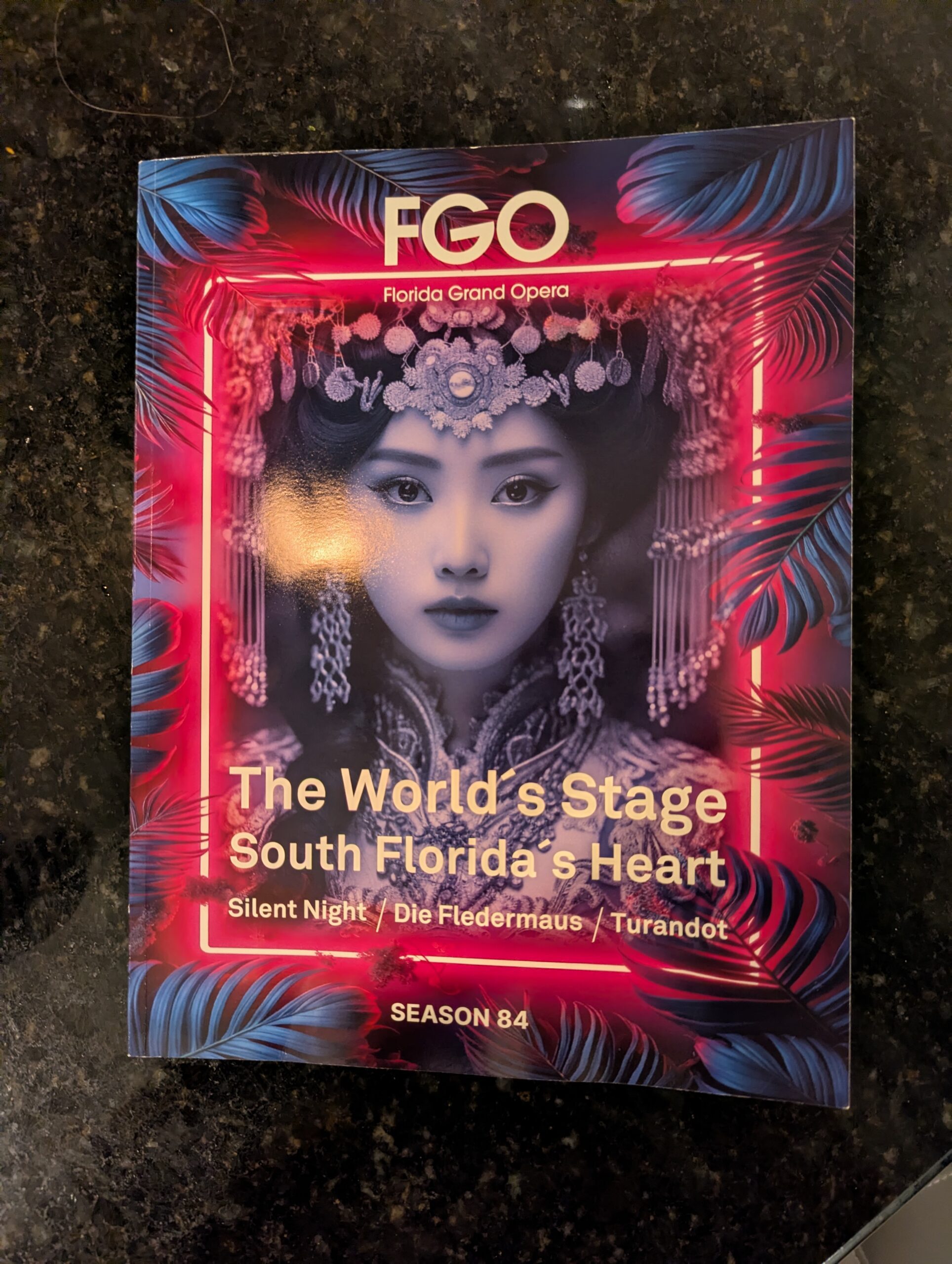
    The Florida Grand Opera delivered a production of Die Fledermaus with a level of polish and class that would hold its own in any major city on the planet. Every part of the company works in harmony, from the performers to the design team, creating a seamless and confident theatrical experience.

    Die Fledermaus was one of the most entertaining operas in recent memory.

    It was captivating, epic, and genuinely funny.

    It ran the full range of storytelling.

    It’s an opera, yes, but one with an unusual amount of play woven between the music. The dialogue across three acts grounds the audience in character and mischief before the production lifts into full operatic flight, dropping viewers into sweeping moods that feel almost cinematic. Then it returns, once again, to story. The result is something silly, clever, and deeply joyful. There’s plot, betrayal, and lies, but all in the name of fun.

    It’s easy to see why this opera has become a New Year’s Eve tradition in Vienna.

    Meanwhile, back at home, one of South Florida’s best-kept cultural secrets is catching an opera at the Florida Grand Opera on a Tuesday night. The company’s schedule is delightfully unconventional. They open on Saturday, a Sunday matinee, dark on Monday, and close on Tuesday. There’s something quietly magical about sitting in a grand hall at 8 p.m. in peak season, when the rest of the country is frozen and Miami is alive with visitors and possibility. It’s hard to imagine a better way to spend a Tuesday evening.

    This was culture at full volume. Dance, song, theater, costume, lighting, comedy, romance, and a full orchestra breathing life into the room.

    Die Fledermaus

    At the heart of the story is Dr. Falke’s elaborate revenge on his friend Eisenstein. Years earlier, Eisenstein humiliated Falke by abandoning him drunk in a public park while dressed in a bat costume, earning him the nickname “Dr. Bat” and making him the laughingstock of Vienna. That old prank becomes the fuel for an entire night of elegant chaos at Prince Orlovsky’s ball.

    And what a ball it was.

    The Florida Grand Opera stages it in a grand, Art Deco, 1920s, Great Gatsby–style world that feels decadent, glamorous, and joyfully over the top.

    The cast is stellar. Ginger Costa-Jackson’s Prince Orlovsky stands out as bold, gender-bending, and extravagantly playful, grounding the production in decadence and humor. Jesus Garcia shines as Alfred, the mischievous trickster and hidden lover, while soprano Rebecca Nelson commands the stage as Adele, her voice ringing out with confidence and charm.

    This is the kind of storytelling that deserves to be celebrated loudly, especially for new audiences discovering how thrilling opera can be.

    Prince Orlovsky’s ball becomes a spectacle, a party, and a celebration of art, excess, and theatrical joy.

    In its 84th year, the Florida Grand Opera proves once again that excellence is not an accident.

    Bravo.

  • Cosford Cinema Is a Treasure for Miami Film Fans

    Cosford Cinema Is a Treasure for Miami Film Fans

    Damien Chazelle’s 2022 film Babylon  unfurled some months ago at the Bill Cosford Cinema on University of Miami’s campus in Coral Gables for an audience of myself and the venue’s manager Rene Rodriguez. After the screening, Rene, who’d been interested in revisiting the film since his initial viewing upon release, and I ambled toward the back of the auditorium awash with glee and convened just outside the theater to share an equal measure of ecstatic commentary over Chazelle’s boldly audacious love letter to the ineffable divinity of cinema. So, there we were; two film lovers still in the throes of a youthful obsession that never receded and likely never will.

    While I certainly found Chazelle’s film a remarkable accomplishment, the afternoon became an indelible memory for me for another reason. Since 2022, Cosford Cinema has served as the exhibition launch pad for all but one of my feature films. In this most spacious A/V sanctum, I screened them for the first time before a gallery of family, friends, collaborators and their guests. And upon the first of these gracious accommodations made possible by Rene, I pledged my most loyal patronage from then on and, since my gesture, I think I’ve proved its earnestness by having attended 60+ screenings at Cosford. However, I never anticipated how deep and abiding my appreciation of cultural stewardship and those who take up its cause could become.

    But what’s the point of going to the movies? Why should we tolerate exorbitant ticket and concession prices, the lack of etiquette among fellow moviegoers who always believe their indiscretions are exceptional and the possibility that our movie selection may not satisfy our aesthetic or emotional yearnings or those of whom we wish to treat? All for a momentary stay of all the pressures, troubles and urgencies of life beyond the darkened theater?

    Because it is a battle and it always has been. A battle to care for something one or more human beings have crafted in order to squeeze a sliver of truth, beauty and/or moral refinement out of our sordid and fundamentally mysterious existences. That’s why we put up with it. That’s why we tolerate the soreness of our legs, the strain on our bladders and the often questionable skill of the filmmakers who’ve offered up their work to our highly discerning taste. Many of us persist in these auditoriums out of sacrificial duty to a cause greater than our immediate flesh and nerve. It is never easy to focus for hours at a time on a narrative thread or other offered extremity of mimetic construction but it’s what holds together the very foundation of culture and civilization. Patience, restraint and a touch of stoic character. It’s all that holds our puny social order together. Without this discipline and durability, we are vulnerable and compromised.

    Cosford Cinema

    So, Cosford Cinema is where I’ve chosen to regularly practice this form of viewerly asceticism. And the rewards have been rich and varied. From a vast showcase of UM’s own student films to retrospectives of mainstream directors’ catalogs to a thorough roll call of the global critical community’s top favorites to new 4K masters of modern classics to selects from luminaries of the local community (where I met Mayor Daniella Levine Cava and gifted her a copy of my book) to advance screenings of hotly anticipated titles to simply works selected on account of seasonal appeal or the theater manager’s plain and simple preference, Cosford has offered an embarrassment of riches to those who’ve taken up the aforesaid challenge to engage with one of the most ennobling pursuits of our often clumsy, wayward species. And a fair amount of the time, the screenings offer opportunities to hear directly from the filmmakers involved or their loved ones, as in the case of a past Q&A with local documentarian Billy Corben following a screening of one of his latest films or a live, in-theater Zoom call with the wife of Gene Kelly after a presentation of the 1952 musical Singing in the Rain.

    Moreover, Rene furnishes all of his revivalist weekend screenings with the finest, most informed curation you’re likely to find in all of South Florida. Throwing his weight into the job as a seasoned film critic who’s shared ample time, space and words with some of the most legendary filmmakers in the North American film industry, Rene lends a wealth of insider insight and perspective into his introductory remarks, complete with a comprehensive slide presentation. And following screenings, Rene is routinely on-hand to kick-off and guide a discussion with attendees about the merits and context of a given classic film or more contemporary offering. But there’s no limit to the range of discussion and everyone is always encouraged to participate, making it a refreshingly civic and democratic event.

    Nearly two decades before Rene’s management of the theater, there had existed an air of intelligent, counter-cultural programming at Cosford that appealed to many discerning locals in an environment of increasing media company consolidation, including a dear high school classmate of mine who often encouraged my attendance at the theater. However, my history with the venue as a patron commenced some time after my friend’s imploring, when my parents, who raised my siblings and me in a household where trips to the local cineplex were extremely rare yet highly desired, assented to my burgeoning and rapacious adolescent interest in filmmaking by encouraging me to attend an exhibit of short films from UM’s graduating film students. I remember sitting in the rearmost row with my parents and later feeling more than cocky in asserting my thoughts about the perceived strengths and weaknesses (mostly weaknesses) of the work on the car ride back from the event.

    After a traumatic mental health-related experience as a film student at University of Central Florida, I returned to Miami in the late 2000s and reconstituted myself with the help of association and involvement with a community of film students at UM. Consequently, I would attend their film program’s exclusive Canes Film Festival at Cosford to see the results of the hard work applied throughout their semesters, some of which I had a hand in. It was here that a familiar impulse to put my patience and focus to the test by watching hours’ worth of student work from these fellow aspiring filmmakers. I attended several editions of the film festival before the demands of my own personal filmmaking picked up again along with the responsibilities of my return to the university setting at Florida International University as a Communication Arts major. Experiencing a personal renaissance in the mid-to-late 2010s, my development as a filmmaker – and one beginning to produce his own feature films – would soon land me in the good graces of a veteran film critic with a fairly new gig in town.

    Cosford Cinema is like Home

    I don’t recall under what circumstances we became Facebook friends but it’s not uncommon to send/receive friend requests to/from those within the local film community, who share many mutual contacts and are rather extroverted online about a common affinity. Either way, I came to know that Rene Rodriguez was a well-regarded film critic who’d recently been hired as theater manager at Cosford in the early 2020s. This information became of particular interest when I was in search of a theater venue to host the first public screening of my 2nd feature film State v. Unknown which I had produced throughout the dénouement of the global COVID-19 pandemic and completed in the spring of 2022. So, I reached out. Thankfully, Rene responded with a welcome promptness, open-armed about the prospect of screening my film at Cosford and we set to meet some time later at the theater to ingest my film into the theater’s DCP projection system.

    When I arrived on the patio just outside of the auditorium, I believe my characteristic earliness caught Rene off-guard. He was shirtless, perspiring and preoccupied with moving some outside furniture into place. And so, my first impression of Rene was a man who put his body and sweat into the job – quite literally. Our ensuing interactions were the most cordial and amiable. Whether he mentioned the length of his film critic tenure at Miami Herald (33 years!) made no difference to me. Rene was, at once, a prepared, thorough, sincere, caring and extremely intelligent man to whom I would always listen first and let guide the direction of every interaction from then on. We became fairly fast friends that day and my fondness for Rene as a writer, cinephile and mentor has only accumulated since the start of my association with him. To say the least, our coordination and execution of my 2nd feature’s screening went off without a hitch and we remained in regular contact as I made good on my promised patronage at Cosford. When Rene would playfully deride my peculiar vow, I would respond that I possessed “few loyalties.” Rene and Cosford among them.

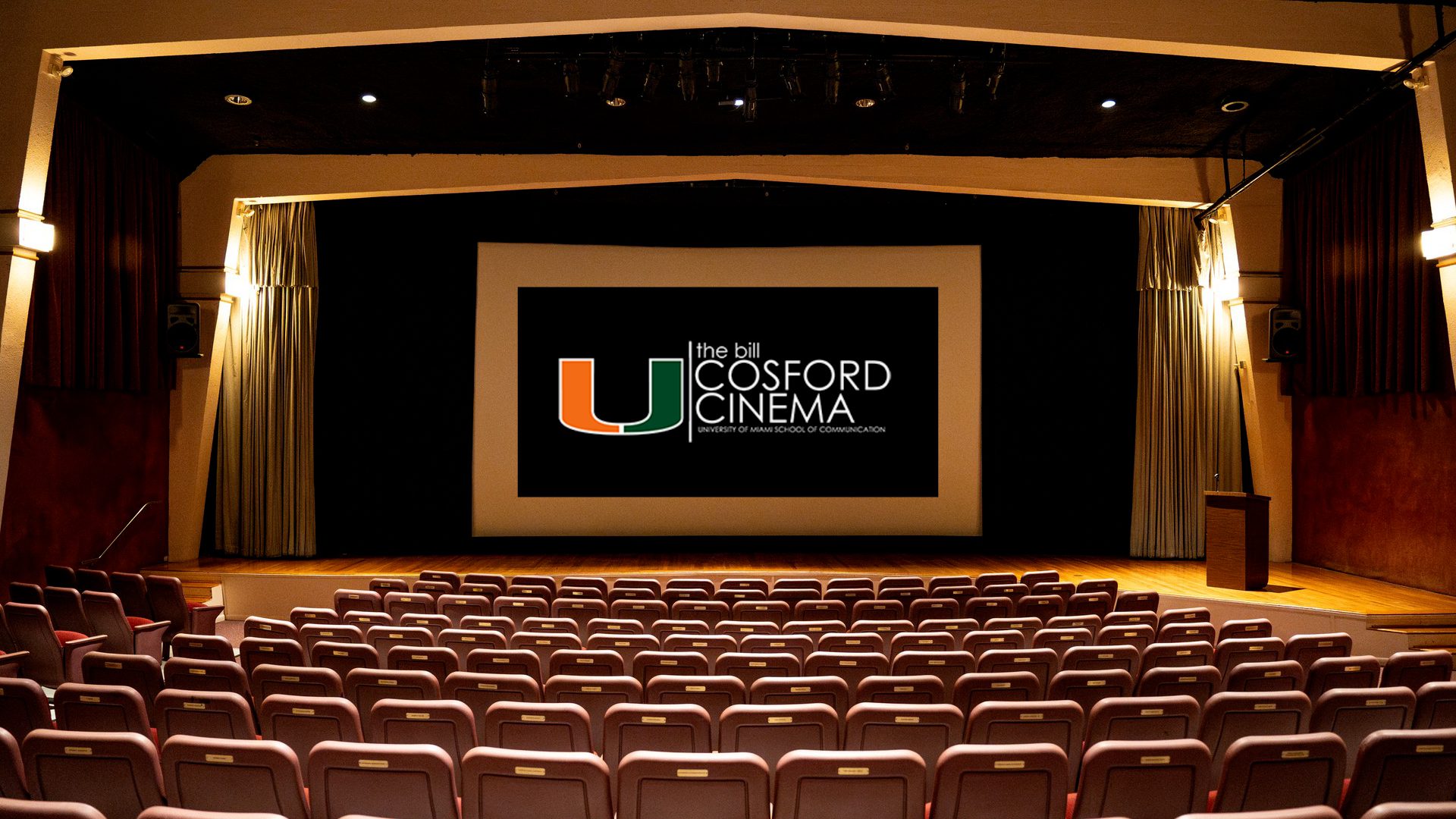
    4K digital projection., 7.1 Dolby Digital sound, 70-square-foot screen, and 240-seat auditorium. The Bill Cosford Cinema is the largest, single-screen theatrical venue in all of Miami. You can find its schedule of programming at cosfordcinema.com. Come on down sometime!

  • Escuchame Miami – Fiction

    Escuchame Miami – Fiction

    Brian Newell passed through Nelly’s office. Noise canceling headphones back in-place, she heaved an armload of folders into the maw. The Exonerator roared. Brian’s pace quickened as he fled the noise. The outer office door lay flat as a coffin’s lid — its frosted glass and The Honorable J. J. Carpenter, in gold leaf, intact.

    He strode past empty commission chambers and into city hall’s lobby. The Vizier and the lesser beings were gone. The metal detector lay trampled beside Sylvie’s upended security perch. The detector’s twisted gray metal bars lay amid Sylvie’s scattered quilts, feigning the sardonic humor of post-modern sculpture. Brian glanced up at the blinking red light on Marco’s security camera before pushing through double doors, returning to that humid Miami morning. He squinted against the sun – its light refracted and brightened by impending rain.

    Captain Gofuckyourself stood in front of city hall, back to Brian, hands on hips.  “Come on,” he hollered. “Load them up. We’ve got a full day ahead.”

    A white school bus with “Border Patrol and Enforcement” in blue letters running back to front was parked lengthwise across city hall’s traffic circle. Black wire grates covered its windows. An ICE agent atop the bus, binoculars in hand, paced from side to side — stopping at each end, he scanned the surroundings.  A clutch of people, hands zip-tied behind them, struggled, twisting against their bonds. Brian recognized constituents from the city commission chambers, some of the lessers who’d gathered in the lobby, and members of Miami’s media bouquet. A pile of purses, shoulder bags, baseball caps and backpacks lay in a jumble on the graying asphalt. ICE agents, waving their arms and shouting in Spanish, Haitian Creole and English encircled them.

    Off to the left, Roger Carlisle stood in the shade of a blue and gold Miami Design District umbrella. Chanting “U-S-A, U-S-A, U-S-A…” he thrust the umbrella skyward in time to the rhythm of his cries. Behind him in the parking lot, his generator ground on as the squad of red, white, and blue TRUMP 2024 inflatable tube men gyrated, flailed and flopped, snapping the air with whip like cracks.

    On the traffic circle’s right, three ICE agents behind clear riot shields corralled all that remained of the local media, Charles Plessy and the camera man Monroe.

    A sodden American flag wrapped the flagpole.

    As the ICE agents harried the people beside the bus into a single line, Brian realized he was now their witness. He took out his iPhone to record, capture, and document all that he saw. Starting left, at the line’s end, a man’s face filled his phone’s screen: eyes tearing, mouth tight, dried saliva caked his lips. Brian tapped his phone, the screen blinked and held the man’s image. He moved one person right — a woman, gray hair in tight curls, mouth firm, eyes squeezed closed, head back, chin tilted upward – as if demanding God explain himself. The screen blinked and captured her bewilderment. Counting faces, he continued, from one to two to three. Making a record. From eight to nine to ten. His feeble effort to protect these people from secrecy and anonymity.  To nineteen. They were human. Twenty. He was human. Twenty-one. He did not know them. Until he did. Twenty-two — a young woman, with bright green hair, small silver hoops piercing ears and lower lip, a blue, green and gray tattoo covering her right arm. Brian took the photo and gazed at Carmen’s profile. He tapped the iPhone’s screen twice. The opening bars of Bizet’s Carmen came from the pile of bags on the asphalt. Carmen turned and stepped toward the pile. An ICE agent rushed beside her, arms waving, he yelled her back into line.

    Out on Bayshore Drive, the ancient Dodge pickup’s engine roared. Canting like a rearing horse, trailed by a billowing black cumulous of exhaust — a swaying spire of flattened cardboard rose skyward from its bed. The truck turned onto Pan American Drive and rumbled toward the bus, the prisoners and the government agents. Horn honking, gears grinding, its engine’s growl grew louder.

    “Becker, the hell is this madness?” Captain Gofuckyourself, shouted to the man on top of the bus.

    Becker focused his binoculars down range and shouted back, “Can’t tell, Cap…”

    As it drew closer, the exhaust cloud overtook the truck, shrouding its progress.

    Captain Gofuckyourself cried, “Spread out. Weapons drawn.”

    Agents ran to defensive positions on either side of the bus; dropping to one knee, all drew

    their sidearms and steadied their weapons with both hands.

    The agents corralling Plessy and Monroe dropped their shields and ran toward the bus.

    Captain GoFuckYourself stepped to the bus’s right side and rested his left hand on a kneeling agent’s shoulder. “Hold fire. Don’t panic.”

    The exhaust cloud concealing the truck drifted toward city hall carrying the nose-stinging aroma of water mixed with burnt petrol.

    A woman in the line beside the bus shouted, “Correr… Rapido… Vamanos… Correr…”

    Men and women, hands bound behind them, legs pumping, ran — frantic dashes in all directions.

    Charles Plessy, yelled, “Monroe, you getting this?”

    Monroe muscled his camera up on his shoulder. “We’re hot, Charlie.”

    Plessy, his back to the bus, shouted into his microphone. “An ICE round up today at Miami city hall descended into chaos…” The truck’s exhaust shrouded him. Its roar drowned his voice.

    Roger Carlisle closed his umbrella, held it out like a fencing foil and stepped in front of a fleeing woman. Blonde hair drawn back in a ponytail, hands bound behind her, wearing black yoga pants and a blousy black and gold Versace top, she veered left. Carlisle lunged. She parried right, head-butting his chest, spinning Carlisle in a circle and toppling him like a bowling pin. The woman kept going.

    The cloud drifted over the bus and enveloped Brian in an oily fog. Tiny black droplets spotted his skin, hair and seersucker. Nose wrinkling at the unctuous tang, he tapped his phone’s screen and moved through the smoke toward the strains of Bizet’s opera. He grabbed Carmen’s satchel from the pile, hung it over his left shoulder and moved toward the bus. From his own phone came Carmen’s voice, Hola. Soy Carmen… Por favor deje un mensaje. The phone beeped in English.

    He shouted at the phone, “Carmen, it’s me, Brian. I’m right here.”

    “Brian? Quien? Who?” she called out from his right shrouded by the cloud.

    He moved toward her voice.

    Carmen, hands bound behind her, stood where she had been when he snapped her photo.

    Brian wrapped his hand around her bicep. “Come on. Let’s go,” he said.

    “Go?” She turned, looked into his eyes. “I need to document this.”

    “They’re taking you to jail.”

    “I’m a citizen — born at Baptist.”

    “Great, you’re a citizen. Let’s go.”

    “I need to see what happens to these people. Do you think the corporate media is going to report it?”
    “These people are running away. Do the same. Before you’re jailed. Deported. You won’t report anything.”

    Carmen wriggled her wrist and shoulders, slipping free of the zip tie. She handed it to Brian. “They’ll let me out when they see I’m a citizen.”

    Brian glanced at the zip tie in the flat of his hand. He slid it over his left wrist. “They don’t care where you’re born. I’m wearing a bow tie. They almost took me.”

    “I’ll be fine,” she said.

    “You won’t be.”

    “Listen for my podcast. We’ll have lunch next week.”

    “I’ve got pictures on my phone. You can have them. Interview me. They roughed me up. Tied a woman to her chair. They won’t care. We’ve got to run away before the smoke clears.”

    “You do what you want, but we aren’t going anywhere.” Carmen took the satchel from Brian’s shoulder and draped its strap over her own. She dug her headphones and microphone from the bag, unwound cords and plugged both into the recorder. She fiddled with some buttons and spoke into the mic, “Prueba, check, check. Uno do tres. Escuchame Miami, aquí Carmen María Nuestra-Gómez, justo frente al ayuntamiento…”

    The truck’s engine grew louder, its sound as overwhelming as the noxious cloud.

    Brian squeezed his fists and spun in a circle. He faced Carmen again, as she shouted into her microphone. Her voice strained to rise above the ancient truck’s chest rattling clamor.

    Captain Gofuckyourself bellowed, “Don’t panic. Hold fire.”

    Publisher’s note — 

    “Escuchame Miami” is part of a serialized novel by Mr. Schmand.

    It can be read here starting with “A Recent Thursday Morning.”