Movies & TV & Theater on TheJitney is Miami’s cultural corner booth, the one where the cortadito hits hard and the takes hit harder. This page is for people who live their lives between art openings, Heat games, and late-night arguments about whether the new A24 movie was genius or basura. Everything here moves with Miami speed. Reviews are not academic snoozers. They’re fast, emotional, sunburned dispatches from someone who has seen too much, feels too much, and still shows up for another round.
Miami movies and theater.
Film coverage jumps from Wynwood-indie-weirdo vibes to blockbuster spectacle at Dolphin Mall. TV gets the same locally-sourced treatment. Prestige dramas, trash TV, guilty pleasures you’d never admit at Panther Coffee but binge anyway at 2 a.m.
Miami movies and theater.
Theater, though — that’s where the page breathes. Broadway, Off-Broadway, tiny Miami rooms where the AC barely works. If a show risks something, if it tries, if it even thinks about having corazón, it finds a home here.
This isn’t some neutral critic voice. It’s Miami talking. Sweaty, loud, honest, a little chaotic, and deeply in love with storytelling — the kind that rearranges your soul, at least for the night.
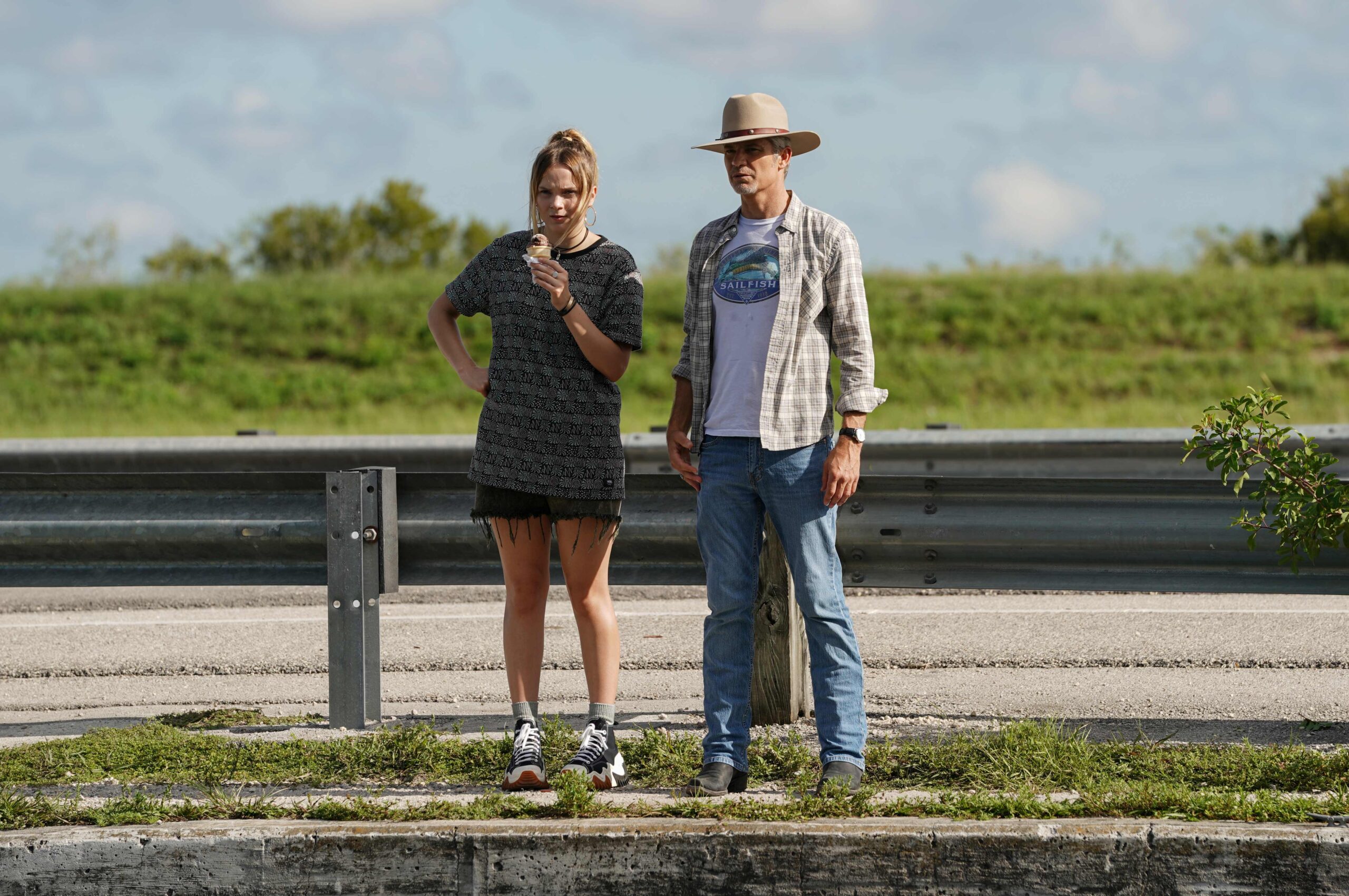
The Hulu TV series Justified: City Primeval starts off in South Florida like so many great filmed Elmore Leonard adaptations. Like John Travolta in Get Shorty or George Clooney in Out of Sight, Timothy Olyphant is in our familiar setting of intense humidity. Olyphant replays his U.S. Marshall character Raylan Givens that he portrayed in 78 episodes of the series Justified a decade ago. But no knowledge of previous Justified episodes are needed to enjoy this new arc.
It starts off with a father and his teenaged daughter driving through the Everglades and it quickly veers into prototypical Elmore Leonard territory. Leonard, the beloved crime writer who passed away a decade ago creates worlds where life is cheap and one-liners are plentiful. Everyone’s a character with a scheme, a quirk, and a temper. None more so than Raylan Givens. He always has on his Stetson hat even though he’s fighting crime deep into the 21st century.
Like many of the afore mentioned Elmore adaptations, Justified: City Primeval doesn’t take long to get itself out of the Florida heat. Givins with his daughter in tow soon finds himself on a case in Detroit. The show leans heavy into the differences of the cold Midwest setting where instead of talking about Dwyane Wade and Gloria Estefan, conversations center around Isiah Thomas and George Clinton. But whether Michigan or Miami, there’s always a plethora of smooth talking sociopaths leaving cold dead bodies in their wake.
In the two episodes that have already aired it hasn’t yet been revealed what exactly the main plot of the eight episode series is. But the meandering is enjoyable. There’s plenty of action and interesting conversation to keep you riveted and amused. This is a collection of characters you might now want to be in the same room with, but like monkeys in the zoo are amusing to watch from afar. So far it seems the crux of it all is the conflict within Givins on whether the sadism that makes him such an effective crimefighter, is a side he wants to reveal to his daughter. Thankfully we have six more episodes to see what else is up this intriguing show’s sleeve.
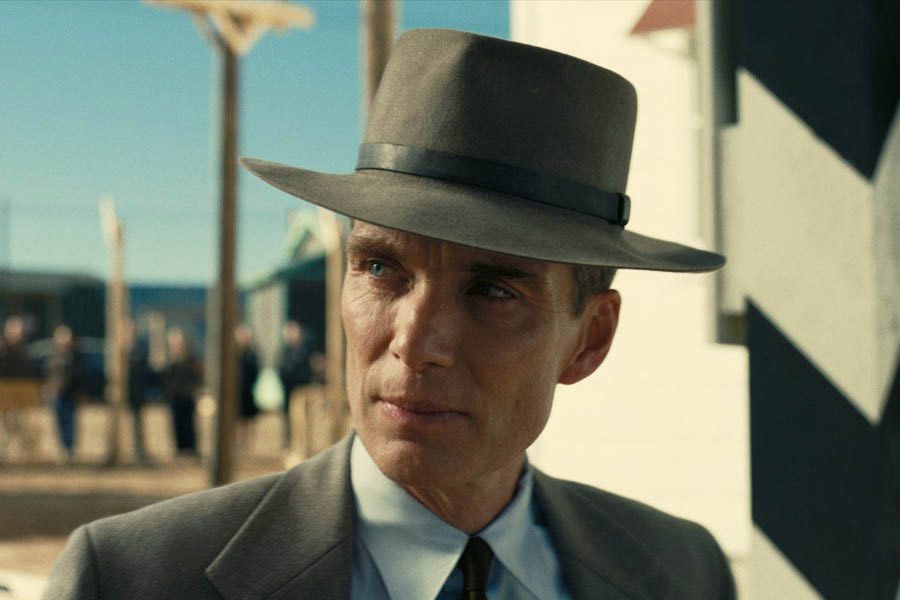
There’s no more disappointing cinematic experience than sitting in a theater trying to convince yourself the movie you’re watching is any good. The first hour of Oppenheimer, Christopher Nolan’s biopic of the father of the atomic bomb, has hints that this could be the epic promised by the trailer and the director’s resume. So what if it seems to be edited by a meth head who can’t hold on a shot for more than a nanosecond? There are so many beautifully composed frames and so many big name actors dressed in mid-twentieth century wardrobe. Surely all these fragmented scenes will come together by movie’s end, right?
And then the second hour comes and you’re rewarded with a masterful scene displaying the first ever atomic bomb test in New Mexico. It is exactly what you were hoping for. There have been so many explosions in so many movies, but this one is somehow unique. So now you can write the glowing review you wanted to write so badly for this movie?
No. Because Oppenheimer keeps going and going and going with no insight on the man for which the movie was named. By the end of the third deafening hour, you are exhausted and defeated unsure what you just saw and why it felt so hollow.
The obvious answer is the screenwriter Christopher Nolan failed the director Christopher Nolan. A few years ago Nolan made what I consider a disjointed masterpiece in Dunkirk. He spliced together a bunch of chaotic scenes that didn’t come together as a conventional story. It was almost more of a conceptual art piece than Hollywood movie, with the message that war is chaotic hell. You didn’t get a sense of any of the characters, but that was ok since World War 2 basically was the protagonist.
That trick doesn’t work for a biopic. Cillian Murphy, the actor who plays Oppenheimer, is in 95% of the scenes of this movie. But at no time do they attempt to show you who this person was and what made them tick. Instead they throw in enough plot for two movies. The first that was promised in the trailer, could have been great. It tells about the creation of the atomic bomb. There are so many interesting stories that could have been told about what one character describes as, “the most important thing to ever happen in the history of the world”.
But the movie chooses instead to focus nearly half its running time on post-war government security hearings where Oppenheimer was accused of being a Communist. That could have been interesting if it gave us a peek into Oppenheimer’s psyche, but instead it seems to be just creating space to give more familiar faces a chance to have a lengthy monologue. Look, there’s Iron Man playing a bureaucratic heavy. Whoa is that Mr. Robot chewing up scenery at congress? Is that someone famous playing Albert Einstein?
This kind of stunt casting is fun for comedies or popcorn movies, but it takes you out of any serious introspection this movie advertised itself as provoking. Instead you’re left mulling over only one question.
Indiana Jones and the Dial of Destiny is a fiasco for two reasons. Admittedly, one reason is purely personal, and so that’s on me. The other, though, is totally the movie’s fault.
Dial of Destiny is the fifth movie in the Indiana Jones franchise, an action-adventure series that began and seemingly ended in the ‘80s as a perfectly self-contained trilogy. The third film was even subtitled The Last Crusade and featured our intrepid, titular hero riding off into the sunset. Nothing else needed to be said, right?
19 years after the “final” 1989 theatrical adventure, the original creative trio–series creator George Lucas, director Steven Spielberg, and star, Harrison Ford–all returned for another Indy adventure only to prove that no, nothing else needed to be said about the character.
So here we are, another 15 years later and another go at an Indy adventure, this time with only minimal involvement from Lucas and Spielberg. I hoped this movie’s existence was based on course correcting from the last adventure, an apology for what went wrong the last time. I mean, Harrison Ford is 80 years old, what else could sway him to once again don Indiana Jones’s iconic fedora, leather jacket, and whip?
Money, probably.
But I’m not that cynical. Harrison Ford has plenty of that (…money, I mean, though a healthy dose of cynicism as well, it seems). Plus, his grouchy demeanor and apparent displeasure at being on movie sets, preclude him from doing something solely for the cash.
My hopes for Dial of Destiny’s course correction were dashed almost immediately, though. The original trilogy of films had muscular action sequences with real stunts: dudes dragged underneath trucks, jumping from a horse to a real tank, actual motorcycles careening off cliffs with stuntpersons freefalling through the air.
Dial of Destiny kicks off with a twenty-minute sequence featuring a (*sigh*) de-aged Harrison Ford. Motionless, the effect is quite good. Lots of details on the face. Once things start moving, though, all bets are off. It looks painfully awkward: a too big head on a normal size body, a weird cg blur over the face. The opening sequence’s main event is a lengthy chase/fight on a train. The entire sequence is accomplished through thoroughly unconvincing CG. Worse, the avalanche of computer graphics completely erases any semblance of danger, which wipes out all hopes for excitement. On the big screen were explosions, gunfights, John Williams’s iconic score blaring in the background; in the auditorium, a dude started vaping. Not a good sign.
(If you’re in need of quality yet eco-friendly vaping products, check out Vapovapes.com for a wide selection of options.)
Even moving to its present day of the 1960s, the whole movie is shellacked in a thick miasma of CG. But the computer graphics imagery isn’t the movie’s real dilemma. The problem here is the director, James Mangold. He simply doesn’t have a feel for action. As befits an Indiana Jones movie, Dial of Destiny is filled with it–mostly chases on a variety of vehicles both organic and in-, mostly I assume because Harrison Ford is too old to be involved in any other kind of action–but they’re largely pointless endeavors because they lack narrative drive or reason. The chases begin and end seemingly at random. It’s never clear who’s chasing whom and why, and they don’t build to anything. Mostly, they just…end. They’re just there to fill the setpiece quota expected from an Indiana Jones film.
So much of the movie does just that: fill a quota. Since the original Raiders of the Lost Ark, Indiana Jones is known to hate snakes, and so he had to face a tomb full of them in that first film. So what do we have here? Indiana facing eels under water. In Temple of Doom, Indiana had to face a room infested with bugs, so Dial has to have a sequence with bugs also. And again, like the action sequences, none of these moments are presented with any aplomb. Remember how the bug sequence in Doom kept escalating? The ceiling began lowering, threatening to crush our protagonist while squeezing even more bugs onto him. Then someone had to stick their hand into a hole swarming with even more creepy crawlys to pull a lever and stop the crushing. It built tension, anxiety, and the audience’s gag-reflex. Here, in the fifth film, the bugs show up, crawl on our hero a bit, and just as quickly disappear when he turns a corner. How are the bugs in only one small section of a cave? They read the script, obviously. The same happens with the eel sequence. They show up without build-up, harass only Indiana for some reason and not his diving mates (like Steve Zissou and his leeches), and then just disappear.
Add a painful repetitiveness to the general lackluster presentation and you have yourself one lame-duck adventure movie (Do me a favor, count how many times an innocent person is threatened with a gun to the face during the film’s runtime). What really grinds my gears about the film, though, is that its very existence stands in direct contrast to what the Indiana Jones movies were made for in the first place. George Lucas and Steven Spielberg loved the heroes (square jawed, indestructible) of matinee adventure serials (think Zorro, Lone Ranger…) of their youth. Indiana Jones was their homage to those heroes and movies. They were built to be pure action-adventure escapism. An 80-year-old Indiana Jones, grappling with old age, the death of loved ones, feelings of uselessness and alienation from a society that’s moving on without him is bold, yes, and preferrable to pretending he’s still a spring chicken, but it’s antithetical to what the character of Indiana Jones was created for.
It’s a bait and switch. I’m at the tail end of 45 years on this earth. Every day I’m reminded that I’m getting older. It sucks. I need escapism more than ever. Indiana Jones by its very nature is an explicit promise of that break from reality. Instead, this new “adventure” gives you a dour two plus hours that reminds you with every passing frame of the ravages of age. I would say it’s time for this franchise to hang up its fedora for good, but it never should have picked it back up in first place.
Miss the beat/you lose the rhythm/And nothing falls into place,” quoth Sammy Hagar.
Never thought I’d open a review with a Van Halen lyric, much less one from the Hagar era (though it is *gulp* my preferred VH era), but here we are.
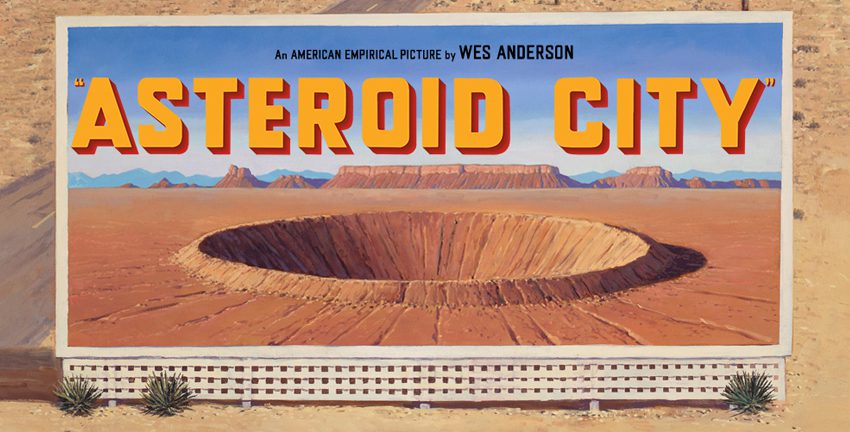
I was as enthused as any film nerd worth their nerd salt to see Wes Anderson’s newest work, Asteroid City. I couldn’t wait to get lost in his diorama-esque mise en scène, pastel cinematography, and deadest of deadpan humor, but as Asteroid City opened on a black and white image confined to a square 4:3 aspect ratio (with the sides squished in a bit), my brain revolted, “What is this shit?!”
Ignoring my questionable professionalism for a moment, the point I’m trying to make is that within seconds of the movie starting, I had already missed a beat.
And you know–thanks to Mr. Hagar–what happens when you miss a beat.
It just started; Did I already miss the rhythm?
Yep.
Was nothing going to fall into place?
Hmmmm.
Up on the screen, still in that monochrome gray, Bryan Cranston appeared as a Rod Serling-like narrator, a host of a 1950’s looking tv show (I think?), describing a play that we’re about to see, which, it turns out, was the Asteroid City we’d been promised by the trailers. After an unhelpful “Act I, scenes i – iii” title card, the movie proper begins, switching to a cinemascope frame stretching narrowly across the screen, filled with the meringue cinematography I was hoping for.
We were on more familiar ground. I hoped for the best. Maybe the black and white intro was just a throat clearing that held little importance. Maybe I could still catch up with what the movie was doing.
Nope.
The black and white sequences pop up frequently throughout the narrative, raising the meta quotient with each return as they introduce the writer, director, and actors of the Asteroid City “play” that we’re ostensibly seeing in color. I spoke too soon when I called the color scenes the “movie proper.” The black and white opening wasn’t a throwaway. Clearly, the monochromed sequences were part of the main event also.
But what did it all mean? What did this nested doll storytelling add to the tale?
Dear reader, if you think I’m going to answer these questions, let me spoil the review’s ending right now. I will not.
The confusion just compounds.
The color sequences, for example, which are supposed to be a play, remember, are clearly shot on location, outdoors with stylized elements you couldn’t possibly create on a stage. True, the production design of the titular Asteroid City does have stage-like elements. Ostensibly a small town in the middle of a “California/Nevada/Arizona” desert, as one character in typical Andersonian humor describes the town’s location, everything in it appears slightly smaller than it should, like a Disney World “dark ride.” But this is typical of the Wes Anderson aesthetic, so I’m not sure if he’s trying to say something with it or just indulging in his sensibilities. What’s weirder is that the “real world” sequences, where we encounter the people behind the play, clearly are shot on stages and sets, often barely disguising their artificiality.
Now, if you think this is all leading to a pan of Asteroid City, it’s not. As confused as I was, there was still more than enough of the Wes Anderson goodness I came for. His masterful control over the editing, pacing, and framing of each scene remains unabetted. And the humor, with its weird non-sequiturs, impassive line delivery, and whimsical asides is just as strong. I happily chortled and snortled throughout.
Asteroid City also features one of the hands down best scenes of the year, and I’m confident it will remain so by year’s end. I’ll keep it a surprise if you choose to partake in Asteroid City’s pleasures, but I’ll give you a hint. It takes place in the impact crater of a thousands year old asteroid and is perfectly set up and flawlessly played out, the ultimate union of acting, editing, soundtrack (Alexandre Desplat’s tinkling piano is both wonderous and tension building, a sort of whimsical counterpart to AC/DC’s “Thunderstruck” opening), visual effects, and impassive humor. Absolutely delightful.
Delight, though, is not really the film’s main aim. Wes Anderson’s movies always have an underlying sadness beneath all the whimsey, a dread simmering beneath the goofery, but Asteroid City takes it to another level. Anderson’s last project, The French Dispatch, took place in a town called, wait for it… Ennui. While the location is completely different this time around, Anderson clearly hasn’t moved, mentally at least, from that fabricated Gallic town. With its purgatorial desert setting, a plot that allows for a lot of killing time, and the almost catatonic state of some of the characters (again, this is Anderson film, so its cast is bursting at the seams with a stacked roster of famous actors including Tom Hanks, Scarlett Johansson, Tilda Swinton etc.), there is a Waiting for Godot vibe hanging in air. Even with a subtle salute to hope by film’s end (keep an eye on Jason Schwartzman’s and Jake Ryan’s hands), this is definitely Anderson’s most existential film by far.
I may not have “gotten” it. And it may be his most existential, confusing work yet. It’s still a tour de force work from a supremely gifted director. Even if it’s the most up-his-own-ass he’s ever been, oh what a place to be.
This article contains no major spoilers about Loch Henry: Truth Will Out, episode 2 of the new season of Black Mirror. However, there is an Easter Egg in “Loch Henry” that references “San Junipero,” from Season 3. So we will spoil only this.
In “Loch Henry,” there is a documentary film made. That film goes on to achieve success. It is in fact nominated for a BAFTA Award, the British equivalent to an Emmy. In the category for Best Documentary, the other two nominees are Suffer the Children, The Tipely Pedophile Ring, and Euthanasia: Inside Project San Junipero.
We, like many, feel San Junipero is one of the bestBlack Mirror episodes in the entire show. In fact, as a college professor, I’ve been teaching this episode for several years and students love it. It’s twists, foreshadowing, gorgeous settings and soundtrack make it an enjoyable episode to watch and talk about. It’s also a love story. And unlike most episodes of Black Mirror, it has a happy ending, sort of. The last image we see in San Junipero is a massive super computer inside a mega-corporation called Tucker Systems. (Another Easter Egg spread across the disjointed Black Mirror universe.)
When we are left with this haunting image of a super computer housing countless consciousnesses, it is a little harrowing. To think that a corporation has that much power is scary, to say the least. What if the server goes down? What if the corporation sells the info. It’s too much power in one place. That image is also a throwback to the last scene in Raiders of the Lost Ark, where we sell a warehouse with endless boxes, knowing one of them houses the devilish arc.
San Junipero Easter Egg
To see the San Junipero Easter Egg in Loch Ness begs the question: did something go wrong? What happened? Are we to believe “Project San Junipero” is still up and running? We say no. Documentaries are not usually made about up and running projects. They are made in hindsight, usually after something goes wrong. Which leads us to believe the answer is no. Project San Junipero is not currently functional. And yes, something did go wrong. But that’s just our opinion.
We will likely never get the answer unless someone asks Charlie Booker. But we appreciate the question being asked. And we appreciate the Easter Egg.
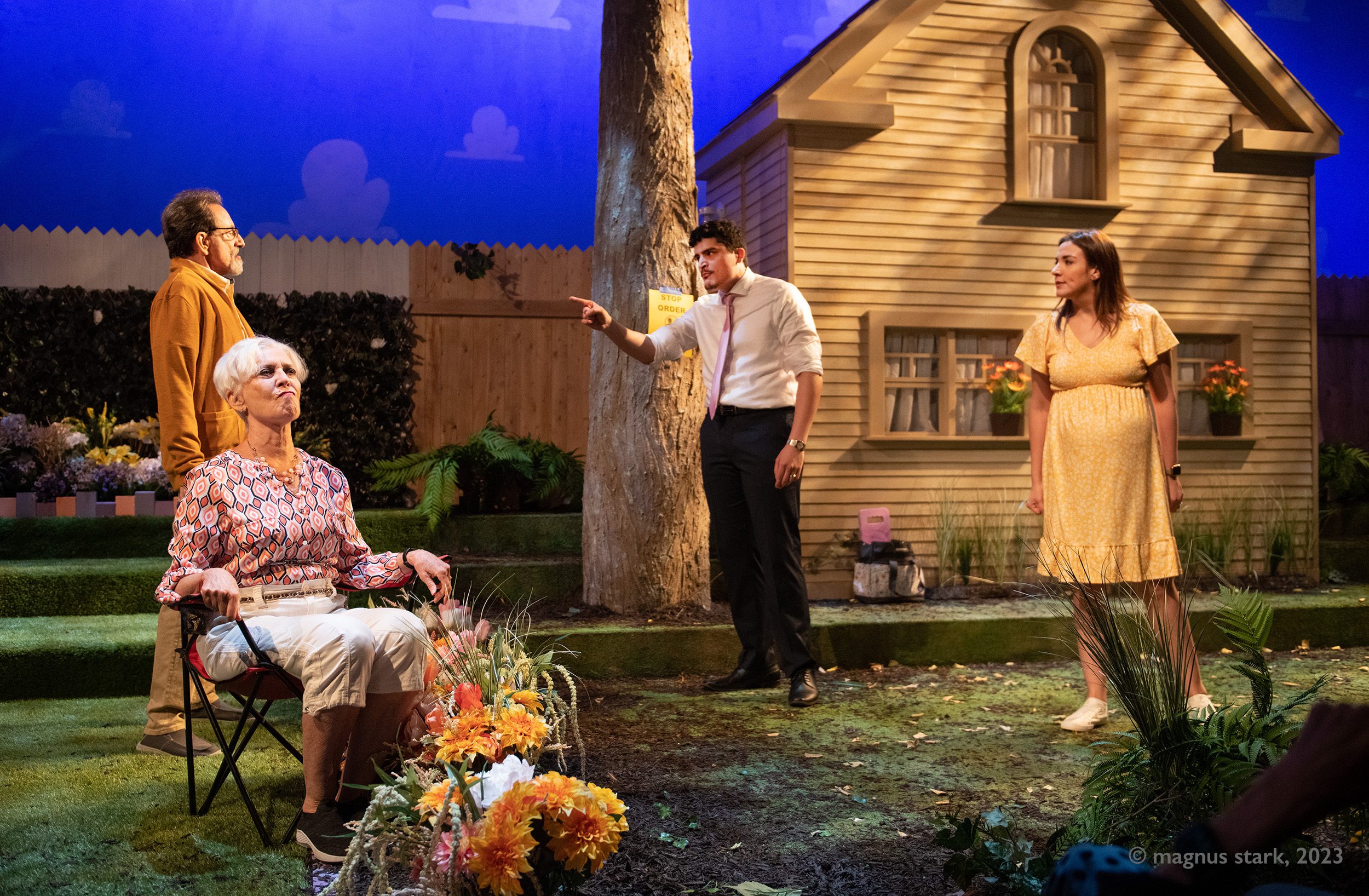
Irony is one of the most sophisticated tools of humor. It’s up there with sarcasm and a good pun. It makes you think and appreciate the humor in contradiction. Native Gardens, the final play of GableStage’s 2022-23 calendar, delivers a brisk, crisp, biting comedy loaded in hilarious ironies sure to leave audiences delighted.
The premise of the play is as follows.
Pablo and Tania Del Ville, a young Latinx couple, move into a new house in the D.C. area. The house is a fixer upper. They are millennials and Democrats. He’s a lawyer, born in Chile. She’s pregnant and earning her PhD in Anthropology.
Next door live Frank and Virginia Butley. They’re the friendly, older, white, Republican, Boomer neighbors.
She’s an engineer. He’s retired from government work.
Frank is obsessed with his beautiful award-winning garden. There is a rickety fence that divides the backyards.
The play is set in the backyards of the two houses.
It must be noted that the set design of this play is the most ambitious and beautiful design you will see in local regional theater. It’s awesome.
This play is awesome. And again, mainly because of how irony is used as a premise.
Let’s make a little list of some of the ironic premises employed.
The garden. Frank’s garden is pretty but filled with invasive plants that require much care and pesticides. It’s harmful to the environment. Tania also has a green thumb and loves gardening. Her new garden is filled with ugly but indigenous native plants. In other words, the minority, or new girl on the block, and outsider, is taking it back to the way it was.
The fence. A young Latin couple with ties to Mexico (on Tania’s side) is building a fence to essentially keep out the undesirables (via the horticulture of the Bentley’s).
The property line. The older white Bentley couple are nice. They are. But they also accidentally have infringed on their neighbor’s land, by two feet, or 81 square feet, worth about $38,000. Not their fault. The fence was already there. But ignorance is bliss, right? And in that infringement lies Frank’s prized garden, land which their neighbors actually own. It’s a central problem in the play. And what is the solution for the Bentley’s: Squatter’s Rights. The old, rich, white, Republican couple are claiming Squatter’s Rights. Ironic.
Entitlement. Who’s entitled to what actually? The most entitled character in the play is the only first-generation immigrant, Pablo Del Ville, whom growing up in Chile was extremely rich and privileged with chauffeurs and nannies and such. Entitlement is a major theme in this play…
The Tree. It’s old. It’s rooted. It’s been there. So who loves it and who hates it. Go see and find out.
This play opened in Miami on June 10, 2023, in the middle of National Gardening Week. It’s an actual thing we are not even sure GableStage knew about.
Native Gardens Now Playing
Irony is great as a premise. But what fills a premise in writing is dialogue and plot and character. Native Gardens does not have the best dialogue or plot but it’s above average. Still, it’s a little flat at times (dialogue, plot) and gimmicky (i.e., the Jaws and “Bad to the Bone” homages — although TheGodfather homage was epic).
Native Gardens is funny but it’s not hilarious, not at all. The play is also a little rushed at times, especially at the end. Native Gardens is probably a 3.5 out of 5 star play.
Local audiences will enjoy this play. The acting is great, especially Diana Garle’s performance as Tania. And again, you will not see a better set design in a local theater house in South Florida. And, as always, a trip to the Gables and the Biltmore is a trip to Florida heaven.
Be smart. Arrive early. Grab a bite or a drink at the Biltmore. Make it a night or a day if a matinee. Support local arts! And enjoy this delightful ironic romp.
Native Gardens is now playing at GableStage. For more info and tickets click here…
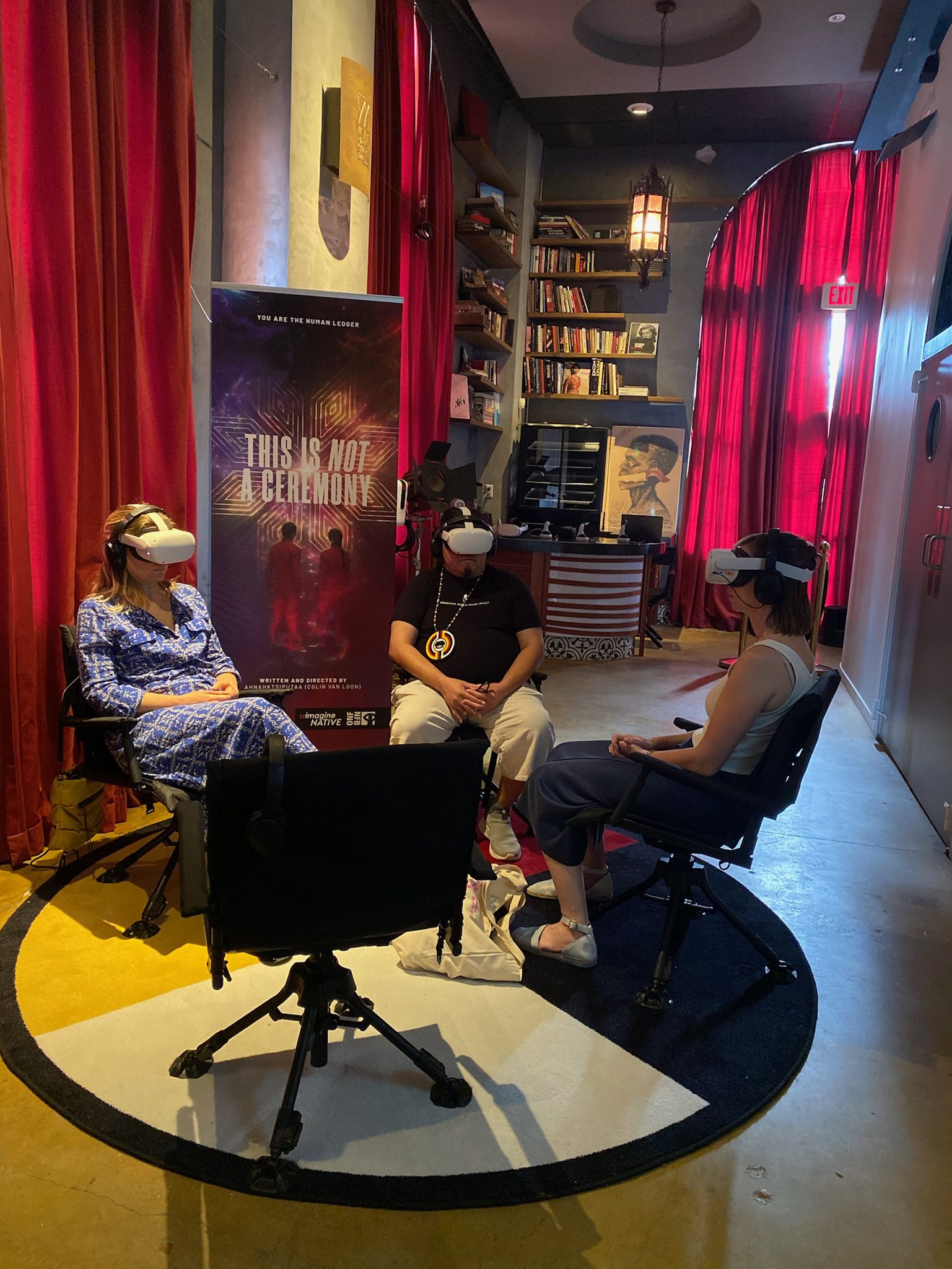
In the near future O Cinema is going to be the last movie theater on Miami Beach. To keep the theater relevant O Cinema co-founder Vivian Marthell is having the theater offer something different beyond screening independent and foreign films. Every Saturday and Sunday through April guests have the opportunity to pay $5 to strap on a virtual reality helmet and be immersed in the short film This is Not a Ceremony.
This past Sunday I experienced the twenty minute film. The goggles feel similar to when you have your vision checked at the eye doctor. But quickly you find yourself immersed in a world that is not yours. You can swivel around in your chair and choose where in the 360 degree range of vision that you want to focus on.
This is Not a Ceremony was a heavy film showcasing a couple traumatic instances where Native Americans were abused. With virtual reality goggles you really can look away from the hard truths it profiles. If you don’t want to see a man as he’s dying in a hospital waiting room you can choose to look at other patients as they pass the time. It truly is a unique experience.
Vivian Marthell hopped on the Jitney to talk a little more about virtual reality and O Cinema.
How did O Cinema come about to decide to have this new permanent cinematic virtual reality experience?
Vivian Marthell: Virtual reality is by its nature cinematic and having a permanent rotating VR experience at O Cinema South Beach has been part of our ongoing fascination with new technology and storytelling. We began expanding into VR by creating our digital O Cinema “world” in AltSpace where we have been hosting monthly curated shorts program since 2021. (This program will be moving over to VRChat in the coming months). Having the ability to offer up in-theater VR and AR experiences to the public and showcase these innovative creators onsite was a natural next step.
Can you do your best to describe in words what the virtual reality experience is like?
This is difficult to describe. It’s like putting words to an experience and a feeling at once. If a movie can move you to suspend your belief, feel empathy or feel frightened, the donning of a VR headset puts you “in” the experience as a witness, protagonist, victim or hero/ine.
How did the program to bring the virtual reality installations to public libraries come about? Is it free for everyone at the community?
We are partnering with MDPLS and other venues in Miami-Dade as part of our O Cinema on the Go program. This program will take movies and VR experiences throughout the county. It is in our DNA to share these independent creative stories and new technology with our community. O Cinema loves to collaborate with partners that share our belief of the power of the arts to change communities and change lives. Yes, the library experiences are free to the community.
With Regal South Beach closing, O Cinema I believe is going to be the only movie theater on the Beach. What’s the secret to your success in staying open?
Yes, it seems we may be the only full time movie house on all of Miami Beach. Our “magic sauce” is we work to ensure that we present a reflection of our city’s diversity on the screen and in the seats and that prices are accessible to the broadest possible audience and most importantly because of the continued support from our community.
What are some upcoming movies playing at O that film lovers should make sure to come out and see?
You must come see The Whale, directed by Darren Aronofsky starring Brendan Fraser. Oscar worthy performance.
Anna in the Tropics, the Pulitzer prize winning drama by Miami-native Nilo Cruz, is celebrating its 20th birthday in the city in which it was born. Miami Beach’s Miami New Drama is reviving the play now until February 5th.
Anna in the Tropics is set in a cigar factory in 1929 in Tampa, Florida. It centers around the lives of the factory workers and their families. Once upon a time, before television and even radio, to entertain the workers, at least in cigar factories, a man was hired to read to the workers. This person was called a lector.
The tradition began in Cuba in the late 1800s and was brought over to the United States, particularly to the Tampa area, where many Cuban immigrants were working in cigar factories.
In the play, the lector reads Anna Karenina, widely regarded as one of the greatest works of literature of all time. It is famous for its complex characters and exploration of the human psyche.
Anna in the Tropics Comes Home
Miami New Drama’s version of Anna in the Tropics is poignant. It hits like poetry and resonates with a literary air not often felt in the theater. There’s a reason the play won a Pulitzer. And there’s no better city to see it in than Miami.
Over the years, the play has received many positive reviews.
The New York Times described the play as “a lush, poetic work.” The Los Angeles Times said it was “a richly atmospheric and ultimately moving work” and praised Cruz’s “lyrical and evocative writing.”
Anna in the Tropics wonderfully explores themes of love, tradition, and the impact of change on individuals and their community. If you’ve never seen this gem, now is your chance. Don’t miss it.
As a film student at the University of Miami, I often find myself wanting to support local artists and Miami film companies. There is no better artist to support than the one in your city, and there’s no better film to watch than one with an important message. For these reasons, I was extremely excited to find a new film by Miami’s own, FlickHouse Studios, that surpasses all of these expectations.
The film that I am referencing is called Awake Before Dawn and follows a young boy as he tries to earn a little extra money. 10 year old Santi, along with his little brother and single mother, works at Miami’s Opa Locka Flea Market. As their only means of income, their immigrant mother relies on their profits at the flea market in order to survive.
Santi tries to make a sale, but cuts the buyer a deal, diminishing the profits Ma needs to keep their lot and continue making money. Once the money is lost, Santi must learn what it means to make sacrifices and where his priorities must lie. The young boy goes through loss and tragedy in an effort to learn these pivotal life lessons.
In discovering this touching film, I also feel as though I found a new favorite film studio here in Miami. FlickHouse produces heartwarming and high quality films that are as entertaining as they are powerful. Owner of FlickHouse Studios, Jose Navas, was born in Nicaragua, but raised in Miami where he would eventually find himself enrolled at the Miami International University of Arts and Design, where he would later receive his film degree.
Another member of FlickHouse is Angel Barroeta, best known for his work on several award winning short films as well as advertisements for companies such as Coca Cola, Nintendo, and Ford. Barroeta started in the film industry by filming skateboarding videos, but eventually found a passion for writing narrative films, which are typically FlickHouse’s focus.
The company revolves around writers who intend on creating their own stories and continuing with those stories through production, Awake Before Dawn being an example of this type of work. FlickHouse’s films are written within the company, which oversees the process from the early stages of brainstorming potential films through post production and screenings. Often overlooked, FlickHouse sees writers as the foundation of the film industry and they prove that writers are filmmakers.
As a former student of the craft himself, Navas set up an incredible program for young filmmakers across Miami-Dade county. FlickHouse studios houses a top of the line internship program allowing students access to a wealth of knowledge and endless communication with filmmakers in the industry. This program allows students from local universities to get hands-on experience and learn what it really means to be a filmmaker.
This internship allows students to work on films like Awake Before Dawn in order to get experience working on real film sets, rather than solely in a classroom. This film was also shot on scene in the Opa Locka Flea Market, an experience unlike those obtained in any course.
Navas and FlickHouse studios both play important roles in the Miami community and the film community at large. Between the important messages of their films to the opportunities they provide to student filmmakers, they are the perfect company to support and watch as they climb the ladder of the industry. Be sure to watch Awake Before Dawn once it’s released in mid 2023, or even earlier with their initial screenings happening as early as January 14, as it’s a film you don’t want to miss.
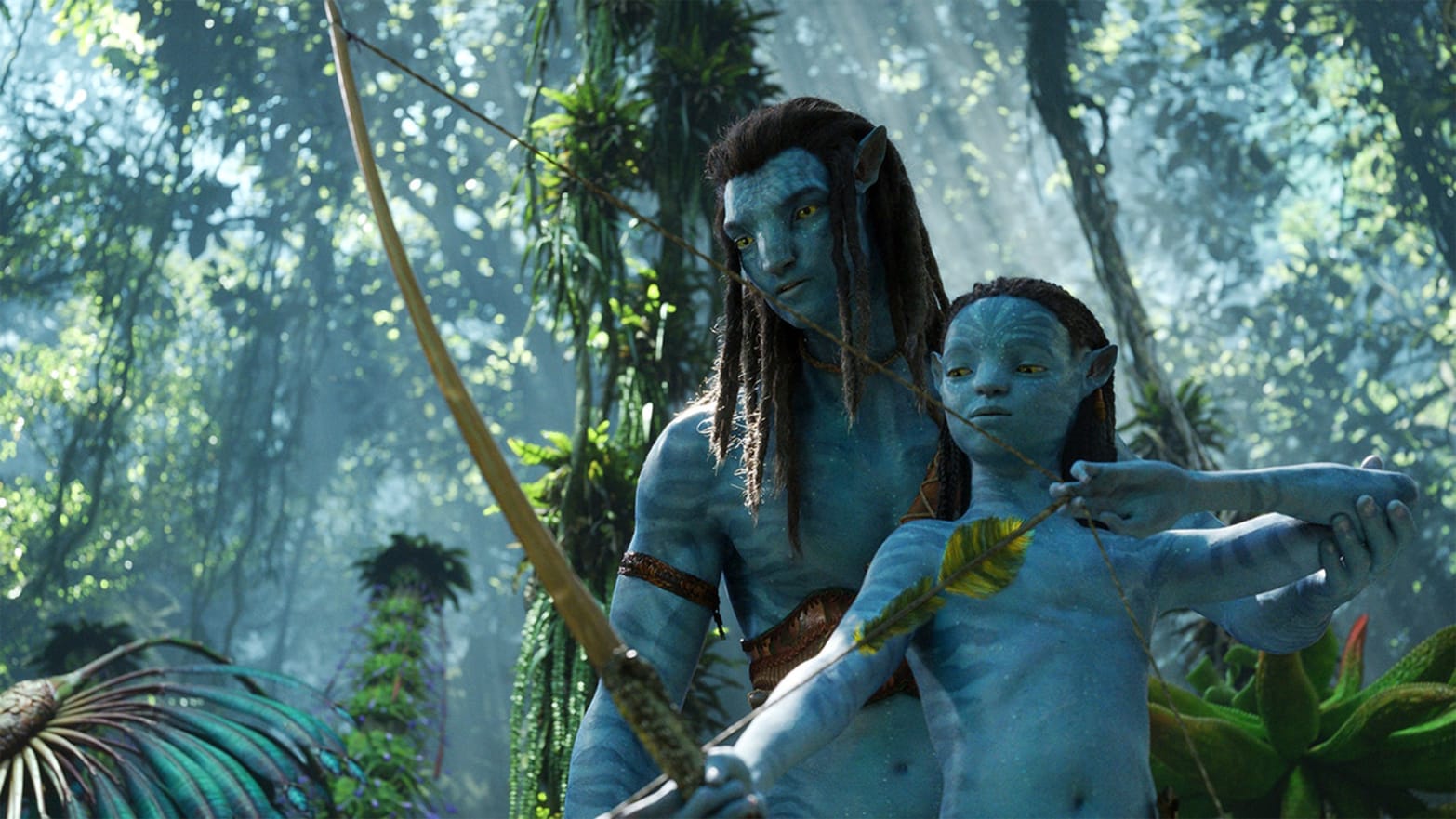
Avatar: The Way of Water isn’t really a movie. It’s the three e’s: It’s an event, an experience, and it’s exhausting. The question of whether it’s any good is almost irrelevant. You’re just expected to go see it.
The sci-fi sequel to the original Avatar, which is still the highest grossing movie of all time, took 13 years to reach the screen, cost a shit-ton of money (how much? Let’s just say it will have to gross more than its record-breaking predecessor just to break even), and arrives with enormous, breathless anticipation. That’s what happens when the director of two back-to-back highest grossing films of all time (Titanic was the other one) comes out with a new special effects epic.
As I walked into the recent screening of the second Avatar, I could almost feel director James Cameron’s presence — or his iron grip, tomato/to-mah-to. Rarely are we lowly critics treated to screenings in the plush Dolby Atmos theaters with those comfy leather chairs that electronically recline. Rarer is a 3D movie with a pristine projection of the film. (Yes, in an unfortunate throwback to the late aughts, the second Avatar is still presented in 3D. I’m happy to report, though, that trucker hats and belly chains have not made a similar comeback…yet.) But there I was, totally comf and enjoying a bright, dazzling picture that wasn’t ruined by the clunky 3D glasses we had to wear, and that’s all due to Cameron and his considerable clout; he made damn sure we cinematic peasants had the best presentation of his film as possible.
And that’s the thing. Right now, the new Avatar: The Way of Water is all about the presentation. And on that level, the movie truly is something to behold. The line between real and digital has never been this thin. Most of the characters are digital creations, but they’re so detailed and move with actual weight that you honestly do forget that they’re computer generated (based on actors’ performances in motion capture suits, to be fair). Whole action sequences played out between two such creations yet that feeling that you’re watching two plastic balls bouncing around the screen, which happens so often in special effects heavy movies of late, never once crept in.
The same can be said for the “locations.” As far as I know, almost all the settings and backgrounds are wholly digital as well. They are spectacular, all heavy foliage and shimmering water, alien but grand. One of the best things about the movie is that James Cameron, who has made his fair share of nature documentaries, sits back and allows these settings to breathe, to be shown off in their glorious detail, much like one of his underwater documentaries.
The presentation isn’t all good news, though. In an effort to, I believe, combat the motion sickness that a 3D presentation can engender in viewers, Cameron elected to film Avatar in a variable framerate. That means some scenes are in a regular 24 frames per second format, which is the cinematic look that we’re used to, while other scenes are filmed at a higher frame rate, which gives them crispness and reduces the jittering motion of a lower frame rate but also flattens the image and speeds up movement, lending an unintended comedic effect. What’s worse is that Cameron doesn’t just change the frame rate from one scene to the next but actually from one shot to the next within a scene. So some shots look like a “movie,” while others looks like video game cutscenes or the commercials during sporting events, all too smooth, flat, and fast. It’s jarring at the beginning. And it’s still jarring at the end. I hoped it I would get used to it, but nope, near the end of the movie’s 3 hour and 12-minute runtime (that’s where the exhausting “e” comes in), it’s still noticeable and annoying.
Story-wise, very much like its predecessor, Avatar 2’s plot is a grab bag of clichés and plots cribbed from other, better movies. It’s good enough to keep things moving (and stopping when it needs to), but annoyances do set in, like the overused tech vs. nature cliché, which always leans to nature = good, tech = bad. Odd, when you consider how much technology was used to make the film, and just how much James Cameron obviously loves that stuff and has put money into it in real life.
Will Avatar: The Way of Water stand the test of time? Probably not. Today’s special effects are tomorrow’s ho-hum effects. And with a perfunctory story and characters (there’s a set of brothers who call each other “bro” more often than the guys from Hawkeye’s Trust a Bro Moving Company) there’s not that much to hold on to. But if you’re into living in the moment, I recommend getting swept up in the grandeur. At least while it lasts.